

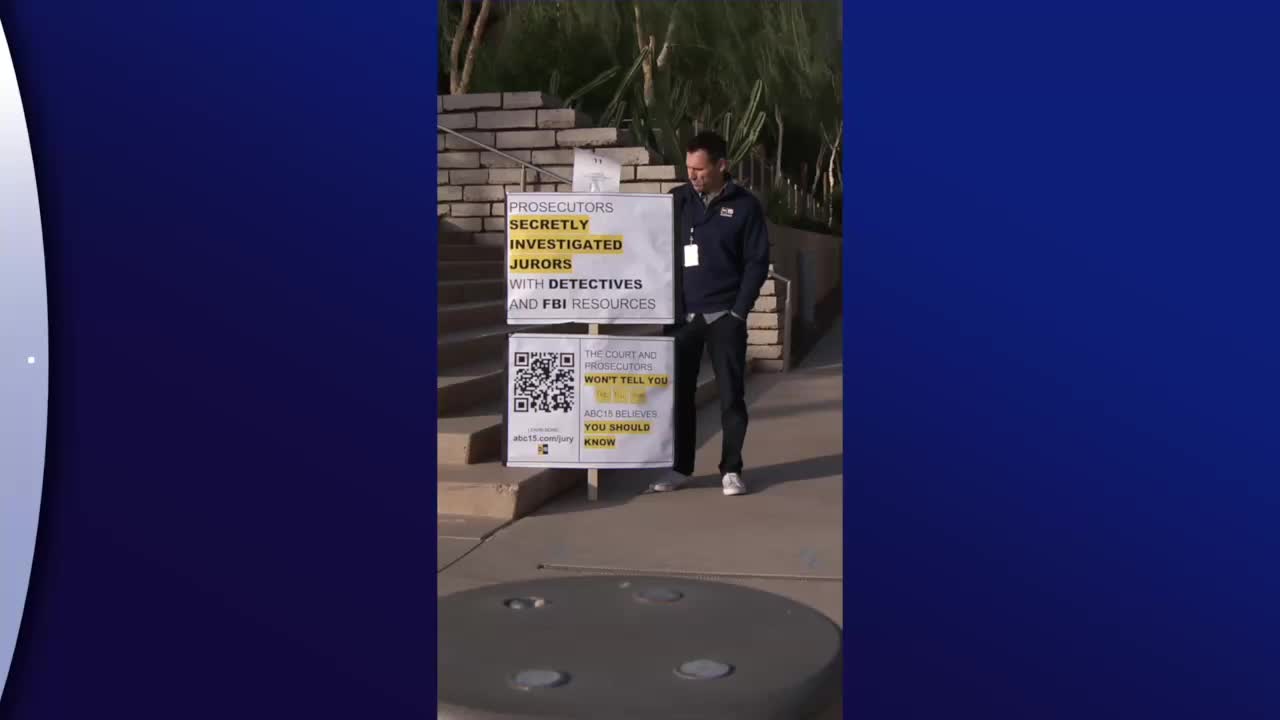


PHOENIX — ABC15's series exposing the Maricopa County Attorney's Office’s secret investigation of jurors using a confidential FBI database is significantly reshaping how Arizona's legal system handles and considers jury privacy.
Direct changes are happening inside court and at prosecutor offices and defense firms across the state.
FULL COVERAGE: JURORS / INVESTIGATED
So far, the Maricopa County Superior Court has begun informing jurors, MCAO created a new policy, other Arizona prosecutorial agencies are prohibiting the practice, and defense attorneys are now directly forcing the issue in court with special motions based on ABC15’s investigation.
But experts from across the legal and political spectrum said most of these changes fall short, and in some cases, even make the situation worse as the central question of whether the practice is legal remains unresolved.
Here's a breakdown of what has changed:
Court’s new question
In late September, ABC15 launched “Jurors / Investigated” a series exposing how MCAO prosecutors had secretly investigated jurors in a death penalty case with the FBI’s National Crime Information Center database.
The NCIC is considered one of the most powerful tools in law enforcement.
Within days of ABC15’s reporting, Maricopa County Superior Court added a question to the juror questionnaire and new information to its website. [New information in the last section of the webpage.]
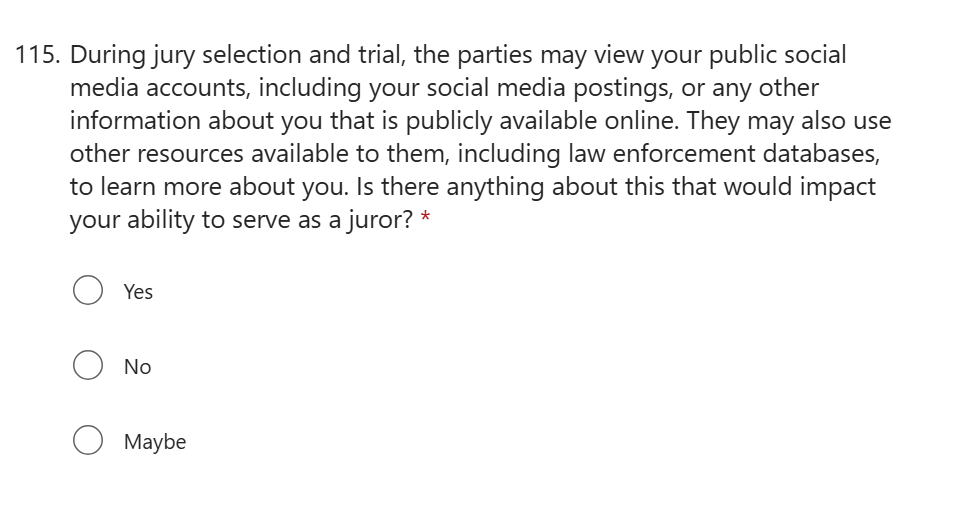
But a handful of experts said the court's question is misleading, inaccurate, and will further stack juries in favor of the prosecution.
“It makes the cure worse than the disease," said David Euchner, who’s the current headof the Arizona Attorneys for Criminal Justice. He added, "What the court should be doing is telling the state, ‘knock it off.’"
Jillian Barfield, one of the jurors who was secretly probed by MCAO and was never informed that she had been investigated, called the court’s new question “crazy” and “misleading.”
“The (question) doesn’t actually explain what they’re doing,” Barfield said. “They're going deep into your life history.”
In a follow-up interview outside the courthouse where she served for five months, she added, “I think that the jury needs the judges, the court, to do more to make sure that the jurors aren't investigated.”
But multiple experts said the question seems to show a tacit acceptance by the court.
"It's express consent," Euchner said.
Esther Hong, an associate law professor at Arizona State University’s Sandra Day O’Connor School of Law, also said the question and website information may mislead jurors into believing the practice is accepted and normal.
"I think it's very problematic," Hong said. "I think by asking them, 'Are you okay with this?' A lot of people are going to say, 'I think I should be okay with this, right?'"
Experts also agreed that the question is not accurate because it falsely states both sides can use law enforcement databases.
The defense does not have access to the NCIC.
"I don't think people understand what they're actually being asked here," said Matthew Cavedon,director of the Cato Institute's Project on Criminal Justice. “It is absolutely possible to misinterpret somebody checking off the box there as some sort of genuine consent."
Another major issue is that experts said the court’s new question opens more jurors to investigation and could further stack the jury pool.
"The problem is that this practice is being utilized in a way that is changing the makeup of the jury," said Will Snowden, director of The Juror Project.
Asked if this was giving prosecutors more ammunition than before, Snowden said, "I think so."
"(Voicing concern) should not be a disqualification,” Hong said. “But what it can do is target them for more questioning.”
Euchner added, "We're going to lose a lot of prospective jurors as a result."
ABC15 asked the court to respond to each of the specific concerns raised by experts. A spokesperson said only that the concerns had been referred to the court’s Jury Committee.
MCAO’s new policy
The Maricopa County Attorney’s Office’s new policy allows the secret investigation of jurors to continue.
The policy establishes an internal approval process. But there is still no requirement for prosecutors to tell the judge, defense, or jurors.
It states MCAO will tell the court if they find “relevant” information.
Maricopa County Attorney Rachel Mitchell declined sit-down interview requests to respond to concerns.
But she stood by her office’s practices during a press conference on August 27, 2026.
When asked if she would continue to allow them without telling the court, Mitchell responded by referring to her office’s forthcoming policy, "I'm not going to comment on the final wording of the policy, but we had been working on that."
The final policy went into effect on the same day as the press conference.
"They're wielding power that they don't, they shouldn't have, and nobody is stopping them from doing it," Barfield said. "They could have been doing this for years and years. We don't know.”
In previous statements, MCAO has said it doesn't track how often it has investigated jurors with the NCIC, but is "confident" the practice is "rare" and done "only with good cause appearing."
When that was told back to Barfield, she laughed.
"That's ludicrous," Barfield said.
ABC15 discovered Barfield was run through the NCIC because prosecutors failed to get her struck from the jury because of her “demeanor” and “body language” during pre-trial screening, according to court filings and archive videoof the jury selection process
The FBI declined to answer specific questions regarding MCAO’s actions.
But in a statement the federal agency said, “(Federal regulations authorize) law enforcement and criminal justice agencies, including criminal courts and prosecutors, to use NCIC for criminal justice purposes. This authority extends to prosecutions, including the process of jury selection in criminal trials. However, individual state laws and authorities may vary. For questions specifically regarding Maricopa County, please direct your questions to the Arizona Department of Public Safety.
DPS told ABC15 it has “no opinion” on whether state statutes or any other rules authorize jurors to be run through the NCIC. The state police force also said it had no opinion as to whether more guidance, rules, or safeguards are needed.
Other Offices Ban Secret Juror Investigations
After seeing ABC15’s reporting, two other top Arizona prosecutors expressed alarm and ensured their offices would not secretly investigate jurors with the NCIC.
"We need people to trust the system and trust government, and then do the incredibly important, critical job of being a juror," said Pima County Attorney Laura Conover.
Conover, who runs Arizona's second-largest county attorney's office, called for an immediate briefing from her top staff.
"(I asked) Do we ever do this? And the resounding answer was absolutely not," Conover said. "There was a level of alarm... No one present who's running any serious cases had ever heard of this."

ABC15 is committed to finding the answers you need and holding those accountable.
Submit your news tip to Investigators@abc15.com
She added, "None of my career prosecutors can figure out how (prosecutors) would tie a law enforcement purpose to searching someone not suspected of crime, not accused of crime. You know it's a person trying to serve."
The Attorney General's Office told ABC15 it doesn't do it either and is now writing a policy.
In a statement, the office said: "We do not currently have a policy in place but are in the process of developing one given the instances reported at MCAO. The Attorney General's Office would not do so without the court's knowledge or approval. The Attorney General's Office believes prosecutors should be transparent with the court, defense counsel and/or jurors on these types of issues."
Conover also stated that if a circumstance necessitated a deeper investigation of jurors, her office wouldn’t keep it secret.
"Absolutely,” she said. “If this were to ever somehow come up, we would take it to the court... it would be open and transparent."
Defense Attorneys' New Strategy
Some defense attorneys are now proactively attacking the issue in court by filing special motions seeking to stop MCAO from using the NCIC and to inform jurors if the court allows it.
"It's the government's own personal Flock cameras pointed at jurors that jurors have no idea this is going on," said David Cantor, a board-certified criminal defense specialist. "Your story brought it to the light. We brought it in front of a judge."
Cantor said attorneys in his firm will now file motions to block NCIC searches against jurorsin every trial. Other defense attorneys also told ABC15 they will challenge the practice.
"The government should not be allowed to investigate the private lives of citizens who've been called to sit on a jury," Cantor said. "We felt the jurors had a right to know that they were being checked with an NCIC database.”
The first time Cantor's firm filed one of the motions wasat the beginning of a trial onOctober 15, 2026.
In response, the judge balked, calling the issue a moot point because the prosecutor immediately said he didn’t plan on using the NCIC.
"It's a new defense hot button issue. I don't want to create an inadvertent precedent," the prosecutor told Judge Stasy Avelar during a hearing.
Avelar responded by saying she wasn’t going to enter a substantive ruling.
"I'm going to trust the state... and we're just going to deem it a non-issue," she said.
"I think MCAO has backed off when we filed our motion because they knew they would lose," Cantor said.
"I think the longer they can go without this being decided, the longer they can get away with it if it's not brought to a court's attention."
Arizona Supreme Court Response
Experts said it’s concerning that judges at multiple levels aren’t taking control of the matter and issuing rulings.
During the October 15 hearing, Avelar referenced ABC15's juror information campaign outside the courthouse and appeared to criticize it.
"There were people stationed outside of our courthouse telling the jurors that this was going on... I hope that's not still going on," the judge said.
In a follow-up response, a court spokesperson said, “The Court respects the news media’s role in reporting on matters of public interest, including court practices.”
"The judges are there to decide the hard questions," Euchner said. "Kicking the can down the road and hoping the problem goes away on its own is not what we need from our judiciary.”
In a previous case, when another judge discovered MCAO secretly ran jurors through the NCIC, she questioned if it violated the law and ordered legal briefing.
After reading MCAO’s responses, the judge said she was left with "more questions," but also did not make a "substantive" ruling.
"Legal issues are for the courts to decide, not the county attorney," said Karen Clark, a legal ethics expert and former State Bar of Arizona attorney. "And here is one where it's crying out for a decision on whether it's legal or not.”
In a written response sent through a spokesperson, Arizona's Supreme Court Chief Justice Ann Timmer said the state’s high court didn't know about the practice and that it's outside their control.
"We were unaware of this practice. What the executive branch does in juror selection outside the courtroom is outside our knowledge or control," Timmer wrote.
Experts say the Supreme Court can and should act.
"The court needs to do more here, particularly because it was on their own creation that they eliminated peremptory strikes," Snowden said. "They have to deal with the bed they created.”
In 2022, Arizona's Supreme Court eliminated peremptory strikes, which allow lawyers to kick jurors off without a reason. Arizona is the only state without them.
Hong said if the Supreme Court can get rid of peremptory strikes, they can set rules for secretly investigating jurors.
"I think this is one area where they can and should act, and they can just issue a rule like they did in the peremptory challenge context," Hong said.
This digital article was produced with the assistance of AI and based on the written and broadcast reports written by ABC15 Chief Investigator Dave Biscobing (Dave@abc15.com). Our editorial team verifies all reporting on all platforms for fairness and accuracy."
