



PHOENIX — Maricopa County supervisors are questioning the signature-verification process for mail ballots after this year’s election had a higher rejection rate than the previous gubernatorial election.
The Board of Supervisors voted unanimously Wednesday to certify the election results, sending them on to next week’s statewide canvass.
Several supervisors slammed Heap for not attending the county canvass and answering questions like officials from the county’s Election Department, a separate office from the Recorder’s Office.
“I can’t remember a time where the county recorder fails to show up,” said Supervisor Steve Gallardo, the lone Democrat on the board. “It’s his responsibility. It’s his job. It’s what he signed up for. It’s what he got elected for.”
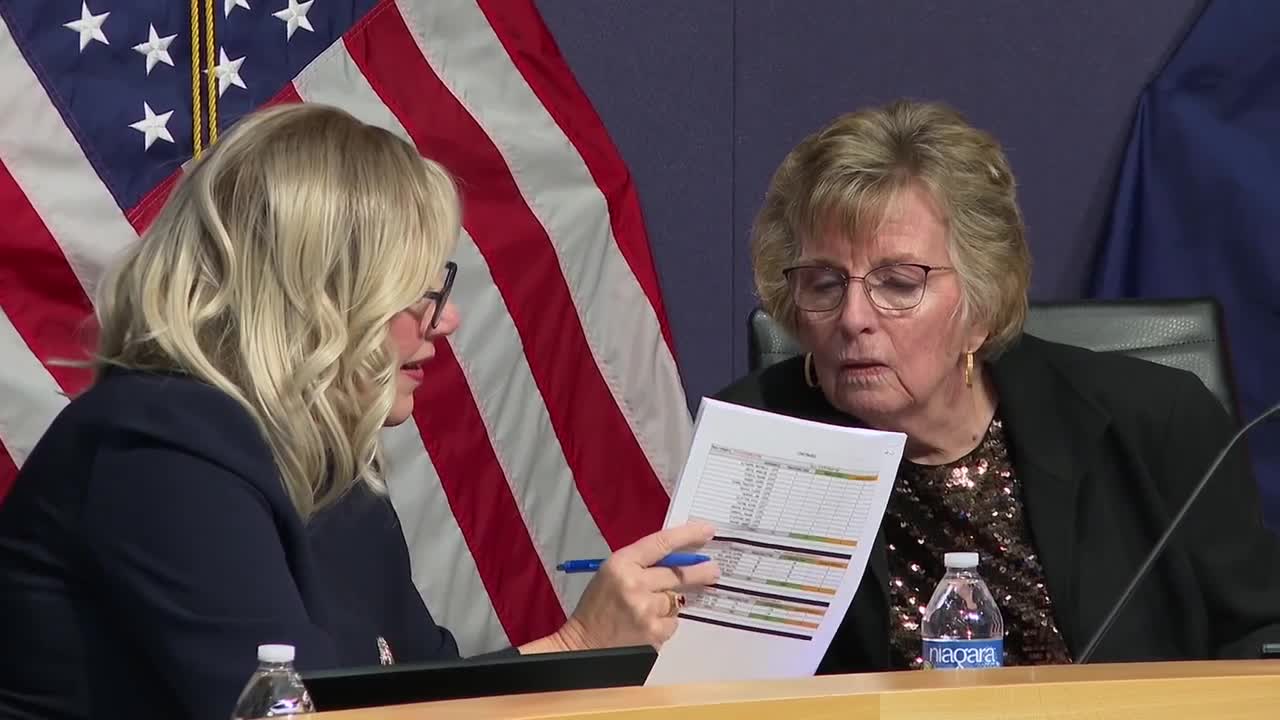
Board Chair Kate Brophy McGee and Supervisor Thomas Galvin both questioned the number of early ballots rejected during the signature-verification process. Election workers in the Recorder’s Office compare the signature on a mail ballot’s green outer envelope with other signatures on file for a voter to verify the voter’s identity.

Do you have a concern in your community or a news tip? We want to hear from you!
Connect with us: share@abc15.com
Brophy McGee told reporters after the meeting that it’s important for her to understand all aspects of the election, including why ballots were rejected, because she certifies the count.
“I still don’t have clear answers,” she said. “I don’t have clear information, and I am seeking that going forward.”
Far fewer ballots 'cured'
According to the tally of election results in the county, more than 6,000 mail ballots were rejected – and not counted – over bad signatures. That’s more than triple the number tossed out in the last gubernatorial election.
“If a signature cannot be correlated, it needs to be rejected,” Heap told reporters Wednesday. “That's what should always have been happening.”
But according to figures provided by the Recorder’s Office, his team did not flag significantly more ballots compared to 2022. Instead, they successfully “cured,” or verified, far fewer ballots this year.
Four years ago, 18,510 ballots were flagged over signatures and sent for “curing,” the process by which election workers try to contact the voter to fix the signature problem. The vast majority – 15,411 – were verified, or “cured,” with only 1,800 ballots going uncounted.
But this year, with roughly the same number of early ballots and a similar number – 18,151 – flagged for curing, only 11,047 ended up verified and tabulated. According to the county’s canvass, 6,089 mail ballots were rejected and uncounted.
Voters have five days to “cure” their ballot if their signature is rejected. Heap, who held his own election briefing before the Board of Supervisors certified the election, said his office sends a mailed notice to affected voters. His team also calls them multiple times and sends a text message if the voter is signed up to receive texts about their ballot.
This year, voters could verify their signature on the county’s election portal, BeBallotReady.Vote.
While a similar number of early ballots were tabulated this year compared to four years ago, more than 150,000 voters skipped the signature-verification process all together by showing ID when dropping their ballot off at an early-voting site or at a vote center on Election Day.
The two options are new this year thanks to changes in state law.
A new signature verification system
Heap revamped the way the Recorder’s Office verifies signatures on mail ballots.
“Our system delivers faster, more secure, and more rigorous verification than any prior administration,” he said in a statement to ABC15. “Our responsibility is to faithfully enforce Arizona law and ensure that every signature receives the thorough, impartial review required to protect the integrity of our elections.”
The software now shows five or more signatures at once, and any personal information about the voter, such as their party registration, is not shown.
“As it goes now, every signature that comes in goes to two distinct people of two different parties, who will view that signature,” Heap told reporters. “If they don't both agree that that's a valid signature, it'll go to a second queue, where it'll be reviewed again by a second bipartisan team.”
Heap said his team has built a bipartisan verification system that is a model for how signature verification should be conducted.
In September, he vowed to process all early ballots through signature verification by the day after election, something that has taken three to five days in previous elections.
His team finished signature verification on all early ballots by 1 p.m. on the day after the election, Heap said.
He also said the rate of rejected ballots is now close to a national average.
But Brophy McGee said such an average does not exist because every state and municipality handles elections differently.
“There is no national average,” she said. “There’s no national standard. There’s no state standard.”
Brophy McGee said this year’s contests were not close enough for the rejected ballots to make a difference – but said that may not be the case in future elections.
“If we had close elections, I would be asking more questions,” she said. “We have to get this resolved before the next election.”

