

PHOENIX — Monsoon season is Arizona’s stormiest time of year.
Each June into early July, our predominant winds shift out of the south as high pressure builds near the Four Corners.
That shift in the winds brings in moisture, which rises to form towering thunderstorms in the heat of the day.
We're breaking down everything you need to know about our 2026 Monsoon in our half-hour special, which you can watch in the video player above:

The monsoon season officially begins on June 15 and runs until September 30. During that time, thunderstorms often form in the heat of the day, bringing heavy rain, lightning, damaging winds, dust storms, and flooding.
Not all monsoons are the same, though. Some years, our monsoon season is hot and dry, while other years are not as hot and very rainy.
RELATED: What is the Monsoon?
So, how will Monsoon 2026 play out?
The NOAA Climate Prediction Center has odds favoring a wetter-than-normal monsoon across Arizona this year.

Wetter summers often follow dry winters and this past winter was one of the driest on record across Arizona.
Phoenix only picked up 0.29 inches of rain during the months of December, January and February, marking the eighth driest winter on record.
RELATED: Why are dust storms called 'haboobs?'
Up north, Flagstaff only picked up 18.5 inches of snow this winter. That was the 18th driest on record.
Statewide, Arizona plunged deeper into drought as rainfall and snowfall were scarce.

The dry soils across Arizona will lead to enhanced surface heating heading into the monsoon and could bring an earlier onset of storms.
We’re also tracking the potential of a very active hurricane season in the Eastern Pacific as ocean temperatures warm near the equator. Those warming ocean temperatures in the equatorial Pacific are what’s known as El Niño.

Typically, the biggest El Niño impacts in Arizona are felt during the fall and winter months as the jet stream plunges farther south, bringing more rain and snow our way.
During the monsoon, there is no clear correlation between El Niño and increased rainfall in Arizona.
In other words, some El Niño monsoons are wetter than normal and some are drier than normal.
RELATED: Monsoon storm safety tips
This year, due in part to the dry soil moisture leading into the monsoon season and the very active outlook for hurricanes in the Eastern Pacific, odds are favoring a wetter-than-normal monsoon season.
We’ll have to pay close attention to any hurricanes or tropical storms off the coast of Mexico. Moisture from those storms could get pulled up in our monsoon flow and lead to big rain events across Arizona.

The wettest day in Phoenix history happened during the monsoon when remnants of Hurricane Norbert moved up into Arizona on September 8, 2014.
Much of the Valley received three to five inches of rain in just a matter of hours. Sky Harbor officially received 3.30 inches of rain, which is more than the average rainfall of our entire monsoon season.
That average has changed a lot in the past 50 years, though.
Every 10 years, new normals are calculated based on a rolling 30-year average.
RELATED: Understanding lightning and thunder
Our latest update came in 2021, giving us a new average that is based on rainfall data from 1991 to 2020.
This new normal showed an average rainfall in Phoenix for the monsoon season of 2.43 inches of rain. That’s more than a quarter of an inch drier than the previous average, which is a big difference here in the desert!

This shows climate change’s impact on our monsoon weather in Phoenix. It’s not only trending hotter as our urban heat island expands, but also drier as our climate changes.
This year’s monsoon season is expected to be wetter than normal, but that is wetter than the new normal of 2.43 inches of rain.
The Climate Prediction Center also has odds favoring a hotter-than-normal monsoon in the Valley and all across the Southwest.

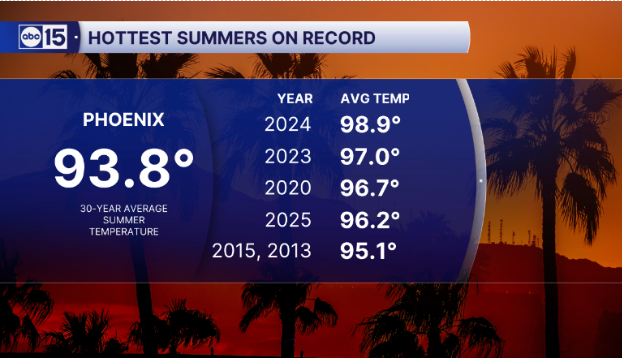
While this summer may not be the hottest on record since we have more rain in the forecast, it could still end up among the hottest on record as our urban heat island expands and our climate continues to change.
Four out of the top five hottest summers on record in Phoenix have happened in just the past few years.
So, count on ABC15 to keep you ahead of the storms. We’ll have updates on-air, online, on social media, and on all of our streaming channels.
Want more news in your community? Add ABC15 as a preferred source on Google below: