

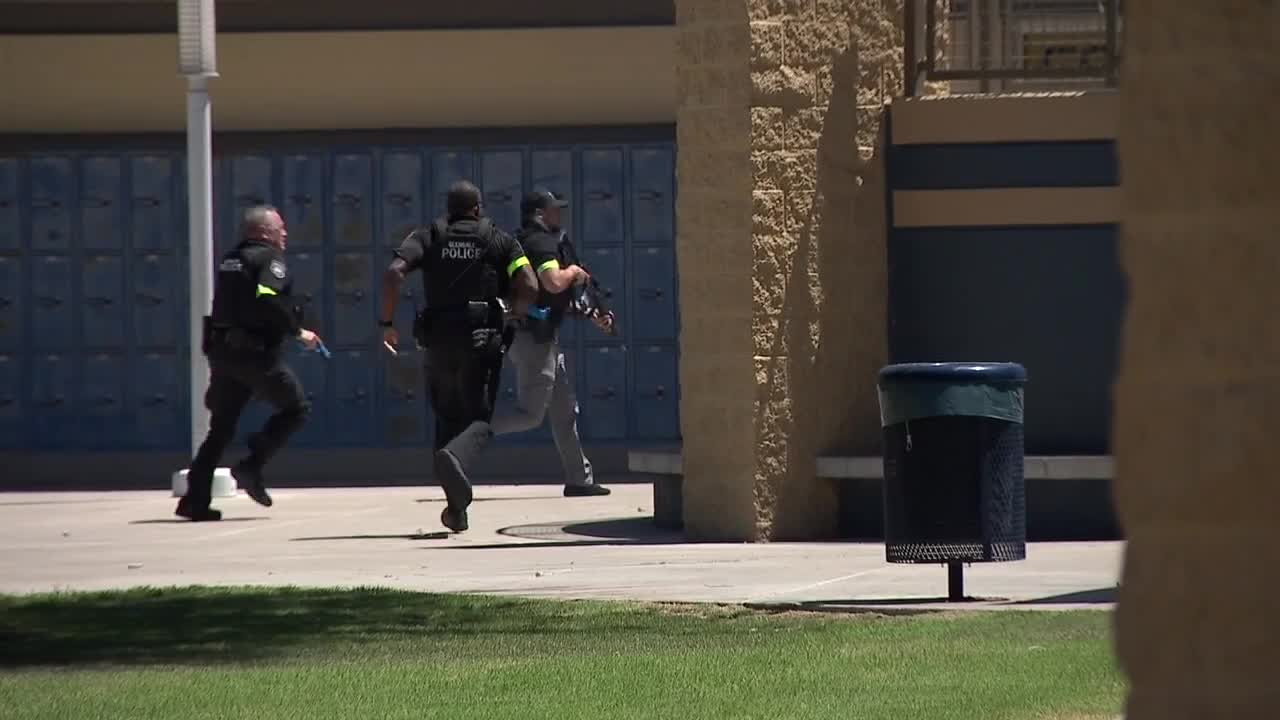


GLENDALE, AZ — Glendale police officers trained for active shooter scenarios at Raymond S. Kellis High School, running through high-stress simulations designed to prepare them for some of the most dangerous situations they may ever face.
The training, which happens annually, uses trainees, paint rounds, and realistic audio to replicate the chaos of a real active shooter event. Officers practiced clearing rooms, identifying threats, communicating with teammates, and distinguishing between suspects and victims.
Commander Scott Waite of the Glendale Police Department said the goal is to build repetition around incidents that are rare but catastrophic.
"We want to train for what could potentially be the worst day of these officers' lives."
Waite said the department deliberately works to increase how often officers encounter these high-pressure situations in a controlled environment.
"We talk about these incidents that are very high intensity, low frequency, and we're trying to bring as much frequency as we can to it."
The scenarios are built to feel as real as possible. Actors play injured victims and hostages. Gunshots echo through the hallways. Officers respond in real time to what they see and hear.
"We try to elevate their stress level and what we want them to see is exactly what could happen in real life," Waite said.
Officers train with paint rounds, ammunition that stings, leaves marks, and in some cases draws blood.
"You're going to bleed, most likely, but it's going to hurt," a training instructor said.
Among the most important skills being sharpened during the training are judgment and communication, knowing when to use force, when not to, and how to work as a team. Waite said officers train both individually and in groups of 6 or 7, learning to call out what they see and hear, coordinate movement, and avoid putting each other in danger.
When gunfire breaks out elsewhere in a building, the directive is direct.
"Go to the gunfire and go get in the mix. Go take care of the problem," a SWAT training instructor said.
Waite also addressed the mental demands of active shooter response, saying breathing is one of the most critical tools officers have.
"When you stop breathing, you start to lose your vision. You get tunnel vision. You start to lose sense of hearing," he said. "The more you see it, the more. You don't have that deer in the headlights, and that's what we're trying to train."
In Arizona, every officer goes through active shooter training before they begin field work. After that, officers complete at least 30 hours of training annually, along with additional firearms qualifications. School resource officers and SWAT teams receive even more specialized training on top of that.
Glendale police said they have dealt with active shooter situations before, including an incident at the Westgate Entertainment District. Officers also regularly respond to domestic violence calls involving hostages and barricade situations, and the city is home to multiple colleges, high schools, and elementary schools.
Waite said the department wants the public to understand both the difficulty of these situations and the depth of preparation behind every response.
"We want the public to believe in us, to trust us that if given the worst day of their life, and what will be, I can promise you, the worst day of our lives, that we're going to get through it together.”
