

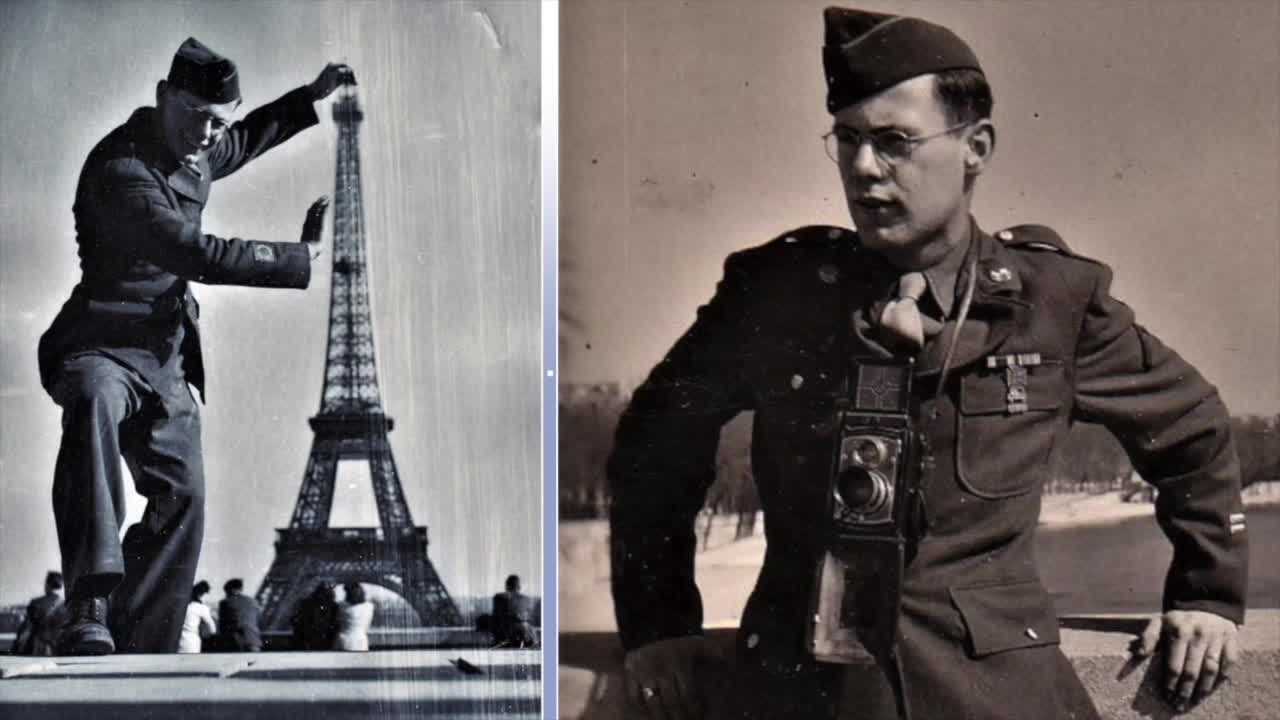


With World War II underway, Bob Stone knew it was just a matter of time before he'd find himself on a warship heading overseas. He was 21 and made a decision to take control of the situation, the best he could.
“If you let them pick where you’re going, you could wind up in the trenches,” Stone said. “And they offered me an option where they would teach me some radio engineering… so I took it.”
Now 103, the New York–born World War II veteran recalls training eight hours a day, six days a week, for six months in radio engineering — the equivalent, he said, of a two-year course. By the time he finished, the Army had enough radio technicians.
“They offered me some other options,” Stone said. “I could become a pigeon trainer. I could become a cook… and then they gave me an option of becoming a teletype operator. Since I was able to type, I took that.”
That choice put Stone at the heart of the Allied war effort in Europe. Deployed to the European Theater in 1944, he arrived on the continent about two months after D-Day, first passing through the muddy, rain-soaked orchards of Normandy.
“We went through Normandy, and we spent a couple of weeks in the apple orchards,” he said. “We were living in these little tents, two men to one of these tents, and it rained most of the time. So it was not enjoyable.”
Conditions changed when his unit reached Paris. There, the U.S. military moved into a heavily fortified communications center the Germans had built.
“We spent most of our time in a bombproof concrete blockhouse that the Germans had built in Paris,” Stone said. “When we chased the Germans out, we took over the blockhouse and made that the headquarters of our communications… and we operated three shifts, eight hours a shift, around the clock.”
His work as a teletype operator helped keep messages flowing under Gen. Dwight D. Eisenhower’s command across the European Theater and back to the United States.
In Paris, Stone picked up another role — unofficial combat photographer. A fellow soldier with photography training sparked his interest.
“I became friendly with another fellow… he was in the photography, and he got me into it, got me interested,” Stone said.
Supplies were scarce, but Stone discovered that American rations could open doors.
“We were able to get good cameras and film without any cost to us, just by trading candy, cigarettes and so on. We could get anything we wanted. The French were dying for that stuff,” he said.
Unlike many of his peers, Stone never smoked.
“The other guys, most of them, were smoking them, using them for trading. I never smoked. I never stuck one in my mouth,” he said.
Instead, he bought cartons of cigarettes at the PX and used them as currency.
“So, I bought different cameras, and I graded up as I learned photography,” Stone said. “I used to take pictures and had them developed at no cost to me, just for some cigarettes.”
Every image had to be cleared by military censors before it could be sent home.
“The pictures all had the census stamp. The pictures had to go through censorship, and every one of them was stamped ‘passed the censor,’” Stone said.
His mother collected them all. Hundreds of images capture both the destruction from war and the more lighthearted moments of enjoying Paris with his fellow soldiers.
Those photographs, taken as he moved with U.S. forces from Normandy to Paris and later to bomb-ravaged Berlin, became a visual record of his service — made possible by a soldier who chose the teletype over the trenches and a camera over a cigarette.
“I have quite a collection of photographs from my days in the Army,” he said. "What you were trying to do is do your best and survive. So we did."
Bob Stone was recently honored during Cactus League spring training by the Kansas City Royals by throwing out the first pitch. His story was also published by Imprints of Honor.

