

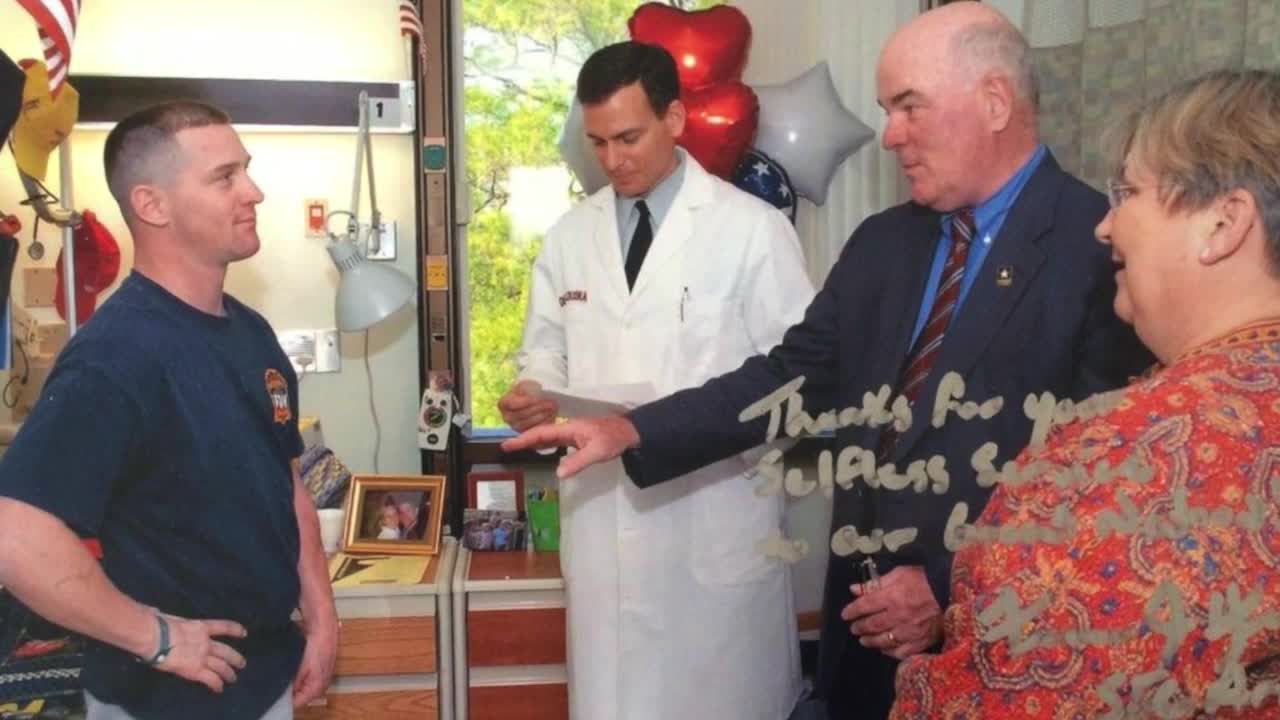


For Army veteran Dennis Chamberlain, the hardest mission of his 26-year career didn’t happen on a battlefield. It began when he took off his uniform for the last time.
Chamberlain, who served in the Army from age 17 to 44 as a helicopter crew chief, engineer, recruiter and infantry officer, said the prospect of retiring in 2020 left him “terrified.”
“The military was all I knew from 17 to 44,” he said. “To be a little vulnerable, I was terrified.”
That fear began to ease when a fellow soldier he trusted, now president of a local veterans organization, nominated him as an honoree for the Phoenix Wounded Veteran Ride, the flagship fundraising event for the Arizona nonprofit They Fought We Ride. The group supports combat-wounded and other struggling veterans who have “fallen through the cracks.”
Chamberlain said he initially saw the role as a way to help the organization, not himself.
“I thought I was helping him and being a Purple Heart recipient that I could help grow the organization,” he said. “I led a life of service. Never in a million years would I have thought I needed help in my transition.”
What he found instead was a community that helped bridge the gap between soldier and civilian — a “tribe” that rallied around him even as the COVID-19 pandemic threatened to shut down public events.
“It wasn’t about finances,” he said. “It was 100% looking for a tribe. I just felt very loved by the community and by the veteran organization, and that was crucial to me understanding what my next 20 years was going to look like.”
The Phoenix Wounded Veteran Ride brings together hundreds of motorcyclists, veterans, families and supporters for a highly visible procession between Arrowhead Harley-Davidson and Roadrunner Restaurant & Saloon in New River. Along the way, it raises money and awareness for veterans facing medical, financial and personal crises.
For fellow honoree Christopher “T-Rex” Bain, the scars of service are both visible and constant.
Bain served about 15½ years in the Army before medically retiring in 2010 due to injuries he suffered in Iraq. He said he was hit by three mortars and shot twice, injuries that left him bleeding out on the battlefield.
“I ended up bleeding out, died for 10 minutes,” he said. “Two interpreters did a blood transfusion, brought me back.”
Bain spent three and a half years at Walter Reed Army Medical Center. Doctors considered amputating his limb, but he opted for experimental surgery instead. Today, a battery controls his left side.
“The best way I can describe it to somebody — you ever been electrocuted or stuck your finger on a light socket? That’s how I feel every day,” he said, adding that the sensation earned him the nicknames “T-Rex” and “the Energizer Bunny.”
Bain, who wears his Purple Heart on his hat and has it tattooed on his shoulder, said he frequently gets stopped by people wanting to see the medal or hear his story. He uses those moments to explain why he believes public support for veterans must go beyond words.
“If you say you support the troops, don’t play lip service,” he said. “Come down. Write us a check, put some money towards it. Support the vets. Come hang out. Touch us on the shoulder and say, ‘Hey, what’s your story?’”
He said what you hear will bring you closer to price many veterans pay.
“The reason we say ‘freedom isn’t free’ is because we gave up for our way of life and for everyone else’s,” he added. “For the rest of my life, I’m always going to be in pain… That’s why it’s not free.”
Both Chamberlain and Bain said what they miss most about the military is camaraderie — the sense of family that’s difficult to replicate in civilian life.
“You only know this, what we’re talking about, if you ever actually put the uniform on,” Bain said. “It didn’t matter what their job was… They’re still your brother or sister, and it’s a family that will never go away.”
He described ‘They Fought We Ride’ and the ‘Phoenix Wounded Veteran Ride’ as a “family away from the family.”
“It’s a whole new meaning of brotherhood, sisterhood, family,” he said. “No matter what, you always have someone you can cry on a shoulder, give a hug to, have a beer with.”
Chamberlain, who said he has no other veterans in his immediate family, called events like the ride a “shot in the arm” of motivation and energy.
“I loved coming to these things because I get that shot in the arm of camaraderie and motivation and energy,” he said. “Coming together and supporting another veteran that may need that support and know that he’s part of a brotherhood and a sisterhood outside of the military.”
They Fought We Ride focuses on veterans whose needs are too urgent to wait for traditional systems to respond, said Heather Breceda, the group’s vice president.
“Our whole mission is to help local combat wounded veterans or any veterans that have basically fallen through the cracks,” Breceda said.
The organization assists with basic living expenses, such as rent, groceries and vehicle repairs, as well as medical needs, including treatment for traumatic brain injuries. In some cases, hospitals or other providers pledge care directly for a specific veteran, coordinated through the group.
“Sometimes they may not have the ability to wait six months, so we have the ability to step in right now, immediately, to give them that need,” Breceda said.
The Phoenix Wounded Veteran Ride is the nonprofit’s largest fundraiser of the year and its primary source of support for those efforts. Riders and non-riders can participate, and businesses are encouraged to sponsor the event or donate services — such as mechanical work, home repairs or medical care — that can be directed to veterans in need.
“It’s not always just a monetary need,” Breceda said. “Maybe replacing a set of tires on someone’s vehicle because they don’t have the money to.”
Anyone who cannot attend in person can donate through the organization’s website, she said. Additional funds are raised through raffles and auctions held both at the starting dealership and at the Roadrunner bar and saloon.
At Arrowhead and Roadrunner Harley-Davidson, veterans are a daily presence, said Alex Santa Maria, marketing director for the dealerships.
“Harley-Davidson’s brand has a lot to do with veterans,” Santa Maria said. “Most of our HOG chapters are made up of a lot of veterans. We have veterans that come in every morning just to get coffee here.”
The dealerships host and support the Phoenix Wounded Veteran Ride, building what Santa Maria described as a “big family atmosphere” with food trucks, music, giveaways and a bikini bike wash. He said the goal is to welcome everyone — riders and non-riders, veterans and civilians — to show visible support.
“Whether you ride or don’t ride, or veteran or not a veteran, come on in and help support the veterans,” he said. “We have a lot to be thankful for, for their service and what they’ve done for us.”
One of Harley’s slogans, “ride free,” takes on added meaning in that context, he said.
“As you can tell by some of the honorees that you’ve talked to, these guys are absolutely amazing, and they’ve been there for us,” Santa Maria said. “So Harley can do whatever we can to be there for them.”
Organizers emphasize that the Phoenix Wounded Veteran Ride is open to anyone, not just motorcycle owners. Supporters can drive vehicles in the procession, attend the events at the dealerships, donate online or sponsor specific elements such as raffle items.
“Anyone can take part,” Breceda said. “Civilians, veterans, anyone can sponsor, anyone can donate. It’s just to bring recognition to veterans, to anyone who doesn’t know what that world is like. Because freedom is not free.”
For veterans like Chamberlain and Bain, that recognition — and the sense of belonging that comes with it — may be the most valuable part of the ride.
“They get it, and you don’t have to explain that,” Chamberlain said of his fellow veterans. “The veteran community and the civilian community come together to support a veteran. It’s amazing.”
Register for the ride by heading to theyfoughtweridenational.com.

