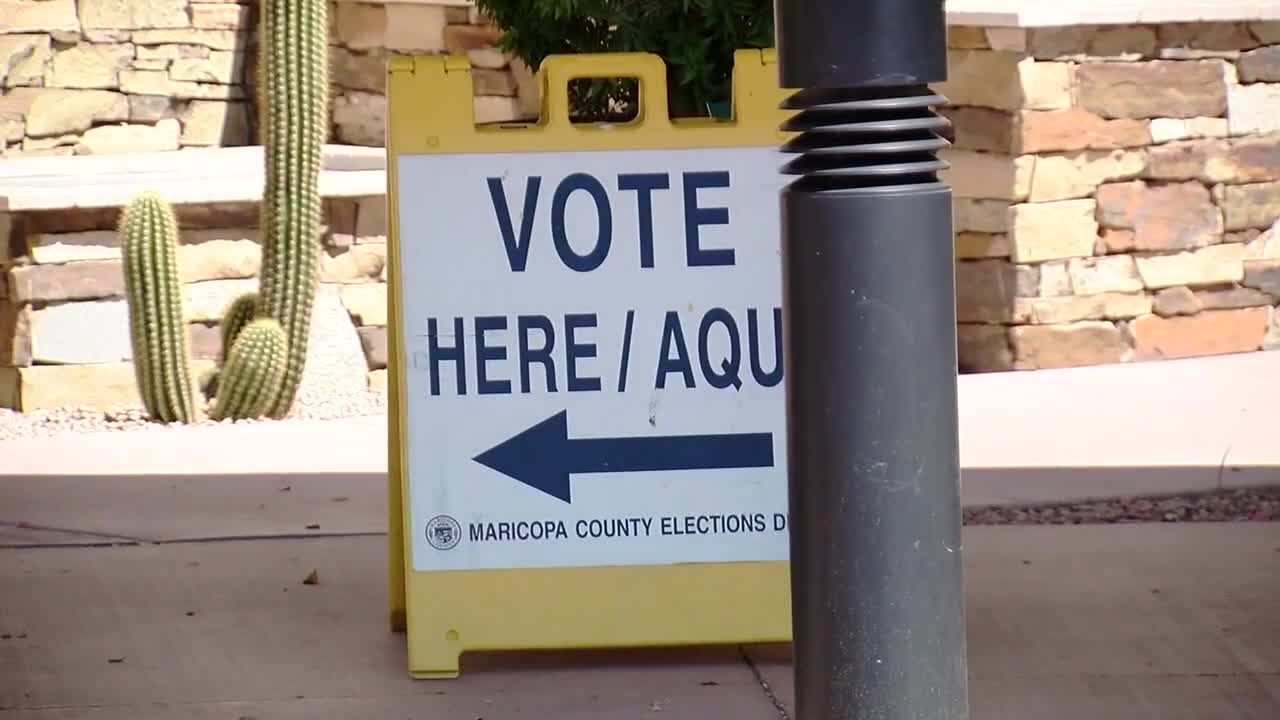


PHOENIX — Maricopa County prosecutors are investigating the citizenship of 207 registered voters, most of whom were flagged by a federal database that has returned widespread errors in other states.
Recorder Justin Heap’s office referred 137 registered voters for investigation on Friday and then added 70 names Monday afternoon, the Maricopa County Attorney’s Office said in a statement Monday.
"I've met with my Investigations Division, and I've turned it over to them to follow up on that," County Attorney Rachel Mitchell said Wednesday.
Heap’s office said last month that it had identified 137 people who are not citizens using the Systemic Alien Verification for Entitlements, a federal service that government agencies can use to verify immigration status and citizenship. Sixty of them had cast ballots in previous elections, his office said.

Do you have a concern in your community or a news tip? We want to hear from you!
Connect with us: share@abc15.com
The individuals were identified when the Recorder’s Office reviewed the records of more than 61,000 people who were mistakenly marked as having provided proof of citizenship by a decades-long Motor Vehicle Division error.
"We're going to be looking at whether they are, in fact, not citizens of the United States, or if they can provide proof of citizenship," Mitchell said.
SAVE returns widespread errors in other states
According to a ProPublica report in February, local elections officials in Missouri and Texas discovered numerous errors after running voter rolls through SAVE. Jen Fifield, a reporter who worked on the story, told ABC15 the tool often marks citizens as non-citizens because it doesn't have their most recent status.
“So for example, in Missouri, they started out and looked at more than 1,200 people that they found to be non-citizens,” she said. “But really, when they kept looking and kept digging at that data, they found that hundreds of those were actually citizens.”
The Trump administration has revamped SAVE, an online system that government agencies previously used to check eligibility for public benefits.
"A lot of the clerks that I talked to across the United States as I worked on this story said, ‘We don't want non-citizens to vote. We just want to find a way that works to identify who is a citizen and who isn't,’” Fifield said.
Gina Swoboda, a former chair of the Arizona Republican Party who is running in the Republican primary for secretary of state, called SAVE an important tool for county recorders but said they need to do more digging if the database flags someone as a non-citizen.
“You can't just use the same database and say, ‘I looked at one database, and therefore all of these people are most definitely not citizens,’” she said.
Stephen Richer, a former Maricopa County recorder, agreed.
"I know that if I were still in office, I would use it as a data point, but I'd be very wary before taking definitive action," he told ABC15.
How other states use SAVE
Fifield said states such as Georgia and Kansas are using SAVE as a starting point, working for months behind the scenes to confirm the accuracy of the data.
“They are working down, line by line, to try to see if they can find better citizenship documentation before they even announce anything, before they put out a statement saying, ‘We found hundreds or thousands,’” she said.
The United States does not have a central database of citizens.
SAVE looks at Social Security data first, Fifield said. But naturalized citizens may get a Social Security number long before becoming a citizen, and the agency may not know about someone’s naturalization.
“So they might have outdated information for you,” Fifield said. “The system has not yet developed in a way that it can find your latest citizenship information.”
As of Thursday, Heap’s office had not answered questions sent multiple times about what steps it took to confirm the people identified by SAVE are not citizens. His office also did not respond when asked how the additional 70 names sent to the prosecutors Monday were identified.
Mitchell referred questions about how those 70 individuals were identified to the recorder.
"I don't know if they were just giving it to us as they prepared them," she said, adding, "You'd have to ask Mr. Heap."
State law requires county recorders to notify a registered voter if they find evidence that the individual is not a citizen. The person then has 35 days to respond with documentation of citizenship, Swoboda said.
“They absolutely have to be notifying the impacted registrant of the situation to give them a chance to cure,” she said.
MVD error discovered before 2024 election
Richer discovered a longstanding MVD coding error shortly before the 2024 election that had incorrectly marked some registered voters as having provided proof of citizenship, which Arizona law requires to register to vote.
"A small number of people were previously flagged under a state database that they had provided documented proof of citizenship, but they had not, in fact," he said.
About 218,000 voters – including 83,000 in Maricopa County – were affected by the systemic database issue that stretched back two decades.
The issues could have been identified and fixed years earlier, an ABC15 investigation found. A bipartisan audit ordered by Gov. Katie Hobbs confirmed that report.
Heap’s office sent a letter last summer to the affected voters in Maricopa County, asking them to provide proof of citizenship.
The Recorder’s Office told ABC15 in July 2025 that affected voters who did not provide proof of citizenship would be moved to the federal-only rolls.
In an opinion released last year, Arizona Attorney General Kris Mayes recommended not canceling voters' registrations over the MVD error, saying counties can ask for proof of citizenship but don't have the authority to change their registration if they don't respond.
Arizona law requires people to provide proof of citizenship to register to vote in state and local elections.
On Feb. 13, Heap released a statement saying his office reviewed the records of 61,681 registered voters affected by the MVD error.
He said SAVE confirmed citizenship for 58,782 of them, adding their registration was updated to ensure they receive a full ballot in future elections.
The review “also identified 137 registered voters who are not U.S. citizens,” the statement said, but did not address the status of the remaining 2,762 people affected by the problem.
Swoboda stressed that county recorders need to reach out to people flagged in SAVE as non-citizens in case they are naturalized, adding if election officials “just send them willy-nilly to enforcement, that's a problem, because that will backfire spectacularly and decrease confidence instead of increasing confidence.”
Want more news in your community? Add ABC15 as a preferred source on Google below: