



MARICOPA COUNTY — Artificial intelligence is helping some Arizona police officers write arrest reports that can be used to determine whether there is probable cause to hold someone in jail.
Now, internal records obtained by the ABC15 Investigators show the Maricopa County Attorney’s Office was already expressing concern with law-enforcement officials by drafting proposed language explaining how AI was used by officers.
On Nov. 12, Gilbert police responded to a domestic disturbance involving a woman who was reportedly breaking items inside a home.
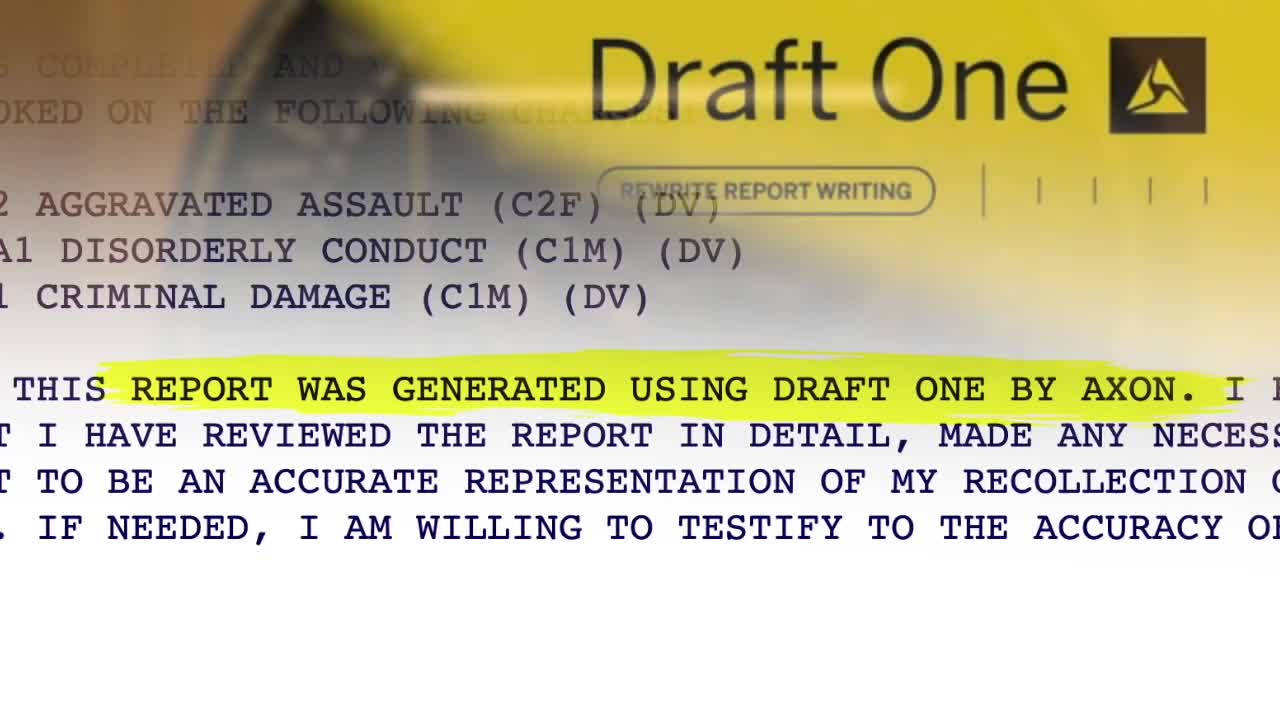
At the bottom of the arrest narrative, however, the officer included a disclosure about using AI, “I acknowledge this report was generated using Draft One by Axon.”
It goes on to say that, “I further acknowledge that I have reviewed the report in detail, made any necessary edits, and believe it to be an accurate representation of my recollection of the reported events.”
Draft One is an artificial intelligence product from Axon that generates draft police narratives using body-camera audio.
Earlier this month, the case out of Gilbert went before Maricopa County Superior Court Commissioner Daniel Fenzel, where he found there was not probable cause for the felony aggravated-assault allegation.
According to the court order obtained by ABC15, the commissioner found insufficient information regarding whether the alleged victim had a reasonable apprehension of imminent physical injury. The commissioner noted the police narrative itself said there were no specific threats and Rodriguez did not move toward the alleged victim.
The commissioner did find probable cause for the remaining misdemeanor allegations but also raised concerns around the use of AI.
In the order, Fenzel wrote: “Although probable cause was found, the weight of evidence is limited given that there is limited information provided about the extent of usage and contribution of generative artificial intelligence that was used in drafting the arrest narrative allegations.”
Gilbert police told ABC15 the department began using Axon Draft One in fall 2025.
The department said Draft One uses body-worn camera recordings and information provided by officers to create a draft narrative. Officers are required to review and verify the information, and a supervisor reviews and approves the report for content and accuracy.

ABC15 is committed to finding the answers you need and holding those accountable.
Submit your news tip to Investigators@abc15.com
This is not the first case that the commissioner found no probable cause.
Earlier this month, the commissioner released a DUI suspect after determining he could not find probable cause in the case because the arresting officer's report was generated with the assistance of an artificial intelligence tool.
The trooper's probable cause statement, filed as part of the arrest paperwork, included the following disclosure at the end of the narrative: "THIS REPORT WAS GENERATED WITH ASSISTANCE FROM TRULEO AI. THE CONTENT REFLECTS THE OFFICER'S OWN OBSERVATIONS AND RECOLLECTIONS. ALL FACTS AND STATEMENTS ARE BASED SOLELY ON THE OFFICER'S ACCOUNT."
In the release order, Fenzel wrote that "without further information regarding the nature and extent to which a generative AI authored or contributed the narrative given that all alleged facts and statements were 'based' on the affiant officer's original account which was not included," the court was "unable to meaningfully weigh whether the factual allegations made in the narrative (e.g., officer's observations, signature of affiant officer) were authored, whether in whole or in part, by a generative AI."
“I think the main concern that we think about is the reliability,” said Bryan Schwartz, associate clinical professor of law at the University of Arizona, “We want to make sure that what is in the police report is exactly what the police officer saw, how the police officer observed and felt about the situation.”
Schwartz said he feels that how AI is being used is inconsistent in police departments and in courtrooms, “We're gonna need to establish some rules, some parameters, guidelines to instruct not just police, but lawyers, and judges on how to handle this type of evidence.”
Two days before the arrest out of Gilbert, the Maricopa County Attorney’s Office sent communications to different law enforcement agencies about the use of generative AI in reports.
Tom Van Dorn, the law enforcement liaison, wrote in the email that MCAO doesn’t have a definitive answer on what judges are looking for in the disclaimers, but provided a drafted example:
Artificial Intelligence Assistance Disclosure
I utilized artificial intelligence (AI) solely as an administrative writing aid to assist with grammar, organization, formatting, and narrative clarity. All factual information and investigative findings contained in this report were provided by me and derived from my investigation. AI was not used to independently establish facts, determine probable cause, or formulate investigative conclusions. I personally reviewed the final report and verified its factual accuracy, completeness, and consistency with the underlying
investigative information. I retain full responsibility for the contents of this report.
GILBERT POLICE FULL STATEMENT:
On November 12, 2026, just after 9:00 AM, Gilbert PD responded to a home in the 3000 Block of East Woodside Way regarding a report of a domestic disturbance involving a woman allegedly armed with a knife.
Officers located 28-year-old Vivian Rodriguez outside the home and began interviewing several family members who alleged Rodriguez damaged property inside the home. During the investigation, one of the victims reported to police that Rodriguez had allegedly picked up a knife and held it in front of their face. Family members then allegedly retreated to a room, locked the door, and waited for police to respond.
Based on the available evidence and information gathered during the investigation, Rodriguez was arrested and booked into the custody of the Maricopa County Sheriff’s Office on the following charges:
• A.R.S. 13-1204(A)(2) Aggravated Assault, a Domestic Violence offense and class 2 felony
• A.R.S. 13-2904(A)(1) Disorderly Conduct, a Domestic Violence offense and class 1 misdemeanor
• A.R.S. 13-1602(A)(1) Criminal Damage, a Domestic Violence offense and class 1 misdemeanor
The commissioner did not find probable cause for the felony charge of A.R.S. 13-1204(A)(2) Aggravated Assault. The reasons provided included findings that the Form IV lacked sufficient information to show imminent physical injury, as required by A.R.S. 13-1203 and 13-1204.
The commissioner did find probable cause for the remaining charges; however, the commissioner did state that “the weight of evidence is limited given that there is limited information provided about the extent of usage and contribution of generative artificial intelligence that was used in drafting the arrest narrative allegations.”
The Maricopa County Attorney’s Office elected to refer the charges to the Gilbert Prosecutor’s Office for review.
We are aware that this is the same commissioner that recently did not find probable cause on DPS’s case, citing to their usage of artificial intelligence, and we are unaware of any other commissioners with the Maricopa County Superior Court that are making these findings or noting these concerns.
In Fall 2025, the Gilbert Police Department implemented Axon Draft One, a system designed to assist officers in writing draft narratives for police reports using their body-worn camera system. The content of the narratives is based on body-worn camera recordings and officers' input in the narratives.
Officers are required to review and verify that all information in the report is accurate. A supervisor must then review and approve the report for content and accuracy, as outlined in Gilbert PD General Orders 1201.40.
Charged or submitted offenses are merely allegations.
All defendants are presumed innocent until pleading guilty or being found guilty.
