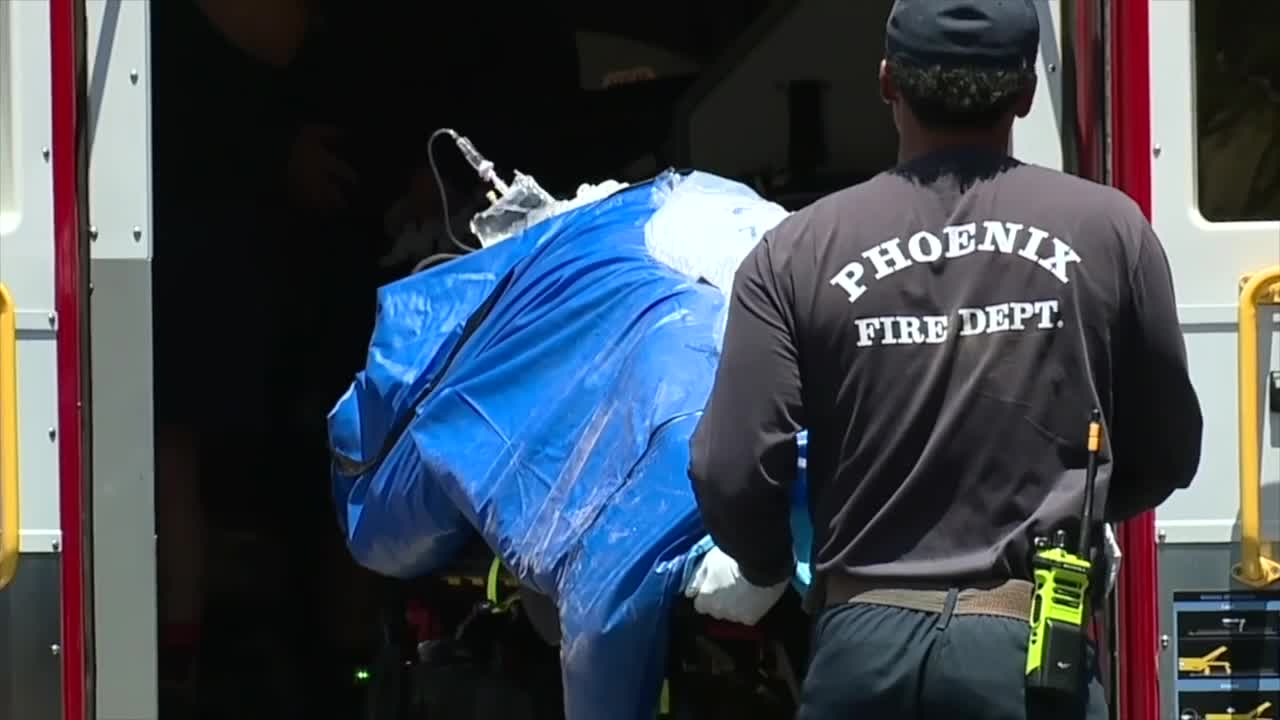


PHOENIX — Phoenix firefighters recorded 1,744 heat-related calls for service from May through Aug. 2026, on average more than one extra call per day compared to the 2025 numbers, as fire officials say extreme heat is arriving earlier in the year and lasting longer.
Fire officials made that presentation before Phoenix City Council's Public Safety and Justice Subcommittee and reported that the last three years have been especially high for heat-related emergency calls.
Approximately 14% of those patients were critically ill, suffering from heat stroke.
Earlier this summer Phoenix Fire Captain Todd Keller defined the condition.
"Heat stroke is defined by 104 or above and an altered level of consciousness," Keller said.
A bag of ice is saving lives
Phoenix Fire first introduced cold water immersion in 2024, a system using a bag and ice to treat patients in the field. The department is now routinely using the treatment three times a day during the summer, lowering the average patient's temperature by five to six degrees by the time the ambulance reaches the hospital.
Fire officials say patients who previously may not have survived a heat emergency are now leaving the hospital with no ill effects.
ABC15 covered the system earlier this summer.
"This is a plug and play system, we have our ice our bag our patient and we're transporting them to the hospital. It turns out it is absolutely life saving," Keller said.
Mountain rescues are pushing crews to the limit
Through August, firefighters rescued 98 people off Phoenix's iconic mountain trails, including 14 patients who had to be hoisted to safety even with Phoenix's hoist helicopter out of service for much of the summer. Firefighters sat sixty percent of the summer rescues were Arizona residents.
Those rescues often came in rapid succession, leaving little time for crews to recover. Assistant Chief Justin Alexander described the strain on firefighters.
"We've seen multiple calls during the same operational period that is incredibly taxing so we've had to be creative and rotate units and bring people in from other parts of the valley so we're not sending the same crews up over and over against," Alexander said.
Extreme heat season is setting records
The National Weather Service issued 47 excessive heat warning days in 2026, closing trails at South Mountain, Piestewa Peak, and Camelback Mountain. The first excessive heat warning day came on March 19, the earliest on record. The summer also brought 39 days above 110 degrees.
Phoenix City Council member Ann O'Brien said some of those mountain rescues could have been prevented.
"If you have a medical emergency like a heart attack, right, that can't be foreseen. But heat exhaustion, going out there when it is too hot, not taking enough water, not turning around soon enough, those are things that are human errors that can be corrected for," O'Brien said.

Do you have a concern in your community or a news tip? We want to hear from you!
Connect with us: share@abc15.com
Want more news in your community? Add ABC15 as a preferred source on Google below: