

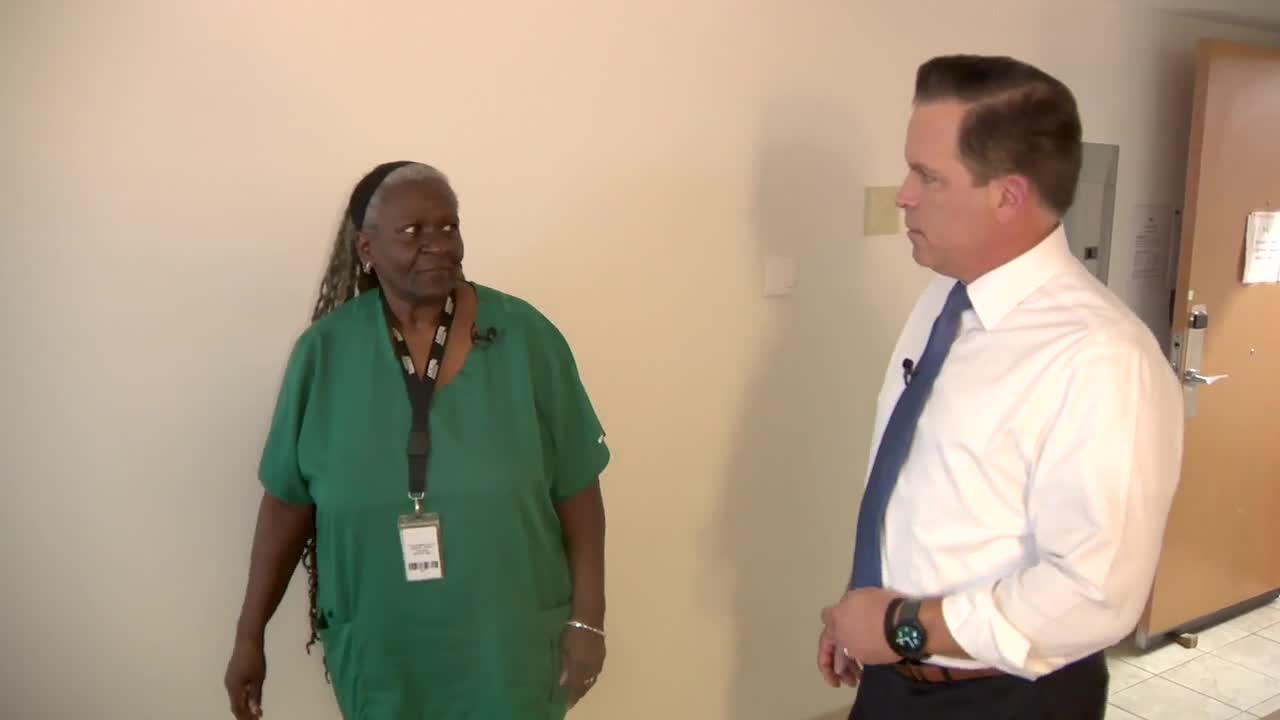


PHOENIX — After nearly a decade in the Navy, cooking for crews on ships, Kristina Jones thought she had done everything right when her health collapsed.
She suffered a stroke last October and suddenly could not work. She applied for disability, waited for the checks to arrive — and lost her home in the meantime.
“I wasn’t able to do my position anymore, and disability didn’t come through until weeks after I got here,” Jones said. “I wasn’t able to pay my rent, so I got evicted.”
Jones is one of a growing number of women veterans now living at U.S. VETS in Phoenix, where a new women-only wing is offering a secure place to live, along with classes, case management and help navigating the Department of Veterans Affairs system.
The facility, part of a large newly remodeled former Holiday Inn just off I-17 and Cactus, was designed to give women veterans something many say has been missing for years: safety and stability.
“It’s very comforting,” Jones said of the women’s section. “It makes you feel very secure to know I have a safe place. With my physical disability, I can’t run. I have PTSD. Once I’m in here, I know I’m safe.”
U.S. VETS Phoenix Executive Director Michelle Jameson said women now make up roughly 16% of the veterans on site — about 22 women — and many have experienced military sexual trauma or other life-changing circumstances.
“There’s not a lot of places for females only,” Jameson said. “A lot of our females have military sexual trauma. Men can be triggering. I wanted a safe place for them to feel safe and secure.”
The new wing includes a women-only lounge, separate laundry room and secure-access doors so residents can move through the campus and still retreat to a space without male residents. The building also has filtered water stations that Jameson calls “basic dignity” for veterans who may have been living in cars or on the street.
“When you’re outside and you’re calling the streets home, you don’t have access to ice machines and purified water,” Jameson said. “Water is essential for life, and dignity is essential too.”
Inside the women’s hallways, the stories vary, but many share a common thread of trauma, years of silence and homelessness that can come even when a veteran has income.
Army veteran Sashley, who served as a clerk responsible for records and emergency travel arrangements, said her service was overshadowed by military sexual trauma that she buried for decades.
“I never told anybody I was a vet,” Sashley said. “I wiped the military out of my life. I didn’t tell anyone I had served, so there was really no help I could get because nobody knew.”
Sashley said she tried to live as if her service never happened, even as the trauma seeped into every part of her life — marriage, family, work and housing.
“I had no clue it was going to affect where I lived and what I did,” she said. “You think you’ve put sandbags around you, but it seeps in. To me, by the time you’re up to your neck, that’s homelessness.”
Sashley said she has spent multiple stretches living in her car over the years, even while holding jobs and maintaining a clean record and good credit. The problem, she said, was never effort; it was trying to meet strict apartment income requirements and upfront costs while living paycheck to paycheck.
“There were no $300 apartments anymore,” she said. “If it’s a $1,500 apartment, they want two or three times that and a security deposit. When what you’re making is always taking care of rent and food, you don’t have the ability to have that extra money to just say, ‘Here, take this, and let me move in.’”
When homelessness confronted her again, she said she resisted referrals to shelters, convinced they would feel like jail. She finally agreed to return to the local VA Community Resource and Referral Center and was connected to U.S. VETS.
She expected bars and restrictions. Instead, she said, she found a locked women’s wing, a private room and staff who let her sleep for days without pressure.
“I was so tired,” she said. “Those doors mean something. To get to the meals, I have to walk past a bunch of guys, but I knew when I could get back here I could just breathe. I only have to deal with women back here. That matters a whole lot when you’ve been through what I’ve been through.”
Sashley said staff also pushed her to explore VA benefits she had long ignored. She eventually secured a VA identification card and learned she was service-connected for disabilities — something she said she never would have pursued on her own.
“I drove by the VA for years. It was always just that place that sat over there,” she said. “I already decided in my mind, ‘I’m not a vet.’ U.S. VETS and a veteran service officer here helped me understand I do have benefits, and that I’m allowed to use them.”
Army veteran Ariel Gomez, who served 12 years as an automated logistics specialist and combat engineer with deployments to Iraq and Syria, came to the program after her own crisis.
She said childhood trauma and stigma around mental health followed her into the military and into civilian life when she left service in November.
“Reaching out for help was always a negative thing,” Gomez said. “When I reached out in the military, it was a negative thing too. I knew something was wrong, and I had a crisis point, but I didn’t know where to start.”
Gomez contacted the VA crisis line, entered a residential program in Prescott, then transferred to U.S. VETS Phoenix. She now works private security, attends life skills and communication classes and is saving to move into her own place.
She said being in an all-women wing has been critical.
“It creates a lot of safety,” Gomez said. “As a camaraderie, we help each other. We’re not alone.”
Jameson said the Phoenix campus runs multiple programs under one roof, including short-term “bridge housing” that typically lasts 60 to 90 days, more intensive treatment programs for veterans dealing with substance use, and supportive services that help veterans move into apartments with assistance for deposits, household items and ongoing case management.
The organization also operates four classrooms on site and offers about 60 classes a week, from relapse prevention and mental health to art therapy and employment readiness. An on-site workforce team helped 283 veterans get jobs last year, Jameson said.
“We want to meet the veterans where they’re at and what they need,” she said.
For Jones, the next step is securing an accessible apartment and building up enough savings to feel stable when she leaves.
“I’m looking for an ADA unit, so that takes a little more time,” she said. “I’m thinking in a couple of months I should be good to go. I’ll be able to have people over again. That’ll be nice.”
She has a message for veterans still sitting in their cars, on friends’ couches or in shelters, unsure about making the call she finally made.
“Don’t be scared to ask for help,” Jones said. “Don’t wait until the last minute. There are people here who can relate to you and help you. It’s just temporary.”
