

PHOENIX — Not all Arizona cities face the same risk from Colorado River water reductions — and the numbers reveal a stark divide across the Valley.
Arizona draws its water from four main sources. Groundwater is the largest share at 41%, followed by the Colorado River at 36%. In-state systems like the Salt River contribute 18%, and reclaimed water makes up the remaining 5%.
Most of that supply never reaches a residential tap. Agriculture consumes 72% of Arizona's water. Cities and towns use 22%, and industry accounts for just 6%.
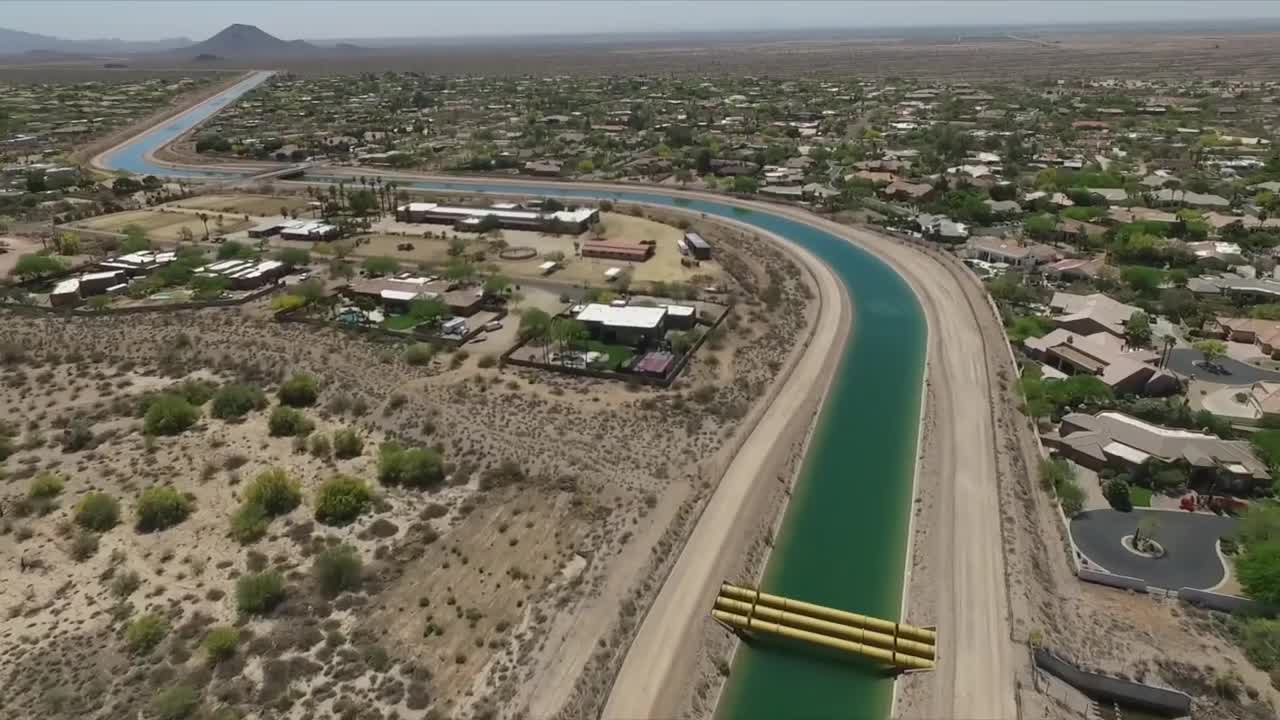
The Central Arizona Project canal stretches 336 miles from Parker to Tucson, supplying 19 cities and towns. For some of those communities, a cut to Colorado River allocations would be devastating.
Anthem relies on Colorado River water for 100% of its supply. Apache Junction is close behind, and Cave Creek sits at 90%. Scottsdale draws 70% of its water from the Colorado River — but uses more total water than Anthem, Apache Junction, and Cave Creek combined, multiplied by four.
The cities least reliant on Colorado River water include Tucson, Tolleson, Paradise Valley, and Avondale.
Among Arizona's 3 largest cities, Mesa has the most exposure — 57% of its water comes from the Colorado River, with 37% from the Salt-Verde system. Phoenix is nearly the mirror image of Mesa. Tucson relies almost entirely on groundwater at 99%, but with a catch on how it replenishes that groundwater.
Tempe is among 206 water systems statewide that receive zero water from the Colorado River. Most of those systems run on wells. Tempe runs on the Salt River, which accounts for 85% of its supply.
How Arizona's water priority system works — and why tribal leases matter
Reliance on Colorado River water is only part of the picture. Where a community sits in CAP's priority system — and whether it holds a tribal water lease — determines how protected it is when drought cuts arrive.
The Central Arizona Project moves about 1.6 million acre-feet of Colorado River water in a year with no shortages. Most of that — 1.4 million acre-feet — is under long-term contract, and who gets cut first depends on where a community sits in a layered priority system.
At the top of the priority ladder: 68,000 acre-feet under water rights settlements with the Ak-Chin and Salt River tribal communities. Just below that sits nearly a million acre-feet reserved for Arizona tribes and most municipal and industrial supply. Then comes 216,000 acre-feet in the non-Indian agricultural pool. Whatever is left can be accessed by agriculture as well.
Right now, there is nothing left over. CAP is already in drought conditions and has cut 512,000 acre-feet from that list — wiping out all excess water and most of the non-Indian agricultural pool.
In real terms for Phoenix, 36,000 acre-feet of water that would normally arrive in a non-drought year is not being delivered. But 126,000 acre-feet with higher priority probably will be. Chandler, Glendale, Mesa, and Scottsdale face the same pattern — some lower-priority water cut, higher-priority supply likely protected.
About half of the entire CAP water allotment is contracted to tribes, with about half of that sitting in the second-highest priority tier. But most tribes do not use their full allotment — instead, they lease it out.
Anthem gets 100% of its water supply from the Colorado River, all of it through a long-term lease with the Ak-Chin Indian Community — which sits higher on the priority ladder than most cities. So Anthem likely will not see reductions. The largest water leases belong to Freeport McMoRan, the Central Arizona Water Conservation District, Scottsdale, and Phoenix — those allotments are probably safe too.
One city that may be shopping for a lease soon: Tucson. 99% of its water comes from the ground — but that groundwater is itself 96% replenished by the Colorado River water, with no contract prioritizing it above what most cities already get.
This story was reported on-air by a journalist and has been converted to this platform with the assistance of AI. Our editorial team verifies all reporting on all platforms for fairness and accuracy.
Want more news in your community? Add ABC15 as a preferred source on Google below: