




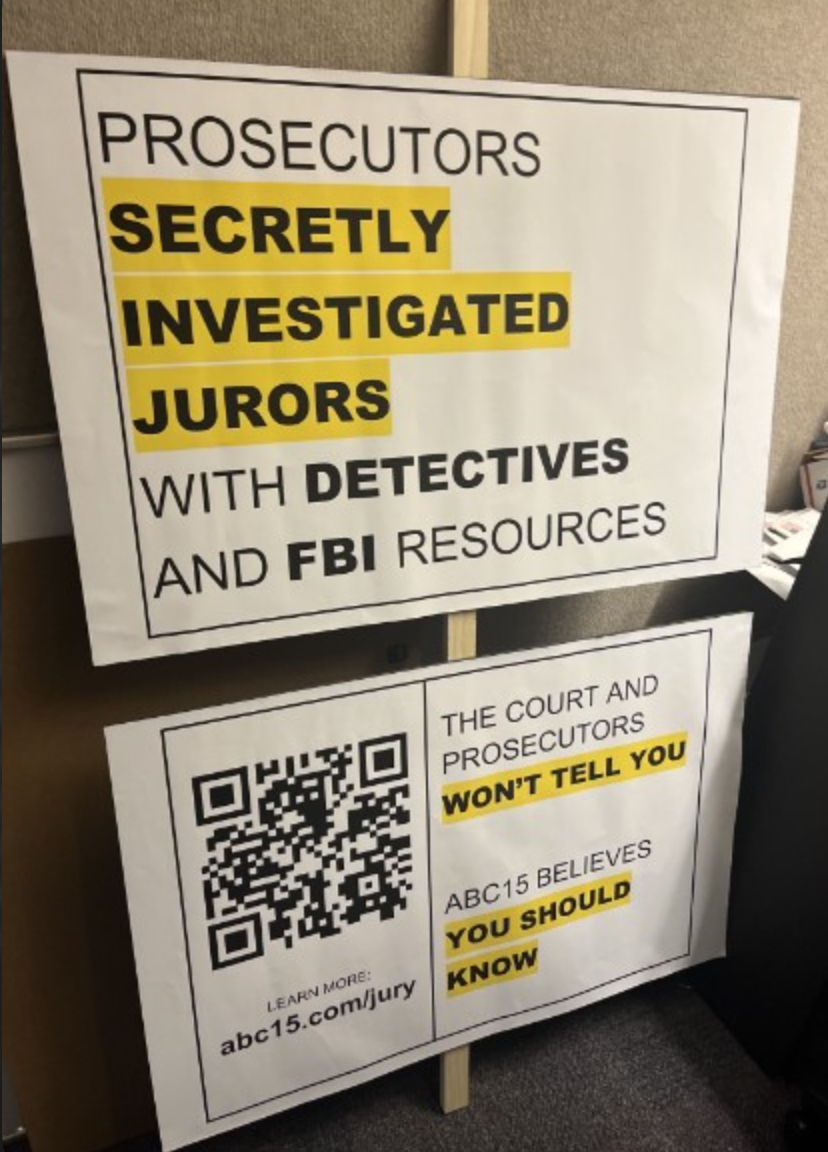
PHOENIX — The Maricopa County Attorney’s Office secretly investigated jurors in a death penalty case using detectives and a confidential FBI database after a judge refused to remove the jurors because prosecutors did not like them.
While vetting jurors is a normal and important part of the trial process, MCAO prosecutors used the National Crime Information Center (NCIC), one of the most powerful tools in law enforcement, to probe a pair of jurors without telling the court, the defense, or the jurors themselves.
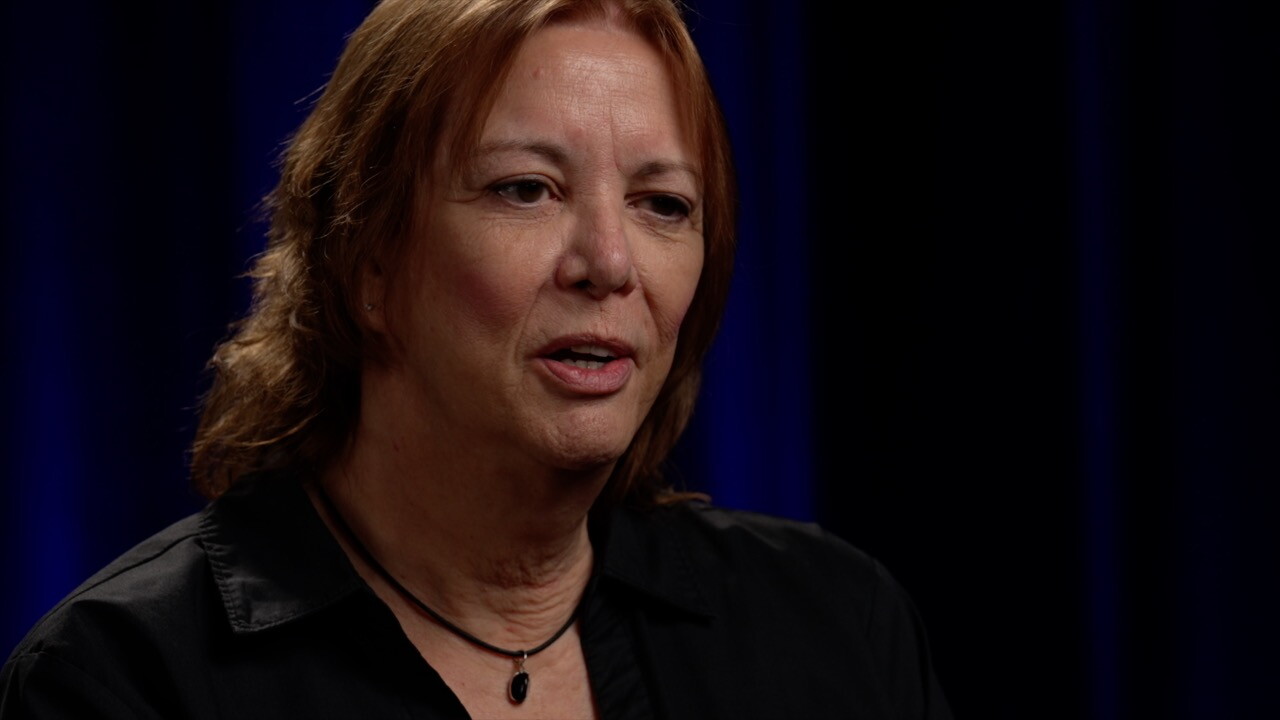
"The use of the NCIC database to investigate me was totally uncalled for, and I believe may have violated my civil rights and the FBI rules for proper use of the database,” said Jillian Barfield, one of the two jurors.
Barfield learned about the secret investigation into her life from ABC15.
“I feel betrayed as a juror who gave five months of my life to the court system."
When the judge discovered what happened and demanded to know whether MCAO's actions were legal, top prosecutors told the court it was “obviously” fine, and it was not the court’s role to question them.
“It seems obvious that even if it's not illegal, which it may be, it's at least unethical and dishonorable,” said David Euchner, President of the Arizona Attorneys for Criminal Justice, a statewide association of defense attorneys.
He added, “It brings dishonor on the legal profession when we bring jurors in for jury duty, we thank them for coming in to sit on trials, and then one side uses law enforcement tools to investigate them to dig deep down into their deepest secrets."
FULL INVESTIGATION: Jurors/Investigated
For nearly a year, ABC15 has investigated what happened by obtaining and reviewing court records, including documents that were sealed the day after a reporter began asking questions about the case. The station has also conducted interviews with legal experts from across Arizona and the country.
The experts said this situation is unprecedented and undermines the entire jury system upon which the court relies. But despite experts’ dire warnings, no legal authority has taken control of the situation.
And no one is telling jurors – except ABC15.
How it started: Jury selection in a death penalty case
On September 30, 2025, during jury selection for the death penalty trial against Franklin Clifton, MCAO prosecutors Kristin Larish and Heather Livingstone moved to have two jurors removed from the case.
Their reason: they did not like the jurors' “demeanor” and “body language.”
Maricopa County Superior Court Judge Monica Edelstein immediately rejected their motion, saying she found no issue with the jurors’ answers or actions.
But rather than accept the ruling, MCAO then had detectives secretly investigate the jurors and run the pair through the NCIC.
When Edelstein later found out, the judge outlined the matter in an order and ruled that MCAO needed to brief the court on whether its NCIC use on jurors was allowable under Arizona criminal law. The order was sealed the day after ABC15 began asking questions about what happened in the Clifton case.
ABC15 saved a copy before the court removed the order from public view.
In the order, Juror 54 is Jillian Barfield.
The second, Juror 42, was eventually dismissed, and her identity has not been made public.
Through court filings and other sources, ABC15 confirmed the NCIC search on Juror 42 turned up a case in which she had been a victim. Prosecutors also found a sealed, dismissed case in which the juror shoplifted formula for her baby.
"I think that's insane... what relationship does that have to being a juror?,” Barfield said during an interview with ABC15.
Investigated juror: ‘I feel betrayed’
Barfield spent five months serving on the jury in the Clifton case.
She said she had no idea she had been investigated until after the death verdict when the judge lifted the admonition on jurors, allowing them to look up outside information about the case.
When searching about the interview, Barfield saw an ABC15 report about Edelstein raising questions about MCAO’s NCIC use.
It sent her spinning.
"It's like going down a roller coaster. My stomach just kind of felt like that kind of experience. It was, I couldn't believe it,” she said. “(I was) angry.”
Barfield believes she was targeted, in part, because of her political background. She had recently run for Congress as a Democrat against Republican Rep. Abe Hamadeh, a former MCAO prosecutor.
“That's the question I have: Why?,” Barfield asked. “If they didn't know me from a hole in the wall, or if they didn't know me or anything about me, why single me out?”
In a statement, MCAO denied that Barfield’s political candidacy had any role in their investigation.
Experts: ‘Disturbing’, ‘Chilling’, ‘Maybe illegal’
The NCIC is a federal database maintained by the FBI and accessible only to law enforcement.
In Arizona, improper or unauthorized use is also a crime, a Class 6 felony, according to state statutes.
Experts across the legal and political spectrum said using it to investigate jurors, especially after a judge already refused to remove them, crosses a "red line.”
"I can't think of anything more disrespectful than treating a juror like a common criminal," Euchner said. "They didn't like how a couple of jurors looked and some of the answers that they gave, and when they were unsuccessful in getting them tossed off, prosecutors were like, you know what, we're going to bring in detectives."
Euchner said the conduct is "at least unethical and dishonorable" and "may even be illegal."
RELATED: What experts say about MCAO's investigation of jurors
Esther Hong, a law professor at Arizona State University, said the implications extend far beyond this one case.
"I think that people would rightly be worried that if they show for jury duty, that they can be under the surveillance of the government," Hong said. "I think that will have a big chilling effect."
Matthew Cavedon, a policy director with the Cato Institute, a libertarian policy organization, said the investigation undermines the fundamental role and function of the jury.
"What is so shocking about what you've uncovered is that the government is pulling out all the stops to ensure that the jury is not functioning as the conscience of the community, but rather that people who are called are pressured into siding with the government," Cavedon said.
Will Snowden, head of the Juror Project, said the tactic is not a legitimate use of law enforcement resources and looks like a tool to stack juries in the prosecution’s favor.
"Secretly investigating jurors after a cause strike has been denied is not helping root out jury discrimination in America, and particularly in Arizona," said Snowden, whose organization is focused on jury reform and equity. "It is a new tactic to achieve the same result of kicking people off the jury without a legitimate reason."

ABC15 is committed to finding the answers you need and holding those accountable.
Submit your news tip to Investigators@abc15.com
Experts said the issue is also unprecedented because Arizona is the only state in the country that does not allow peremptory strikes, which allow lawyers to remove jurors without stating a reason.
Because of that, prosecutors in Arizona must demonstrate good cause to remove a juror.
"When you get rid of peremptory strikes and prosecutors no longer just get a free pass on kicking people off of juries, that is an effort by lawmakers to say we do want juries to just reflect the community and that the government should take juries as it finds them,” Cavedon said. “When you have the government looking for workarounds, trying to escalate by going behind closed doors and running secret background checks and pulling through confidential files on people — they are indeed responding by upping the arms race.”
Prosecutors: ‘Obviously’ legal
Maricopa County Attorney Rachel Mitchell did not agree to sit down for an interview.
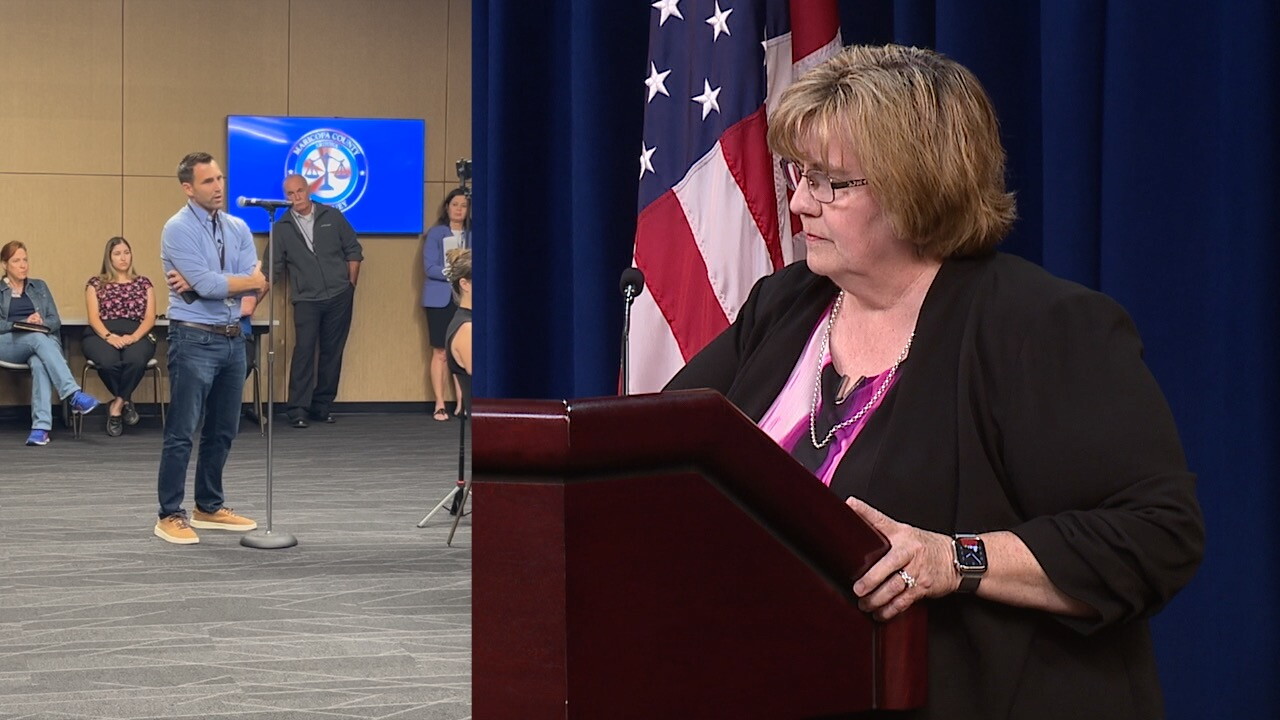
But ABC15 questioned Mitchell at a press briefing on August 27, 2026, and the exchange grew tense. She defended her office and called ABC15’s description of what happened a “gross exaggeration.”
WATCH: County Attorney answers questions from ABC15’s Chief Investigator
Mitchell said her primary concern is seating a fair and impartial jury.
During the Clifton trial, when Judge Edelstein issued an order directing MCAO to explain its use of the NCIC, prosecutors pushed back hard.
In their filed responses, MCAO wrote: "Yes, the State may obviously use the NCIC database to research jurors.” Prosecutors also added that it was “not an issue to be decided by this Court."
To highlight that it was not the court’s role to interject, MCAO cited a ruling from an out-of-state case that said, “[Courts] do not, or should not, sally forth each day looking for wrongs to right.”
Experts found MCAO’s response to be not only wrong, but scary.
"I know a lot of prosecutors, and I've talked to them across the spectrum too, that do think it's appropriate in certain circumstances," Mitchell said, when asked about experts’ concerns.
In a series of emailed statements, MCAO said it does not know how often it has used NCIC to investigate jurors.
“We keep no such tracking but are confident that this kind of review of jurors is rare and is done only with good cause appearing,” a spokesperson wrote.
Despite the office’s defense of prosecutors’ actions, MCAO said it is now considering whether to add a policy related to NCIC use and jurors.
The Court’s Inaction
Judge Edelstein, who presided over Clifton’s death penalty case, initially demanded to know whether MCAO's actions violated the law. But after receiving briefings from MCAO and defense attorneys, the court dropped the matter.
In a final ruling, the judge wrote: "If anything, post-briefing, the Court is left with more questions." But the judge concluded by stating, "no issue needs to be resolved at this time."
ABC15 requested interviews with Edelstein in addition to Maricopa County Superior Court Presiding Judge Pamela Gates and Criminal Presiding Judge Jennifer Green.
Through a spokesperson, all three declined.
In series of statements, court officials said ABC15’s reporting "raises important issues" and it will be part of an evaluation by the Jury Advisory Committee to determine if rules need to change.
Read the Court’s full responses to ABC15
The court also said juror qualification is their responsibility and stated they never asked prosecutors for help. But when ABC15 asked if the court has told MCAO to stop using the NCIC to investigate jurors, the court's written response was: "No."
So far, court officials have only confirmed they talked with MCAO leadership about the “tone” of their response to Judge Edelstein.
Karen Clark, a legal ethics attorney, said the court has a responsibility it has not yet met.
"The judges really aren't just a potted plant," Clark said.
"They're in there to ensure that justice is done." She added, "This is an issue of statewide importance. So, it seems like it should be something for the court to do."
Another juror ‘viciously’ outed by MCAO
This is not the first time MCAO has been accused of targeting jurors.
Attorney Tom Ryan represented a juror in a separate, earlier death penalty case.
That juror, whose name ABC15 is withholding to try to protect what remains of her privacy, refused to vote for capital punishment in a high-profile trial. During the stalled deliberations, the lead prosecutor leaked her name to a trial blogger he was having a sexual relationship with, according to a legal disciplinary complaint.
"When I say outed, I mean in the most vicious way,” Ryan said. “They outed her husband, their place of work, her children's school. They had taken pictures of her wedding and made them look bloody. There were death threats."
Then after the juror refused to vote for death, MCAO investigated her, Ryan said.
"They knock on her door, and they tell her we are here to investigate what you did in that trial," Ryan said. "My client called me hysterically. 'I thought this was over.'"
Arizona State Bar records show that the prosecutor was eventually disbarred, and the county attorney has since changed.
But Ryan said history should not be ignored.
When asked if he felt like MCAO had learned its lesson, Ryan responded, “No, I don’t. It looks like this problem is repeating itself.” He added, "Using FBI resources to investigate the background of a juror is way beyond what's needed. It's using a bazooka to shoot a gnat."
What needs to change?
Experts said the courts, the state bar, or both, need to act.
While both the Maricopa County Superior Court and Maricopa County Attorney’s Office said they are reviewing and considering policies, neither has finalized any changes and did not commit to any timeline.
"I do think there needs to be a clear ruling, hopefully by the Arizona Supreme Court," Hong said.
Euchner said something similar, "It's important for someone in authority, if not a court, for the state bar, to say that this is not allowed.”
Ryan agreed.
"We probably should look at developing rules to prevent this from happening at the state bar level," Ryan said.
But some experts said jurors themselves may be the most powerful force for change.
"Jurors should ask whether the government is investigating them," Cavedon said.
Snowden said that kind of pushback sends a message.
"If a juror is like, 'Hey, I don't want to be investigated,' that then signals a larger problem to the court that there is a policy and practice in place that is actually dissuading jurors from serving in our courtrooms," he said.
Barfield said she hopes her story prompts others to speak out.
"If nobody speaks up, then they're just going to keep doing it," she said.
This digital article was produced with the assistance of AI and based on broadcast reports written by ABC15 Chief Investigator Dave Biscobing (Dave@abc15.com).
