

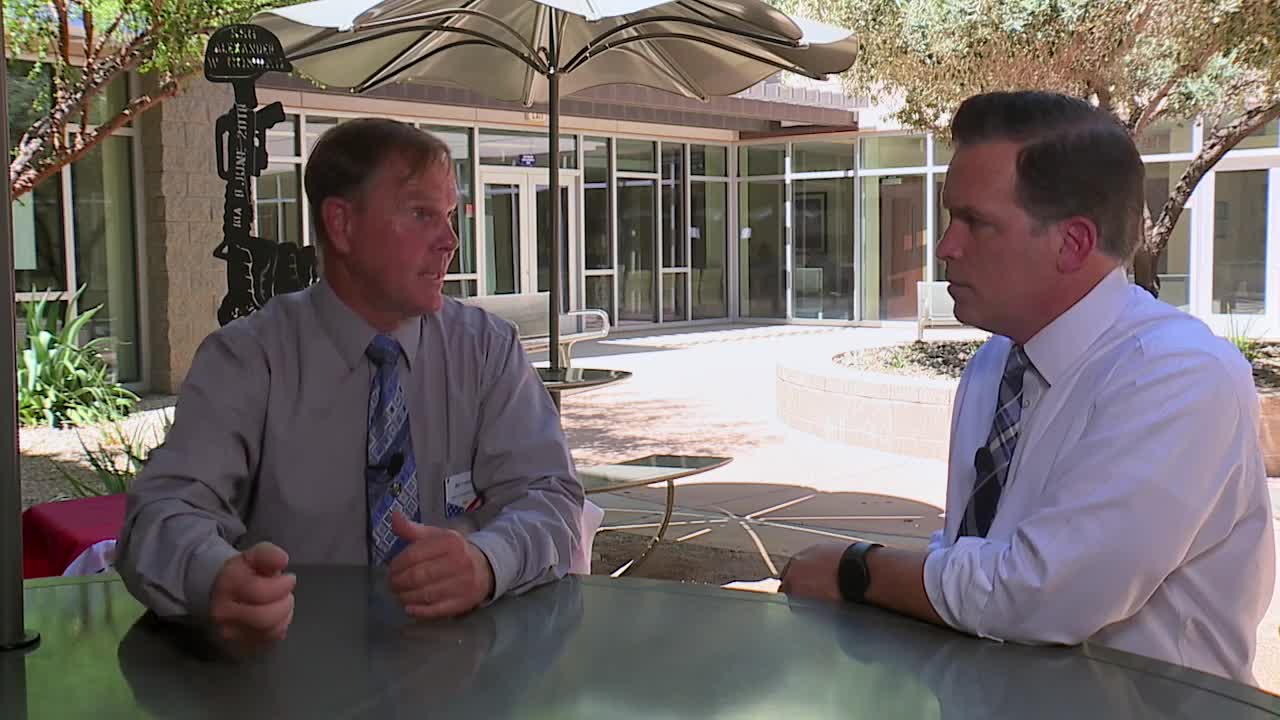


GILBERT, AZ — Roy Conrad remembers the last photograph he saw of his son alive.
Alex is smiling, wearing an Arizona State University baseball cap at a remote military outpost in Somalia.
“He’s as happy as can be,” Conrad said. “He’s doing everything that he wanted to be.”
Hours later, Alex would be dead. He was 25 years old.
The Army intelligence soldier had spent years serving in Afghanistan and Africa, eventually working alongside Special Forces teams fighting al-Shabab in Somalia. On the day he died, Roy Conrad said, Alex left his position of cover to protect a translator during a mortar attack.
For Conrad, that moment says something about his son’s character. But it also represents something much larger.
Alex was a second grader when the planes hit the World Trade Center on Sept. 11, 2001.
He was a teenager when he decided to join the Army.
And he was one of the thousands of Americans whose lives — and deaths — became part of the wars that followed.
Twenty-five years after the attacks, the anniversary ceremonies tied to the day have passed. For Gold Star families, the consequences of the war that followed never end.
On the morning of Sept. 11, 2001, Conrad was getting his sons ready for school at their home in Arizona when they watched the second plane hit the World Trade Center live on television.
“Actually, saw the second airplane hit the tower … it was really traumatic. But at that time, we really didn’t understand the scope of it,” said Conrad.
Roy Conrad could not have known that the events unfolding on television would eventually shape the life of his son so many years later.
Military service already had a place in the Conrad family.
Roy Conrad had served in the Army before becoming a Mesa police officer. His father and father-in-law had also served in the military.
“The Army was a big impact on me, and my dad was a soldier. My father-in-law was a soldier,” Conrad said. “I shared a lot of stories with both my boys about the military … there’s a bonding that is just so strong.”
By about age 16, Alex was looking toward the same path. He graduated high school early and enlisted in the Army in 2008. The boy who had watched the second plane hit the tower was now part of the generation sent into the wars that followed.
Alex joined the Army as an intelligence soldier, a role his father initially found somewhat reassuring.
“I didn’t fear him getting into some harm’s way more so than I feared him not doing what he wanted to do,” Conrad said.
That changed during Alex’s first deployment to Afghanistan.
His team leader was killed during the tour. Alex was supposed to return home but instead asked to stay and help complete the mission.
“They were going to send him home when the team leader was killed,” Conrad said. “He ran up to his CO and said, ‘If I take leadership with the team, will you allow us to finish our mission here?’”
Commanders agreed.
Alex was promoted to corporal and assumed responsibilities normally handled by a much more senior non-commissioned officer.
Alex eventually deployed to Afghanistan a second time before seeking more challenging assignments.
He went to airborne school, learned French at the Defense Language Institute and joined the Army’s 3rd Special Forces Group. His work eventually took him to Niger and Somalia, where he worked with Special Forces teams fighting al-Shabab.
In southern Somalia, Conrad said, Alex helped map the group’s leadership and advise missions.
American and partner forces had repeatedly pushed militants from areas only to see them return after forces withdrew.
Alex helped arrange meetings with a regional governor as officials considered establishing a more permanent presence.
The result was a small outpost near al-Shabab’s base of power in the Lower Juba region.
“Once they created the outpost … al-Shabab said, ‘We can’t allow this here,’ and so they attacked it every day,” Conrad said.
Then came the day that changed the Conrad family forever.
The attack began with mortar fire.
Alex was in a covered position with a translator when, according to the account Conrad received, the translator ran.
Alex followed.
“He gave up his place of cover for that translator,” Conrad said.
Alex moved to another position.
A mortar struck him.
Several others on the team were also injured.
For Conrad, the way his son died is inseparable from the way he lived.
The family learned of the attack through television reports.
Conrad was camping near Flagstaff when his daughter, working in San Diego, saw a CNN bulletin reporting one soldier killed and several wounded.
They hoped Alex would be among the wounded.
“We kept our fingers crossed that, well, maybe he was one of the ones that was … just injured and not,” Conrad said.
Alex’s younger brother, Jacob, who had recently left the Army, contacted former colleagues in Washington, D.C., and learned officials were trying to locate the family.
Neighbors back home told Conrad they had seen soldiers parked outside his house.
Eventually, casualty officers met Conrad and his ex-wife at her home in Flagstaff.
“It wasn’t a total surprise, but we were hoping for the best,” he said. “But then we kind of got the worst.”
That is why Conrad sees the anniversary differently.
He sees more than the planes, the towers and the first responders.
He sees what happened afterward.
“It’s not just one day,” he said. “It’s generations. Some of these guys ran in right after 9/11 and they’re just now retiring. Their entire career has been 9/11.”
Conrad remains connected to the special operations community, returning for ceremonies and memorials and spending time with other families of the fallen.
As a retired police officer, he also feels the loss of first responders killed in the line of duty, including former colleagues whose names he now sees on memorial banners.
He participates in runs, rides and remembrance events across the country — not only for Alex, but for others whose stories he fears could eventually be forgotten.
“I’ve been extremely supported all the way through, and I want to pass it on forward,” he said.
He wants Americans to remember not only that people died in the wars launched after 9/11, but who they were when they died.
“Their fallen member, their loved one is not a loss. They were doing things that they loved.”
The attacks happened on one day.
The wars that followed lasted years.
For families like the Conrads, the consequences are measured in decades.
And 25 years later, the stories of those who carried that burden are still being written.
“The war on terror is not over with. You know, we're starting another generation,” Conrad said. “We don’t want anybody to be forgotten, they’re all important, and they all have somebody behind that needs to be taken care of.”
Roy Conrad is taking part in the Phoenix 9/11 Heroes Run at Mountain America Stadium on September 19th. You can visit the Travis Manion Foundation website for registration information.

