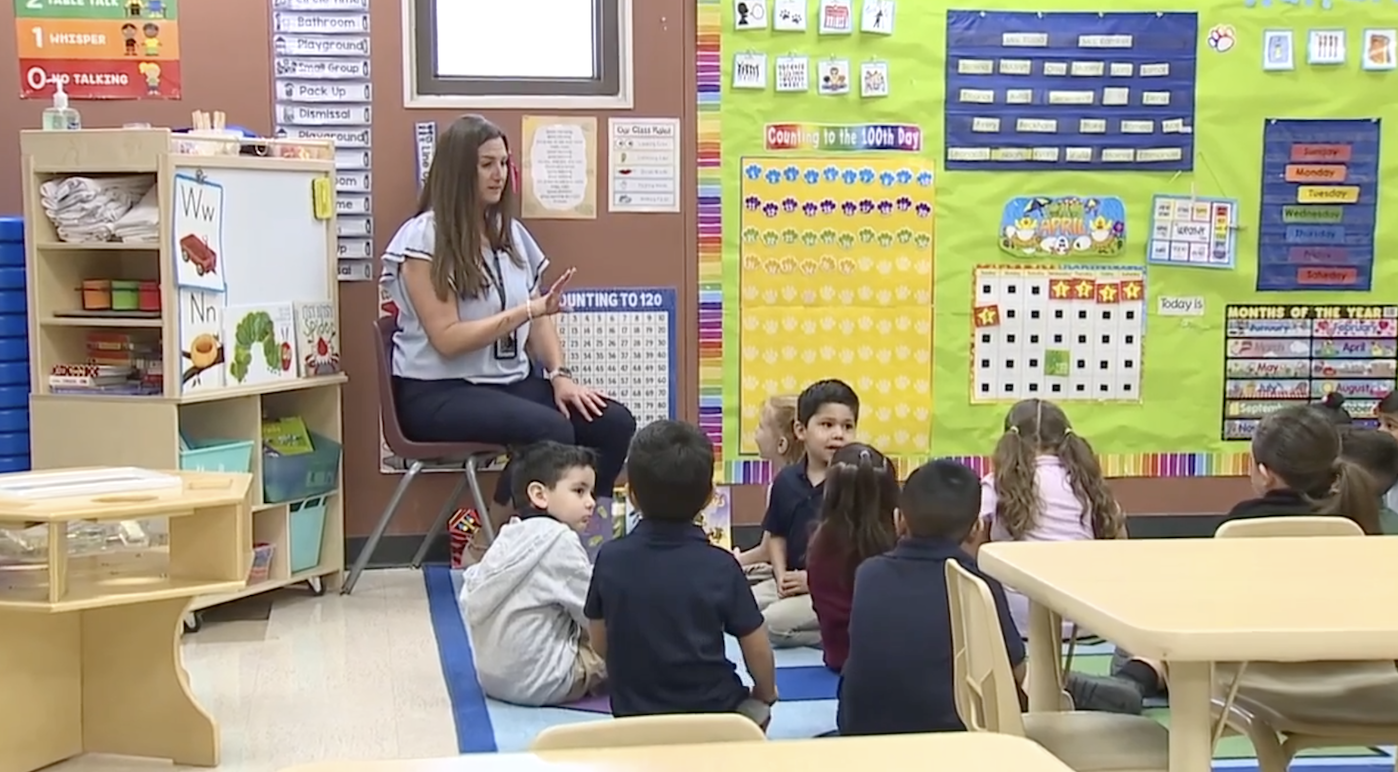


Research shows preschool gives children an early start that carries them through their K-12 education. That’s why Areanna Lozano enrolled her daughter, and she said it’s made a difference.
“We have seen significant improvements with her speech, her social skills and her academics,“ Lozano told ABC15.
Lozano’s daughter was able to go to preschool thanks to the Preschool Development Grant (PDG) the Avondale Elementary School District received over the years.
“We do not get paid well,” she said, also previously working in education. “Finding the funds to be able to support her in preschool was very hard. Without the grant, I don’t think it would be a possibility,” Lozano said.
The first round of funding reached more than 30 organizations, including school districts, distributing more than $22 million statewide, according to the Arizona Department of Education.
First Things First, Arizona’s childhood agency, said the federal dollars were meant to help improve preschool attendance rates for kids across the country. For families like Lozano’s, it meant preschool at no cost.
"We were fortunate to be able to serve about 40 students through the PDG. That, over a series of years, allowed us to reach the kids that would not have been able to pay the tuition to be in our preschool program," Avondale Elementary School District Superintendent Eric Dueppen said.
That grant, however, expired in December. Dueppen said the district found a way to bridge the gap to keep those families supported through the end of the school year, but it will end as the academic year winds down.
“So, there wouldn’t be a disruption," Dueppen added.
Preschool costs can be high for some families. Depending on the programs, from half week to full week, school districts provided costs to ABC15 that ranged from several hundred dollars up to $800 a month.
The cost can be an issue preventing parents from enrolling their students into preschool. According to Angela Rabago, with First Things First, preschool enrollment is not where they want it to be.
"We are only serving a fraction of the kids who need preschool services. Nationally, when you look at where Arizona ranks, we’re way down,” Rabago said.
Arizona ranks near the bottom nationally for preschool enrollment, and the state meets only three of 10 quality benchmarks for public programs, raising questions about the lasting benefits for students.
About 38% of children ages 3 and 4 in Arizona are enrolled in some form of preschool, according to the U.S. Census Bureau. That share has fluctuated over the past 10 years, especially during the pandemic, but it is not trending in any meaningful way in either direction.
Of those Arizona children in preschool, 57% are in a public school program. However, Arizona does not broadly fund pre-K. The exception is Head Start, a federal program serving low-income families.
Despite the cost, some school districts still have waitlists for preschool. Dueppen said they had at most 90 students on the waitlist this year. The Glendale Elementary School District said it had 30 students on a waitlist; those students waiting are asking for scholarships. Chandler Unified said it had almost 70 students on a waitlist as well, and a majority of them were Title I families.
"The need for early childhood education is substantial," Dueppen said.
While the first iteration of the Preschool Development Grant ended, the federal government awarded Arizona another version of the grant for $8.4 million. However, the grant is different this time around. The money isn’t going to individual preschool sites this time. Instead, it went to organizations to strengthen early childhood education programs statewide.
As school districts have opened enrollment for preschool for the next year, families can check with their districts to see if they have any funding opportunities.
Head Start is also a program families can check out if they meet the poverty guideline requirements.
Want more news in your community? Add ABC15 as a preferred source on Google below: