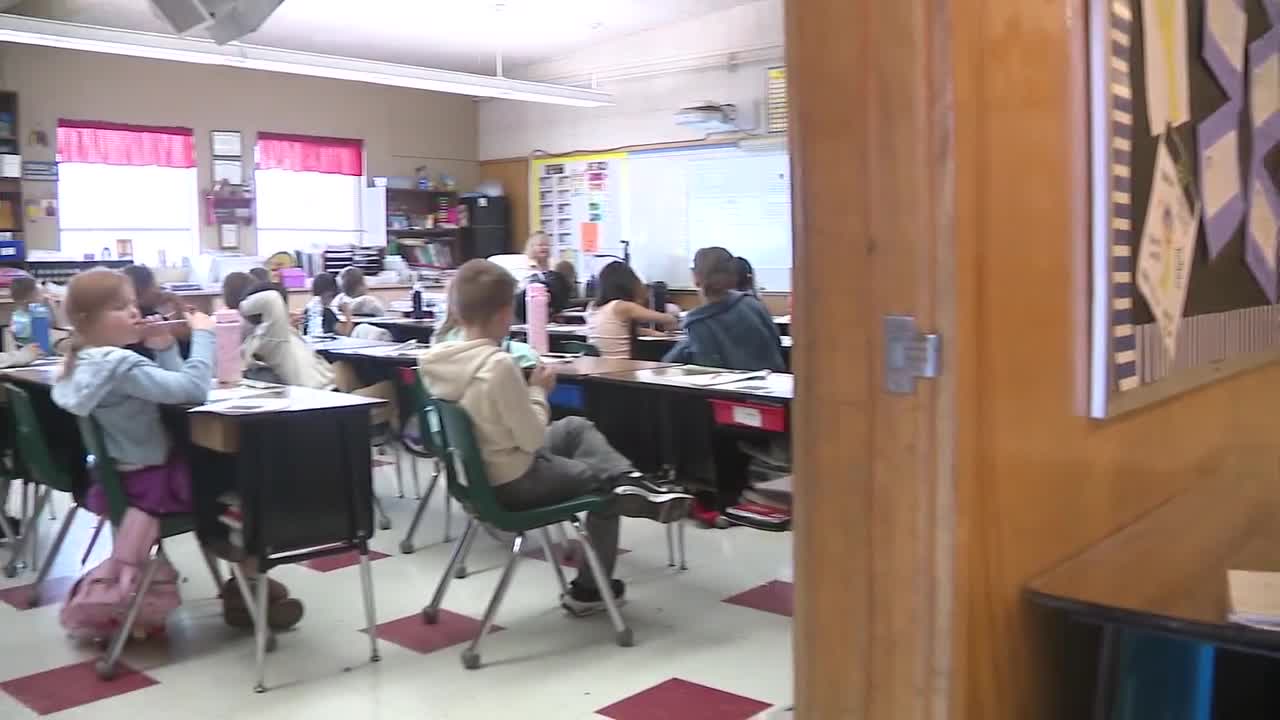


Several Valley school districts are in the process of possibly closing school campuses.
As that happens, ABC15 looked into the process of what it would take to unify or merge school districts, as the state has 236 traditional school districts, according to the Arizona Department of Education.
Scottsdale Unified, Kyrene Elementary School District, and Gilbert Public Schools are the three districts discussing the potential closure of schools at the end of this academic year. Several others have closed multiple schools in the past few years, all citing declining enrollment and a lower budget due to that.
“The question about school consolidation comes up in a different context. Currently, in Arizona, it’s because of declining public school enrollment, in some cases. Although that’s happened without school consolidation in the past,” said Sherman Dorn, an Arizona State University professor and historian of education.
Dorn said that though Arizona now has more than 200 traditional school districts, this is lower than in the past. It’s unclear why there are so many districts; however, some reports say it was to accommodate growth back in the day.
Over the years, some districts have merged or unified. Arizona has different types of traditional public school districts — there are elementary school districts that serve kids from kindergarten through 8th grade, high school districts that have 9th through 12th graders, unified school districts and then some accommodation districts.
In Phoenix, there are several elementary school districts next to each other, some of which have 5,000 students or fewer.
“Usually, it's rural school districts where declining enrollment pushes either local communities to decide to explore mergers or state legislatures to say, ‘Hey, why are we having all these small districts?” Dorn said.
There have been pushes in the past by the legislature to merge or unify school districts; however, those measures have failed.
“It’s difficult. It’s controversial because a lot of communities have an investment in having a specific district,” Dorn said.
Superintendent Tom Horne says he supports school district unification.
“There are efficiencies of size. If you don't have an efficient operation, you can’t pay your teachers properly. If you can’t pay your teachers properly, you can’t get the teachers you need and the kids will suffer,” Horne said, adding that smaller districts may not operate as efficiently as larger districts.
A better education is one reason why some districts have unified in the past, wanting to ensure a smooth transition for students from grade to grade.
"To have that interruption in the middle to me would be unnecessary,” said Gretchen Dorner, the superintendent of the Kingman Unified School District.
According to some education experts ABC15 spoke with, the last time, to their knowledge, that school districts merged was in 2001. That’s when the Kingman Elementary School District and Mohave Union High School District came together.
In 2001, Dorner was a 6th grade teacher in the elementary school district.
“The transition was so smooth, the two governing boards and the two districts handled it so well that it felt like a blip on the radar for us as teachers,” she said.
It was a process, though. Each district has its own governing board and a way it operates things, from textbooks to software, salary schedules and more.
“For the elementary teachers, though, there was little benefit. The high school district paid a little bit higher than the elementary district did,” Dorner said.
Dave Wells, the research director for the Grand Canyon Institute, said merging or unifying schools isn’t a simple process, and that there would be initial higher costs to make it happen.
However, Wells said there may be benefits for some districts to merge, saying that there could be some cost savings eventually.
“If you’re in the City of Phoenix, if you have a small district, you do have the ability to pull those districts together and possibly create a better return on the dollar,” Wells said.
Betsy Parker, the former superintendent of the former Kingman Elementary School District, said their transition and process went smoothly as school leaders in both districts agreed to become one. Several other rural districts also ended up merging into Kingman Unified, too.
“It was so interesting because to all of us, it felt like a blinding flash of the obvious. Our district offices were five miles away from each other, we had staff that was replicated, we had two bus barns,” Parker recalled.
For districts to unify now, though, the Arizona School Boards Association said it requires voters in those districts to approve it in an election.
“That’s something that ought to be encouraged for districts to think about, but you shouldn’t force it down their throats. It’s something communities have to buy in and have a timetable to think about that,” Wells said.
Want more news in your community? Add ABC15 as a preferred source on Google below: