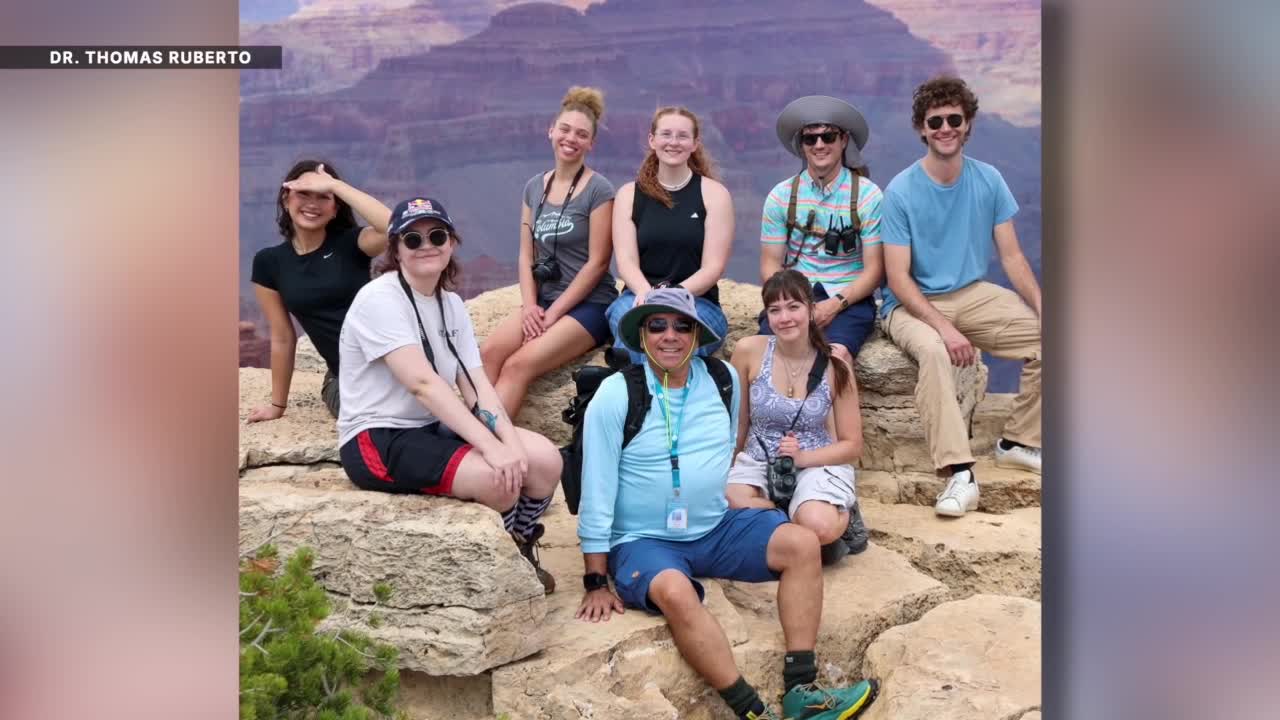


CHANDLER, Ariz. (KNXV) -- A group of Chandler-Gilbert Community College students traveled to the Grand Canyon to study how the landscape has changed over billions of years. One day later, they watched from afar as flash flooding reshaped parts of the canyon in a matter of minutes.
Dr. Tom Ruberto, lead geoscience faculty at Chandler-Gilbert Community College, took seven students to the South Rim on Friday as part of the Ruberto Geoscience Research Lab.
The group was scouting locations for an upcoming project along the Trail of Time, a geologic exhibit that allows visitors to walk through the history of the Grand Canyon's rocks.
Ruberto said the group spent much of Friday looking at the canyon's vistas while staying ahead of thunderstorms.
Through binoculars, the students could see the Colorado River and a footbridge near Phantom Ranch.
"A number of students commented on how peaceful the Colorado looked and how could something that peaceful do all of that carving," Ruberto said.
Less than a day later, conditions inside the canyon changed dramatically.
Heavy rain Saturday triggered flash flooding in Bright Angel Canyon, damaging infrastructure and prompting evacuations from the canyon.
Ruberto said the contrast was striking for students who had just spent the previous day studying geological processes across immense periods of time.
"On Friday, we're looking at changes in millions and billions of years, and on Saturday we're witnessing changes that are happening on the time scale of 30 to 60 minutes," Ruberto said.
Ruberto said the Dragon Bravo Fire burn scar played an important role in how the landscape responded to the rain.
Wildfires can remove vegetation and other material that normally helps slow and absorb rainfall. Ruberto said burned areas can also develop soil conditions that make it more difficult for water to soak into the ground.
"What once could absorb water no longer can," Ruberto said. "It's just that the land had changed because of that fire."
With less water soaking into the ground, Ruberto said runoff can move rapidly downhill. Bright Angel Canyon's narrow geography can further concentrate that water rather than allowing it to spread across a wide floodplain.
For the students who had been there just hours earlier, seeing the aftermath brought what they study into focus.
Ashlee Lane, a second-year student at Chandler-Gilbert Community College, said the group captured images of the canyon before the flooding.
"It's definitely surreal how much everything can change in the canyon," Lane said. "In geology, you basically learn how erosion and moving sediments can change everything so quickly."
Junior geography student Abigail Huish said the experience reinforced her interest in studying environmental and geological change.
"It's what brings me or drives me to really study environmental change, climate change, all of these different geological processes," Huish said.
For Ruberto, the events demonstrated why studying those processes matters beyond the classroom.
"We want to understand the Earth's processes," Ruberto said. "We want to protect people, and to do that, we need to understand these processes."
For a group that traveled to the Grand Canyon to study changes measured across billions of years, the weekend provided an unexpected lesson in how quickly the landscape can change.

Do you have a concern in your community or a news tip? We want to hear from you!
Connect with us: share@abc15.com
Want more news in your community? Add ABC15 as a preferred source on Google below: