

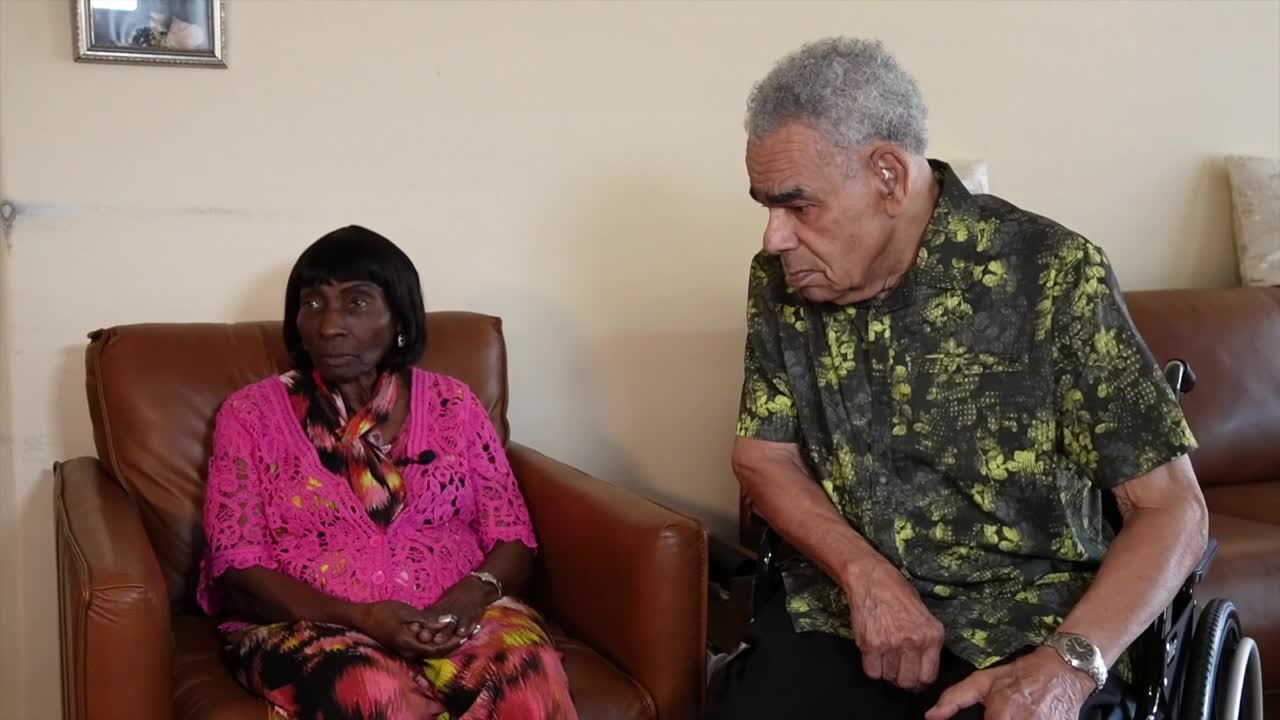


When Magnolia Smith first noticed something was off with her husband’s walk, it sounded small — a subtle change in the way his foot hit the hallway floor.
“He came down the hallway like on his toe, and I said, ‘James, why are you doing that?’” Magnolia recalled. “He said, ‘I’m not doing anything.’ I said, ‘Yes, you are.’”
That quiet moment inside their home eventually led to a life-changing diagnosis for James Smith, a U.S. Army veteran and former artilleryman. In 2019, after Magnolia insisted he be evaluated at the Department of Veterans Affairs, doctors delivered the news: James had Parkinson’s disease.
“It hit hard,” Magnolia said. “It hit hard till he cried.”
Over the next several years, Parkinson’s slowly stole James’ mobility. A walking cane and upright devices were unsafe — he would push them too fast and fall. Eventually, a wheelchair, provided through the VA, became his only safe option.
But as James’ condition progressed, the weight of that diagnosis didn’t fall on him alone. It landed squarely on Magnolia.
Magnolia is clear about what the disease has meant inside their home. Lifting James in and out of bed. Helping him to the bathroom. Trying to navigate a bathtub he can no longer safely step into.
“With that Parkinson, it makes his lower back hurt,” she said. “We can’t do that anymore. Only a shower now. A walk-in tub he could use… but stepping over like that is hard for him.”
Physically, it was more than she could handle alone.
Like many spouses of aging veterans, Magnolia slid into the role of full-time caregiver long before she asked for help. She managed James’ appointments. She pushed him to keep going back to the VA, even when he doubted whether they would do anything for him.
“He said, ‘Oh, they’re not going to do anything,’” Magnolia said. “I said, ‘Yes, they are.’ I kept going, and I kept going. They sent me letters, they wrote me, I took the appointments, and I kept taking him.”
The turning point came when Magnolia told the VA she could not carry the burden alone anymore.
Through the VA, Magnolia was connected to Seniors Helping Seniors East Valley, a caregiving agency that contracts with the department to provide in-home support for veterans.
The relief was immediate — even before anyone rang the doorbell.
“I exhaled on the phone,” she said. “They told me they were going to give me somebody, and that relieved some of the stress. It went right down through my body.”
The woman who showed up — Estelita, whom James affectionately calls “Contessa” — has now been with the couple for three years.
“When I come to work, I don’t feel like going to work,” Estelita said. “I feel like I’m a family here.”
She helps James with daily activities, offers emotional support and, critically, gives Magnolia space to rest.
“I feel like I am doing something for the veterans,” Estelita said. “Not just saying thank you for your service, but doing physical care and emotional support that they need.”
Behind that support is a deliberate strategy, say co-owners Sandy Dyk and Kerri Ann Ronquist, who run Seniors Helping Seniors East Valley.
Both have spent decades in senior care. When they took over the East Valley franchise a little more than a year ago, it already had a contract with the VA and a small base of clients. They say their immediate focus was on veterans — a group they describe as “underserved” and often overwhelmed.
“There’s so much information,” Dyk said. “I’m surprised to this day how much our veterans still are unaware of what they can receive.”
For many older veterans, just going online, finding forms, printing, filling them out and scanning them back can be a barrier. For others, physically getting to the VA for appointments — especially on a “bad” day — feels impossible.
“We can help our veterans and loved ones fill out the paperwork, get a copy of the DD-214, even go to the eligibility office,” Dyk said. “Prior to that, trying to have a veteran who is physically disabled do all of that can be overwhelming.”
The VA offers three main types of in-home support through agencies like theirs: home health aide hours for hands-on care such as bathing and dressing; homemaker hours for light housekeeping, meal prep and transportation; and respite hours, which allow family caregivers to take a break while someone qualified stays with their loved one.
In James’ case, the agency provides hands-on care, homemaker support for Magnolia and respite hours that let her step out of the house, even if only for a few hours at a time.
“Caregiver breakdown is real,” Ronquist said. “We’ve seen it so many times where the caregiver will pass before the one they’re caring for, because they really are engaged 24/7.”
To prevent that, the agency tries to keep care teams small and consistent, especially for veterans with many authorized hours.
“It’s an invasion in many ways until they get to know each other,” Ronquist said. “They deserve to build that relationship. Plus, [the spouse] doesn’t have to explain to a new caregiver all the time what he likes and doesn’t like. It just becomes part of the family.”
In the Smith household, that consistency has changed the rhythm of daily life. James remains at home, surrounded by family photos and a memory book filled with pictures celebrating Army days, his work life and a recent birthday party where a dozen local veterans rode in on motorcycles, flags flying, to honor him.
“It was flabbergasting,” Magnolia said, flipping through the album. “They gave me all joy… It was just beautiful.”
She calls the caregivers “family.” She calls the VA workers who helped connect her to them “a 10 out of 10.”
And she has a message for other spouses of veterans who feel buried under the weight of caregiving and don’t know such help exists.
“I just tell the ladies, stick with your husband,” Magnolia said. “Call the VA. Talk with the main person. Tell them you need help.”
“Don’t stop,” she added. “Keep going, keep talking to them, keep pushing for your husband. They did their job for the United States of America, so they need to do the job for us to carry you all on.”
For Magnolia, that means honoring the vows she spoke on her wedding day in 2013 — “to love and to cherish, till death do us part” — and having the support to keep James at home, where he wants to be.
“No man likes to leave home,” she said softly. “It means a lot to me that he can stay here. I can rest a while when he takes a nap. And he loves it.”
You can find out what caretaker benefits are available by visiting VA.gov.

