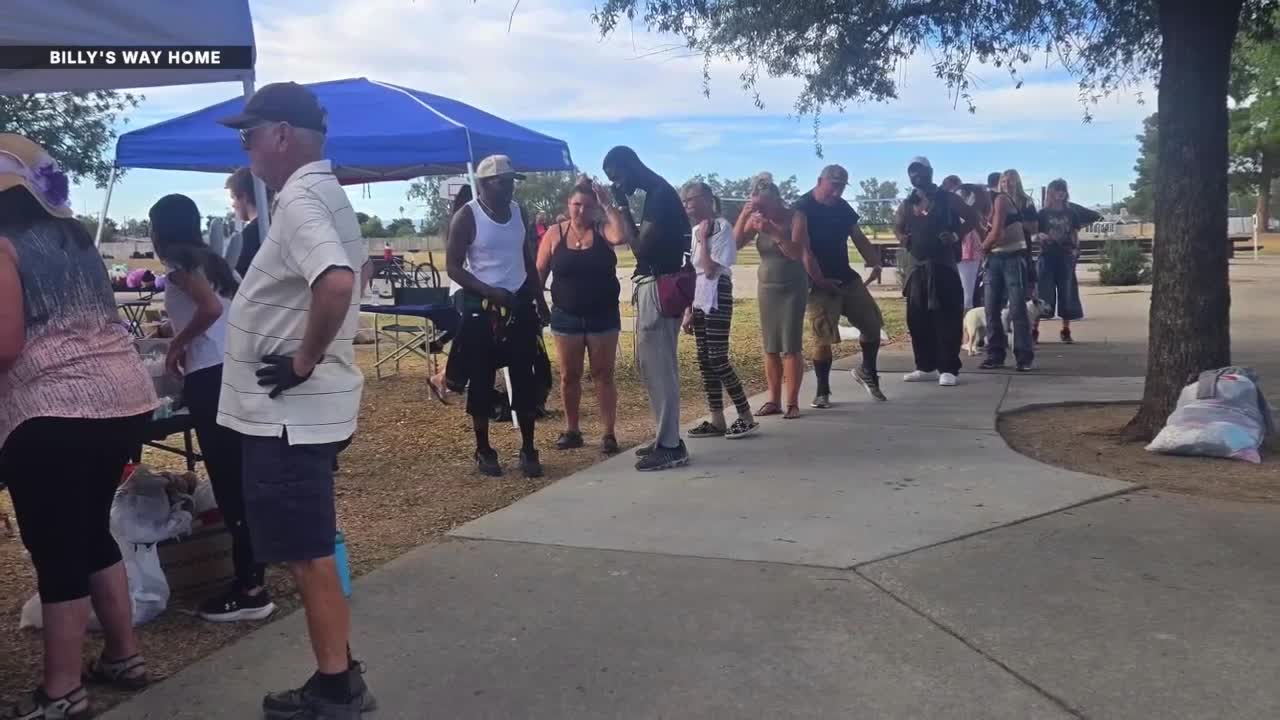


PHOENIX — A revised draft ordinance in Phoenix would limit food distribution and medical care in city parks, sparking concerns from nonprofits that provide services to the unhoused.
The new proposal would restrict these activities to two permits per calendar month for each city park. The permits would cover either a major food distribution event or medical services, and organizations would have to file for them in advance.
According to the draft text, a food distribution event is defined as a gathering for charitable or humanitarian purposes to distribute food to the general public. It excludes private events like family gatherings or picnics.
Medical treatment is defined as any act involving needles, syringes, medical sharps, or producing medical waste, including bandages and dressings.
You can read the full draft here.
Under the proposed rules, permitted medical treatments must take place on park hardscapes or parking lots, rather than sports courts or designated picnic areas. Providers must also use an enclosure, such as a medical tent with a roof and impermeable floor or a mobile medical vehicle, to ensure patient privacy and contain waste. Permittees must also agree to provide adequate indemnification and insurance.
The update follows an initial eight-to-one vote by the Phoenix City Council in December to approve an ordinance titled "Safe Medical Treatment in Parks.”
That measure made it a Class 1 misdemeanor for any person, group, or organization to provide unauthorized medical treatment to the public in a park.
The measure specifically prohibits needle exchanges and the distribution of harm reduction kits. Exceptions are included for first responders, people rendering emergency aid, family members helping family, and the distribution of intra-nasal naloxone.
Councilmember Anna Hernandez, who represents District 7, cast the lone dissenting vote against the ordinance in December and said she is hesitant to support the revised draft.
"I still have a lot of concerns," Hernandez said. "There's not enough changes that have moved me to believe that this is the answer that we need to resolve the issue."
"Where we are truly going to solve this issue is when we have enough permanent housing, enough transitional housing, enough shelter beds for every single of our residents that is out there struggling," Hernandez said.
Licensed healthcare organizations that provide mobile medical treatment argue the ban will punish groups doing vital work and increase demand on city 911 and EMS services. Circle the City, which provides street medicine services, reports there were more emergency calls, hospitalizations, and deaths before their team began meeting people where they are.
Dr. Kim Despres, CEO of Circle the City, said the changes would severely impact their mobile medicine teams, which administer care and IVs to dehydrated individuals during extreme heat.

Do you have a concern in your community or a news tip? We want to hear from you!
Connect with us: share@abc15.com
"I thought that considering all the stakeholder meetings we had and, and the work that we've done, um, that we would have come further than we did," Despres said. "We'll go to a park, care for whoever's there, we'll pack up and go to the next park and the next park, because you can't predict where people are going to be and how sick they're going to be.”
She told ABC15 the permitting process requires planning months in advance.
"So we would have to predict four months in advance when, what park would have the most need on what specific day. Now, it's impossible to predict," Despres said. "We're in competition with the organizations that provide food services to the unhoused in the parks."
Despres suggested allowing licensed healthcare professionals to register with the city instead of using the proposed permit system.
"As a licensed healthcare professional, give us the ability to go from park to park, even if they allowed us one day a week, to go to different parks or two days a week with our mobile unit, that would be much better than what it is now," Despres said.
Council members who support the ordinance maintain it is a public safety issue, aiming to make parks safer for families after community members reported finding needles and seeing drug use. The draft ordinance notes that large service events can strain city resources, create noise, obstruct public spaces, and lead to the accumulation of trash and food waste.
Councilmember Ann O'Brien sent a statement to ABC15 this week supporting the proposal as a way to coordinate services safely.
"I appreciate the dedication of those serving our most vulnerable neighbors, and this proposal is designed to enable that work to continue in a safe and coordinated manner," O'Brien said. "The Parks Department has developed a comprehensive approach to both medical treatment and food distribution in our parks. The goal is to establish clear processes so these activities can happen with appropriate safety, sanitation, and coordination with City resources.
I encourage people to visit www.phoenix.gov/parksordinance. The extensive resource page includes proposed ordinance language, background information, upcoming community meetings, and a survey to receive public input.
I remain committed to keeping our parks safe, accessible, and welcoming for all residents while ensuring services for vulnerable populations can be provided appropriately and effectively."
The Phoenix City Council will vote on a final version of the ordinance on May 6.
This story was reported on-air by a journalist and has been converted to this platform with the assistance of AI. Our editorial team verifies all reporting on all platforms for fairness and accuracy.
Want more news in your community? Add ABC15 as a preferred source on Google below: