



MESA, AZ — Navy veteran Nicole Pogue remembers the moment she realized no one was coming to save her.
It came after multiple suicide attempts, years of addiction, and a military career cut short by sexual assault.
When she finally began to claw her way back, she says she made herself a promise: Other veterans would not have to fight that battle alone.
“I saw my need that didn’t get filled,” Pogue said. “I built this place to get the person everything they need when they need it most, when they think there’s no one there.”
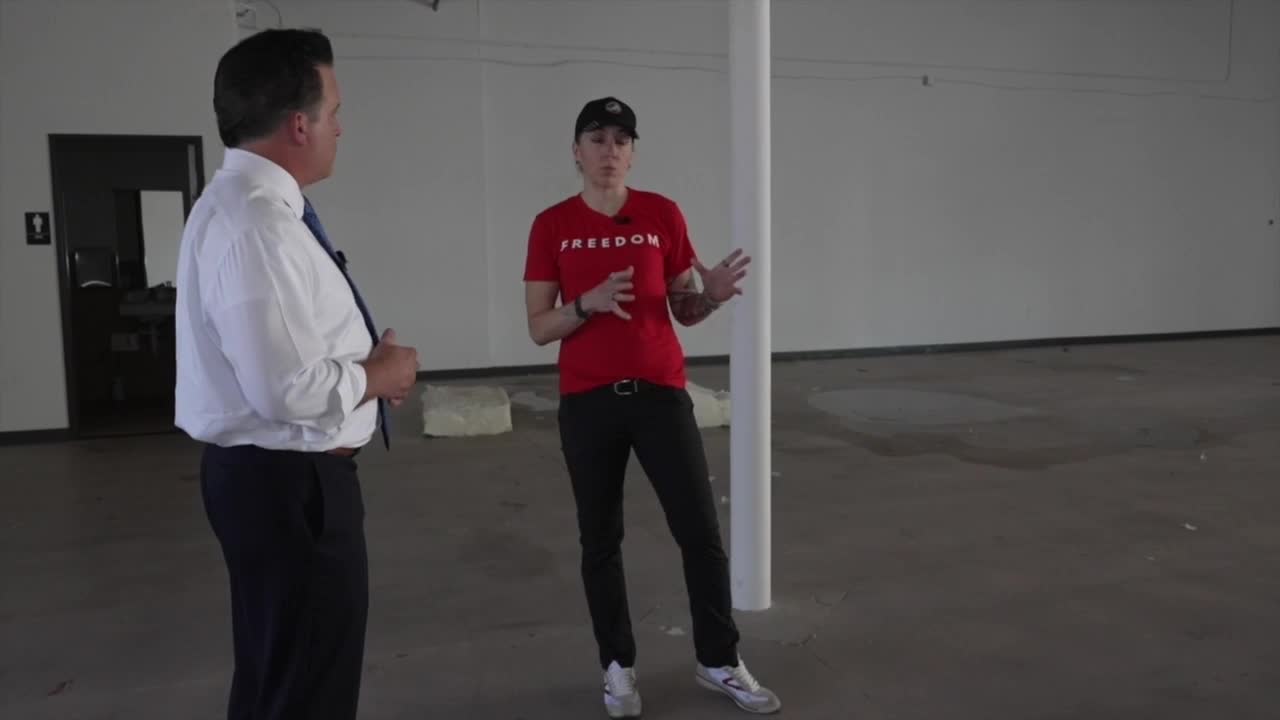
That vision is taking shape in a bare concrete space off West Main Street in Mesa.
The unfinished building will soon become the new and improved Arizona Veterans Resource Center, a one-stop facility Pogue founded to connect veterans with mental health care, benefits, housing, employment and a sense of community — especially during the late-night hours when help is often hardest to find.
Pogue, who introduces herself as the founder and CEO of the center, said the most dangerous time for veterans in crisis is “after dinner until dawn,” when offices are closed, phone trees lead to nowhere, and untrained responders can unintentionally turn a crisis call into something more serious.
“Who are you going to call? Who’s going to pick up the phone?” she said. “If they’re not trauma-informed, they can make it worse.”
Her approach is rooted in her own experience of what can go wrong when systems fail.
Pogue joined the Navy after the Sept. 11 attacks, following a family tradition of military service that included her father, grandfather, and several uncles. She served aboard the USS Mount Whitney, earning her surface warfare qualification early and later training as an aviation mechanic.
“I fell in love with all of it. I was squared away and I thought it was amazing,” she said.
Mentors pushed her toward officer candidate school. A command master chief gave her his anchors at his retirement ceremony, a rare honor that signaled she had a future as a leader.
“That was my trajectory,” she said. “I had this whole path laid out.”
Then, she said, she was drugged and sexually assaulted by fellow sailors.
What followed, she said, was not accountability, but isolation.
“You’re walking through the hangar with this red scarlet letter on you,” Pogue said. “The men aren’t being charged, so you’re walking around feeling like a whore, like you did something wrong when you were drugged and assaulted.”
She said there was no trauma-informed care, no peers stepping up, and little willingness from her command to move her out of a hostile environment.
The culture, she recalls, was quiet and judgmental, not protective.
“Everyone just got really quiet,” she said. “You just kind of fall from grace.”
Pogue completed her four-year enlistment and got out, then spiraled.
She describes a decade-long collapse involving addiction, traumatic brain injuries, three suicide attempts, and the loss of close relationships before she finally entered sustained recovery.
That personal history now shapes nearly every decision she makes at the Arizona Veterans Resource Center.
Pogue said the center is designed first and foremost around trauma-informed care — beginning the moment a veteran walks through the door.
Everything from lighting and sound to layout is being planned to calm an overactive nervous system, not trigger it.
“The vision is the nervous system regulation approach,” she said. “When they walk in, it’s got all of the elements to calm the nervous system for them to immediately feel safe, as if you’re walking into a forest.”
There will be no blaring televisions or aggressive conversations in the main intake area. Veterans will be asked to lock up their weapons.
Loud political arguments and venting about other agencies — including the Department of Veterans Affairs — will be redirected to separate spaces to keep the entryway from feeling volatile.
“We’re in here to help each other,” Pogue said. “What if [the VA] works for them? Let’s not turn them away from something that could help.”
The build-out plans include an intake and case management area, a conference room that can host intensive outpatient programs, a full kitchen and event space called the Defenders Den, a podcast and media space shared with other veteran groups, an open computer lab, quiet rooms for testing or interviews, a dedicated women’s support center, and a small child care room so kids aren’t running through case management meetings.
“It’s all going to be glass, but with that frosted look,” she said while walking through the unfinished space. “We want veterans to walk in with 10 different things and leave with eight of them completed, not just a stack of business cards.”
That idea — getting veterans connected to multiple resources under one roof — is central to Pogue's vision.
She envisions the center as a true resource hub, not just for her own organization, but for the more than 4,000 veteran-serving nonprofits she says exist across Arizona, many operating without permanent space.
Flex offices will be open to partners such as the Arizona Department of Veterans’ Services, Disabled American Veterans and workforce groups like Arizona at Work and Goodwill.
A top-performing Wounded Warrior Project veterans service officer, Darrell Mandrell, is embedded in the center to help navigate complex disability claims.
Pogue said her uncle, a Vietnam veteran exposed to Agent Orange, is still fighting for benefits, illustrating how confusing the system can be.
“The VA system is so convoluted,” she said. “You’d think it would be systemic, but it’s not. Each state runs things differently, and the veteran doesn’t know that.”
The center’s model, she said, focuses on accountability and sustainability.
Veterans can receive help with claims, housing, employment, financial literacy and mental health referrals — but they are also pushed to participate in their own recovery.
“It’s like, yes, you’re not responsible for what happened to you, but you’re responsible for how you take care of yourself now,” she said. “I can’t give you more energy if you’re not willing to put it in.”
One way she keeps people engaged is by inviting them to then help the next veteran after they stabilize — returning to guide others through the same maze they once faced.
“Once you get through the program and you feel great, how do you keep this?” she said. “You keep it by becoming the ambassador.”
And Pogue said she is already seeing what that can look like.
Recently, she said, a 24-year-old Navy veteran walked into the center just six months after leaving service, referred by Veterans Court.
He thought he was there for a gas card and a cell phone.
“I was like, ‘Man, I was you,’” Pogue said.
She shared her story, laid out a plan with timelines, handed him a bus pass and a new phone, and promised to walk with him “every step of the way.”
“When he left, he had a little skip in his step,” she said. “He marked the exact reason why this is built — someone grabbed him six months out before he lost everything.”
Pogue, who recently bought her first home, admits she is still learning how to live in stability herself.
But in the stripped-down rooms she is turning into the Arizona Veterans Resource Center, she sees the same kind of rebuilding happening for others.
“Today you’re alive, and you have a chance today to rebuild your life,” she said.
“My motto is reconnect, rebuild, and rise. Reconnect with yourself and your community, rebuild it, rise up — and then help others do the same.”
You can find out more about the organization by visiting their website.

