

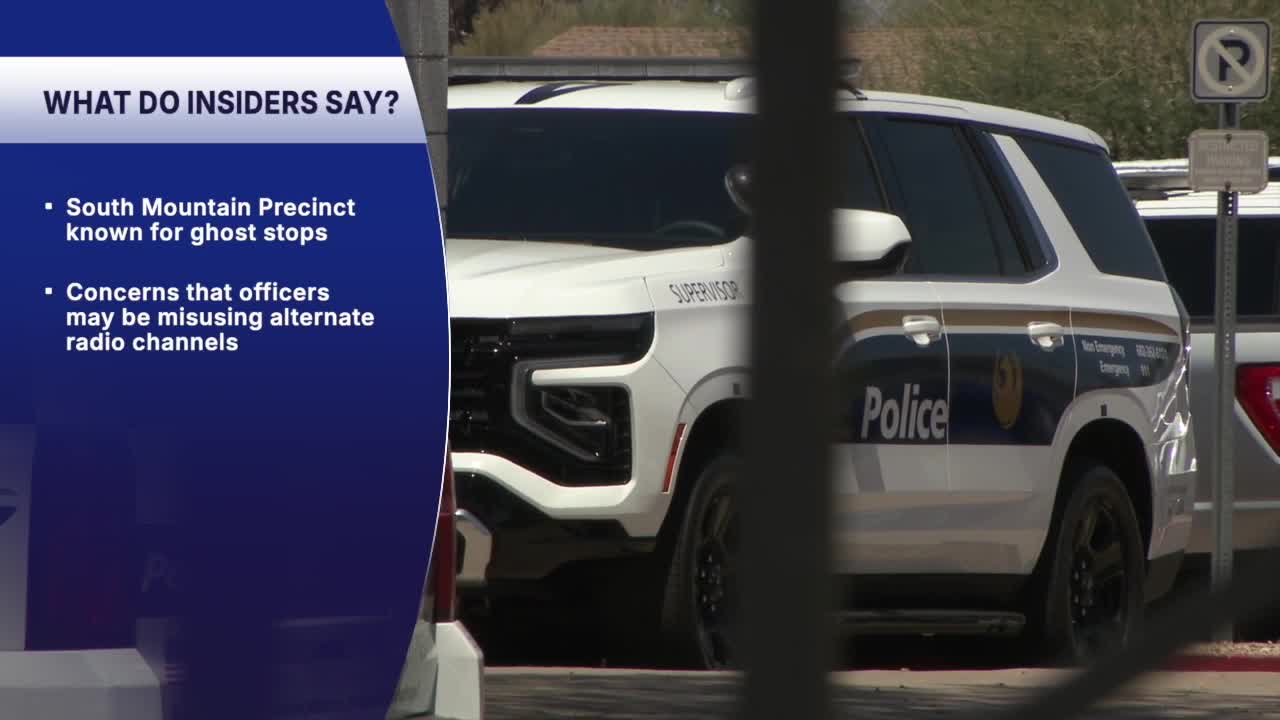


PHOENIX — As the Phoenix Police Department investigates the South Mountain Precinct following the arrest and firing of two officers, insiders are telling ABC15 that ghost stops need to be a central focus of the city's probe.
What is a ‘ghost stop’?
At the most basic level, a ghost stop is a stop or contact that officers don't report.
That means they're not calling them in, not activating their body cameras, and not documenting them afterward.
Why does it matter now?
Officers Luis Vasquez Jr. and Antonio Felix — now fired and facing criminal charges — are accused of conducting a ghost stop on a vehicle and beating and tasering two people in south Phoenix.
The traffic stop on Aug. 5 was not reported, and there was no body-worn camera activation.
When Phoenix Police Chief Matt Giordano announced the arrests, he said the entire South Mountain Precinct would come under scrutiny.
"My concern is more broader than (the two officers). I don't have any indication now that anyone else is aware of this, but I can't just take that at face value. We need to look into that," Giordano said.
What are sources saying?
Since Giordano's announcement, sources have been telling ABC15 that officers in South Phoenix are known for conducting ghost stops.
The sources also told ABC15 that officers may be abusing alternate radio channels not monitored by dispatch.
What does Phoenix PD say?
In a series of statements, the department did not deny that ghost stops are happening but stressed they are not allowed.
"'Ghost stops' are not an acceptable practice. The department has clear policies governing traffic stops and the required FI/Contact Form. These policies were established following recommendations from the City Council and the Mayor to strengthen our ability to track stops that do not result in an arrest or citation and to document what occurs during those contacts. The FI/Contact Form is the tool designed to capture that information.”
The department also explained why alternative radio channels are an important tool for officers.
"Our police radios operate on several assigned frequencies, and each of those has a dispatcher monitoring activity, sending calls for service, assisting with information, and tracking officer-initiated stops. That's the system we rely on for day-to-day operations. In addition to those dispatch-monitored channels, officers also have access to 'talk' channels. These do not have a dispatcher assigned and are used for quick communication between officers when it doesn't require taking up space on the main channel. For example, if one officer is inside a home speaking with a witness and another is outside securing the scene, they can communicate directly without interrupting emergency traffic or dispatcher workload. These talk channels are an essential tool that help officers work more efficiently and safely during dynamic situations. They allow officers to coordinate while keeping the primary dispatch channel open for critical or immediate needs."
This digital article was produced with the assistance of AI and converted to this platform based on the broadcast story written and reported by ABC15 Chief Investigator Dave Biscobing (Dave@abc15.com). Our editorial team verifies all reporting on all platforms for fairness and accuracy.

ABC15 is committed to finding the answers you need and holding those accountable.
Submit your news tip to Investigators@abc15.com
