

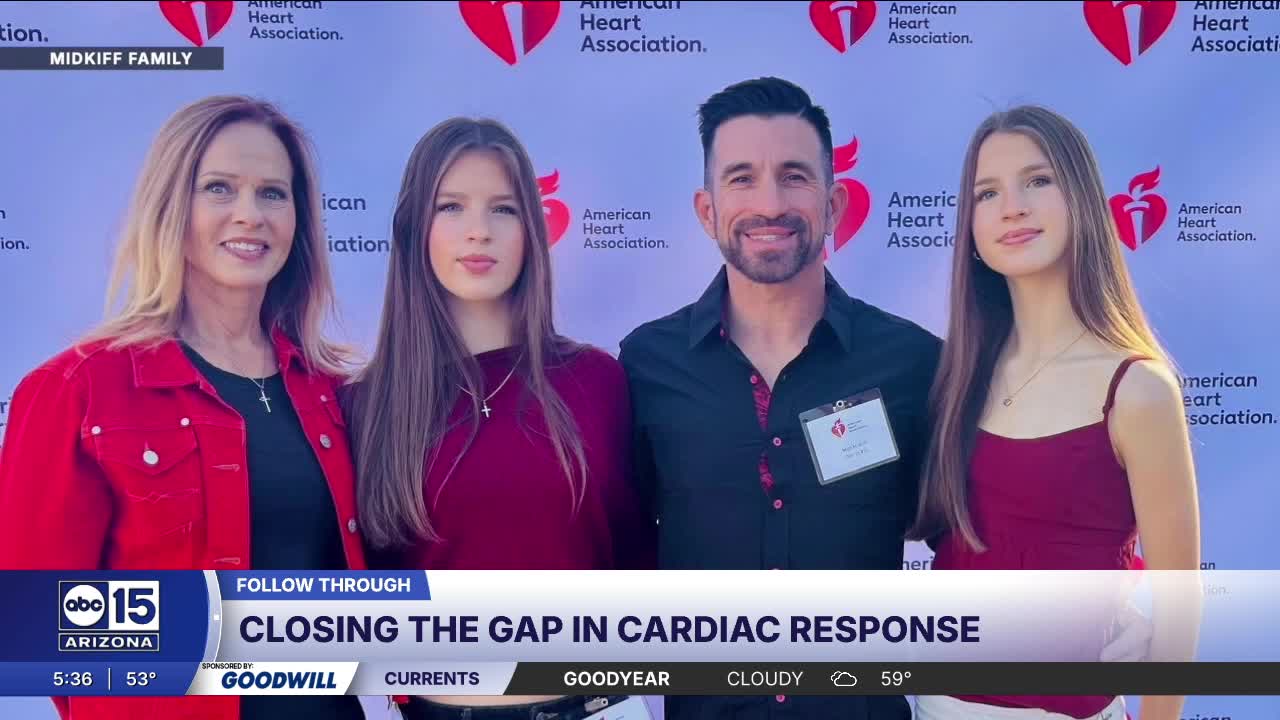


MESA, AZ — Three years ago, what was supposed to be another day on a Mesa soccer field changed everything for the Midkiff family when their 12-year-old daughter, Pyper, collapsed during practice.
Now, the family's fight to improve cardiac safety for young athletes isn't over.
Pyper’s dad, Matt, said another parent had already started CPR, but a critical piece of equipment wasn't immediately available.
"That day, we did have an AED on site at the fields, and it was in an office and wasn't immediately retrieved," he said.
The family says their experience revealed an even bigger concern: how prepared schools and sports organizations are when someone goes into cardiac arrest.
That concern led them to help pass Arizona legislation requiring AED access at all high school sporting events.
Now, they're working with the American Heart Association to push for mandatory cardiac emergency response plans in all public and charter schools.
“Those plans would outline who is trained in CPR and ensuring that all of their AEDs are unlocked, easily accessible, and properly retrieved," Eryn Streeter of the American Heart Association said.

Do you have a concern in your community or a news tip? We want to hear from you!
Connect with us: share@abc15.com
Data shows that for every minute CPR or the use of an AED is delayed, the chance of survival drops by 10%.
For Pyper, sharing her story hasn't always been easy, but she knows the impact can go a long way.
"I feel like I've come to the realization that there is a purpose to share my story throughout, and it can help save other people's lives if I'm able to share it," she said.
After that day, Pyper was diagnosed with a genetic heart condition, known as hypertrophic cardiomyopathy. Her twin sister Emeri was diagnosed with it as well, and has since suffered from multiple cardiac events. Emeri is currently on the transplant wait list, a wait that has become much longer than anticipated.
ABC15 will be taking a closer look at that in a follow-up story next week.

