

PHOENIX — Arizona voters will not see the state's school voucher program on their ballot in November after a pair of Supreme Court rulings.
Voters were set to decide on two ESA-related ballot measures: Proposition 212 would have added reforms to the Empowerment Scholarship Account program, and Proposition 145 would have blocked Prop. 212 and future attempts to reform ESAs.
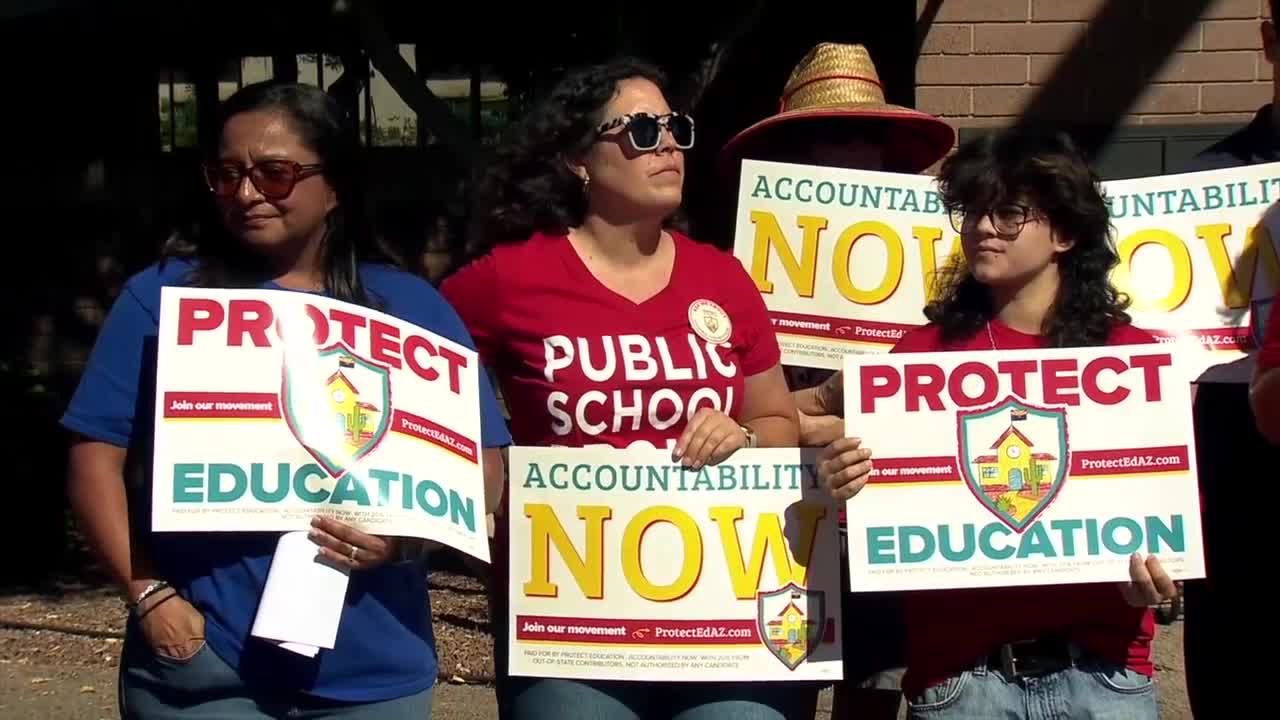
Prop. 212 does not have enough signatures to qualify for the ballot, the initiative's organizers said Tuesday after justices ruled on a challenge to the measure's signatures.
"Today is obviously very devastating for for our team, for volunteers across the state, for parents and educators who just wanted voters to get to have a say on this," said Beth Lewis, one of the co-founders of Save Our Schools Arizona.
The group was part of the coalition that aimed to put the Protect Education Act on the ballot.

Do you have a concern in your community or a news tip? We want to hear from you!
Connect with us: share@abc15.com
Protect Education, Accountability Now said in a statement it was "furious" the measure wouldn't go before voters.
"This does not reflect what Arizona voters want," the group said. "It does not reflect the overwhelming support of educators, parents, and public school advocates across the state who volunteered their time and demanded a voice in reforming a program that abused taxpayer money and pulled funding from their neighborhood public schools."
Arizona families can use ESAs to pay for educational expenses such as school tuition, homeschooling and tutoring. A 2023 ABC15 investigation found the state money was used to buy trampoline parks, driving lessons in luxury cars and more.
Since then, more expenses have been disallowed.
Group aims to flip Legislature
Save Our Schools Arizona now says it will focus its 2026 election efforts on legislative races.
"All the doors that we were going to knock for Protect Education, we're going to knock those for pro-public-education candidates and make sure that our Legislature is flipped to one that will actually support common-sense reforms and stop obstructing the will of voters," Lewis said.
Republicans have controlled the Legislature for decades. Lewis said it's time for a change in leadership.
"They're out of step with Arizona voters," she said.
But ESA supporters are also gearing up. Jenny Clark, the chair of the AZ Loves ESAs political action committee, said the group is planning a $1 million campaign to double the number of ESA students in the next five years.
"We are just getting started," she said.
The group is also launching incubators and fellowship programs to jump start more education options like microschools, homeschooling co-ops and private schools.
Signatures challenged in court
ESA supporters had challenged Prop. 212's signatures in court. Clark was the lead plaintiff in the lawsuit.
"I think this was very clear that Arizona voters did not want this to go on the ballot, and now it is not going to be on the ballot in November," she said, saying the measure's failure is a victory for the state's 102,000 ESA students.
Protect Education had turned in 421,451 signatures, and Secretary of State Adrian Fontes' office determined 389,376 of them were eligible to be verified by county recorders.
State law requires the secretary of state to submit random samples of the eligible signatures to the recorders, who check the signatures' validity. That validity rate is then applied to the total number of signatures to determine if the initiative has enough for the ballot.
The Protect Education Act fell just short.
The Arizona Supreme Court on Tuesday rejected Protect Education, Accountability Now's argument that the calculation method double-counted disqualified signatures.
Lewis said the hundreds of thousands of voters who had signed the petition to put the measure on the ballot showed strong support for reforms to ESAs.
"That is a clear mandate that Arizona voters just wanted to be able to weigh in here on this billion-dollar ESA voucher program," she said.
But Clark said the group's inability to get enough signatures shows voters back ESAs.
"Arizona voters have sent a message that they love school choice, they love education freedom, and they want Arizona families to have more options," she said.
The Goldwater Institute also cheered the decision.
“Despite spending an unprecedented amount of money in an effort to deceive voters into restricting school choice, the unions could not convince even a small fraction of Arizonans to sign their petition,” said Victor Riches, the institute's president and CEO. “Instead, they had to resort to unlawfully collecting thousands of signatures to try to game the system and dupe their way onto the ballot.”
ESA measure with 'poison pill' remains tossed
The Supreme Court also kept Prop. 145 off the ballot, upholding a lower court decision that found the proposed constitutional amendment was unconstitutional.
Prop. 145 would have prohibited the state from taking back scholarship funds — including ESA money — from the children of military families. The measure also had a provision that would have invalidated any legislation or initiative that allowed the state to recoup ESA money, a key reform in Prop. 212.
The Arizona Supreme Court upheld a Maricopa County Superior Court judge's ruling that the two provisions violated the state's Separate Amendment rule, which requires amendments to the Arizona Constitution be proposed in separate initiatives.
In his ruling, Maricopa County Superior Judge Joseph Kreamer said the two provisions concern multiple sections of the Constitution, adding that they "operate differently in scope, effect and practical purpose."
Lawmakers referred Prop. 145 to voters in House Concurrent Resolution 2048. The legislation was introduced in the final hours of the legislative session after a deal for some ESA reforms between the Arizona Education Association and House Republicans failed and passed on a party-line vote.
Want more news in your community? Add ABC15 as a preferred source on Google below: