

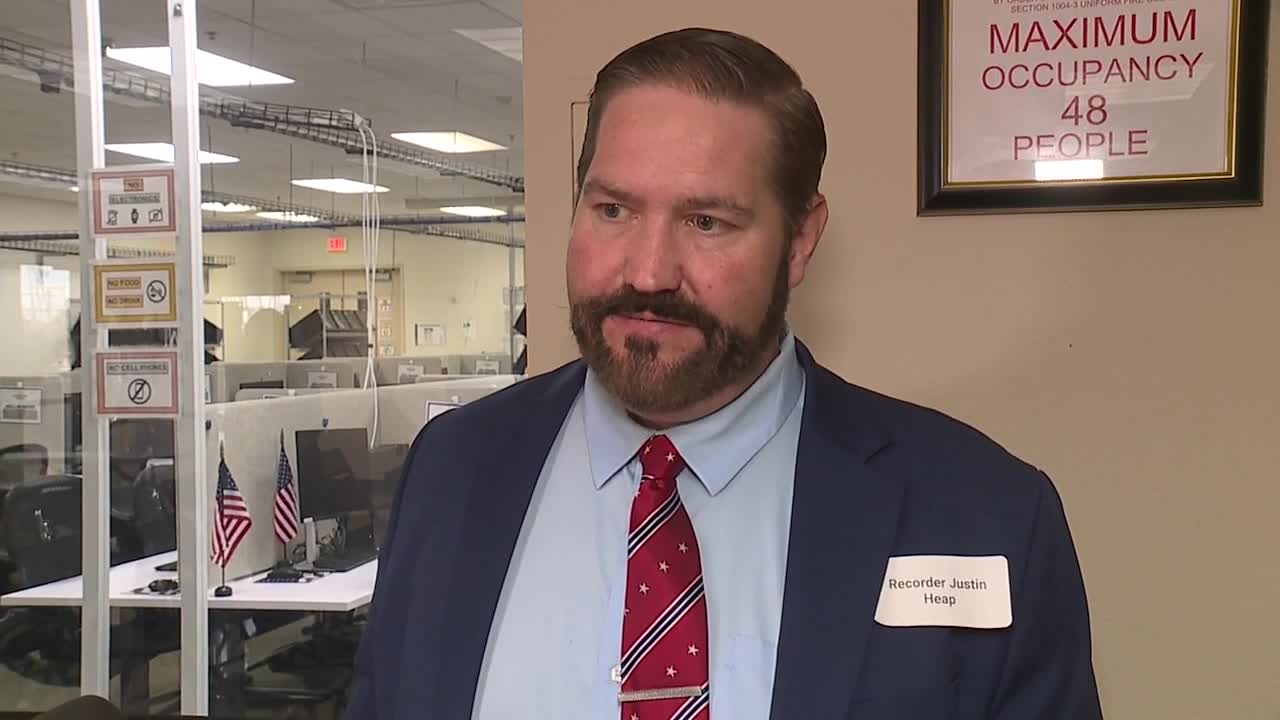


PHOENIX — Arizona’s attorney general and secretary of state are suing Maricopa County Recorder Justin Heap, asking a court to force him to restore the voter registration status of 25 U.S. citizens.
A hearing is scheduled for Friday morning. Heap said in a statement Thursday he would "immediately restore these individuals to full-ballot status" if Attorney General Kris Mayes or Maricopa County Attorney would provide him with proof of the voters' citizenship.
The voters are among 60 investigated by the Maricopa County’s Attorney Office after Heap flagged them as potential non-citizens who were not eligible to vote. Their voter registration is marked “not eligible” — something both Mayes and County Attorney Rachel Mitchell say isn't legal.
“Unless the 25 Affected Voters’ registration status is immediately restored, those voters will be denied their constitutional right to vote in the 2026 general election,” Mayes' lawsuit states.
Mayes and Secretary of State Adrian Fontes are asking the court to tell Heap to immediately change the registrations back, send mail ballots to those who are signed up to receive them and issue regular, non-provisional ballots if the affected people vote in person.
The 25 are some of the more than 83,000 registered voters in the county affected by a decadeslong Motor Vehicle Division coding error that had incorrectly marked them as having provided documentation of citizenship, which is required to register to vote in Arizona.

Do you have a concern in your community or a news tip? We want to hear from you!
Connect with us: share@abc15.com
Heap said in March that his office could not determine the citizenship of 207 registered voters.
Only 60 had cast ballots in an election, and a monthslong investigation found the vast majority – 52 – were actually citizens, Mitchell announced in late September. And according to the lawsuit, vital records show 22 of those 60 voters were born in Arizona.
Nearly a month after Mitchell released her findings – and less than two weeks before Election Day – 25 of the voters Mitchell determined were U.S. citizens are blocked from voting. Seventeen are on the Active Early Voting List and should have received mail ballots earlier this month. Another is on the Military and Overseas Voters list.
Heap's office, which has updated the status of 27 of the 52 voters found to be citizens, did not respond to ABC15's questions on Tuesday and Wednesday.
But Heap released a statement Thursday that said he needs documentation of the voters' citizenship before he can update their registration status.
He had told ABC15 on Sept. 3 that “we'll clear that up and get them back on the voter rolls” if Mitchell’s investigators determined any of the voters are citizens.
Mayes: Heap ‘simply refusing to follow the law’
“Not eligible” is a temporary status that’s used when someone is initially registering to vote and cannot be applied to the voters in question, the attorney general's lawsuit says.
Mayes also argues Heap does not have the authority under state law or Arizona's Election Procedures Manual to change the voters’ status to “not eligible,” saying he is required to maintain a registered voter’s status until he has confirmed the person is not a citizen.
“Recorder Heap’s nondiscretionary duty is clear here — and he is simply refusing to follow the law,” the lawsuit states.
In his statement Thursday, Heap said Mitchell's office advised him to cancel the voters' registrations, which the county attorney denied in a statement of her own Thursday.
“The law does not allow for the placement of the voter in any sort of suspended category under these circumstances,” Mitchell said.
She said state law requires recorders to follow a three-step process: confirm someone is not a citizen, then send the voter a notice asking for proof of citizenship and finally cancel the registration if the voter doesn't provide proof.
Referring people to the county attorney to determine their citizenship, Mitchell wrote, is not allowed under state law.
"This is not my opinion," she said. "This is not a made-up process. This is the law."
Heap also said Arizona's MVD database identified "these 24 voters" as non-citizens in February and the federal SAVE database could not confirm their citizenship.
In a letter to Heap on Monday, Mayes demanded he restore voting rights to 24 people. According to the lawsuit, an updated count shows 25 voters are affected.
“Now that the election is two weeks away, continuing to treat them as ‘Not Eligible’ will have the effect of denying these properly registered voters the opportunity to cast a ballot that is counted,” she wrote in Monday's letter. “You have no legal basis for disenfranchising these voters.”
County supervisors weigh in
After Board of Supervisors Chair Kate Brophy McGee gave her annual State of the County address in Phoenix on Thursday morning, she told ABC15 going to court is an appropriate step.
"I am expecting and believing the recorder will do the right thing, restore those voting rights, and ensure that they, in fact, get to exercise those rights," she said.
Maricopa County Supervisor Steve Gallardo, the board’s lone Democrat, asked Mayes on Wednesday to investigate Heap’s office over the voters’ status as well as his office’s automated phone system, which incorrectly stated the date of Election Day.
The phone message was updated to the correct date as of Wednesday afternoon.
Two of the four Republicans on the Maricopa County Board of Supervisors said the voters’ registrations should be restored.
“Justin Heap now accused of depriving 24 US citizens of their sacred right to vote,” Supervisor Thomas Galvin wrote on X on Tuesday. “This is a full blown disaster.”
And Supervisor Debbie Lesko said she wasn’t sure why Heap hadn’t restored their voting rights.
“It’s important that U.S. Citizens can vote and non-citizens cannot,” she posted on X on Tuesday.
What Mitchell's investigation found
The Maricopa County attorney announced Sept. 28 that her investigators found no evidence of an effort to get non-citizens to vote.
Of the 207 names Heap referred to her office, 60 had cast ballots in a previous election. Only eight of those 60 were not citizens – and they were all in the country legally.
“Most have lived in the U.S. for decades,” Mitchell said. “One person has been here more than 72 years.”
Five were not registered with a political party, two were Republicans, and one was a Democrat. The voters did not all cast ballots in the same election, nor did they vote in every election.
“While we only found eight non-citizen voters in this investigation, one is too many,” said Mitchell, who is calling for legislation to create records of who registers people to vote and to separate MVD and voter data.
Voting as a non-citizen is a felony in Arizona.
Mitchell has not yet decided whether to file criminal charges.
A systemic issue dating back two decades
It affected people who obtained their first driver’s license before Arizona began requiring proof of citizenship in 1996.
When voters in 2004 passed a statewide proposition to require proof of citizenship to register to vote, Arizona driver’s licenses were accepted as proof because drivers had to show documentation to get a license. But those who got licenses before 1996 were essentially grandfathered in when they renewed their license, because MVD’s system displayed the renewal date instead of the original date of issuance, incorrectly showing they had provided citizenship documentation.
About 218,000 voters statewide were affected, including 218,000 in Maricopa County.

