

Lake Mead and Lake Powell are hovering at record low levels, and the instinct is to point fingers at growth, golf courses, and data centers. But a closer look at the data tells a more complicated story.

Do you have a concern in your community or a news tip? We want to hear from you!
Connect with us: share@abc15.com
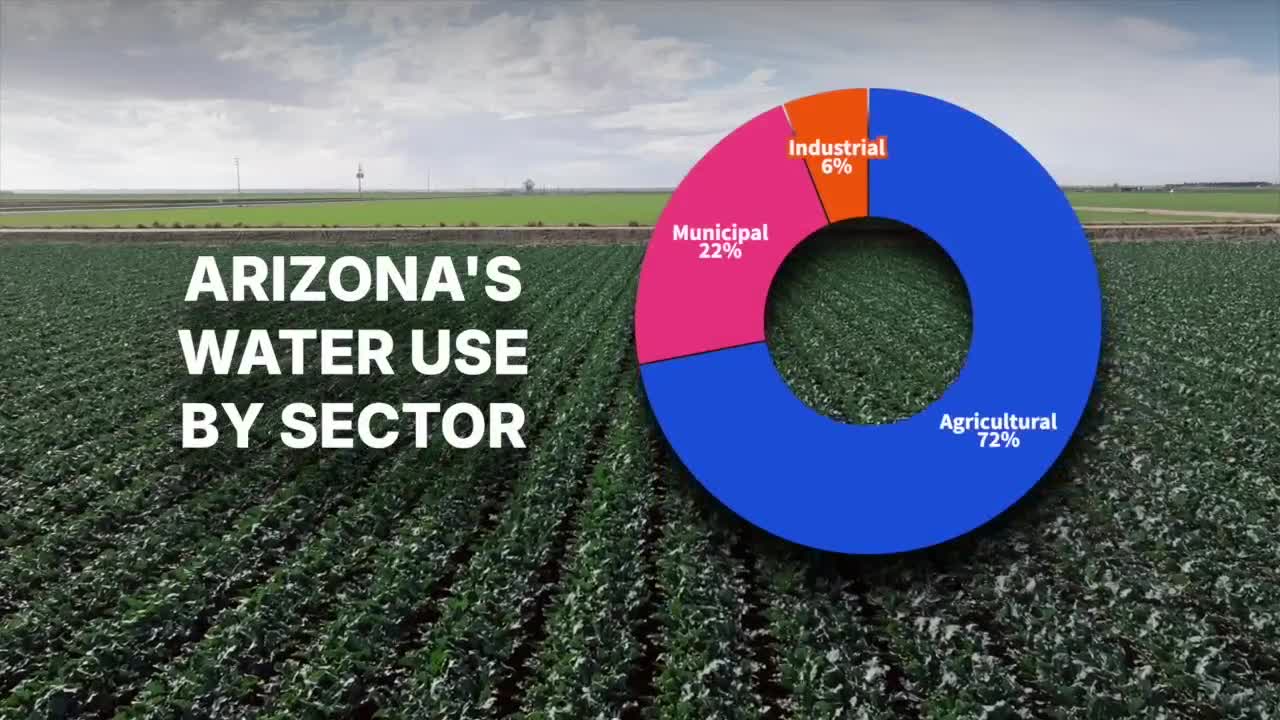
The single biggest consumer of water in Arizona is agriculture — accounting for nearly three-quarters of the state's total use, or about 5 million acre-feet annually. Within that, a single crop dominates: alfalfa, which alone accounts for 1 million acre-feet, or 20% of all water used in Arizona. Cotton is next at 7%. Every other crop comes in at 3% or lower.
Arizona cities used 1.5 million acre-feet in 2024 — and while that number is growing alongside the population, the growth is increasingly efficient. Today, Arizona cities use just under 200 gallons per person, per day. The peak was 279 gallons per person, per day — back in 1989.
Golf courses are often cited as a major drain on water resources, but the numbers show they are actually using less water today than they were 20 years ago. Current use sits at 19 billion gallons, down from 23 billion in 2022, representing about 1.6% of total statewide water use.
Data centers are harder to pin down. They don't have their own reporting category, which requires some educated guesses. At the power plant level, their energy demand isn't moving the needle — water use there has been stable since 2008.
What is climbing is nonresidential water deliveries, which rose from 115 billion gallons in 2024 to 124 billion in 2024 — the highest on record. It's a broad category, but with TSMC coming online around the same time, the data suggests Arizona's tech sector overall is using more water.
As for the lakes, Powell is the one to watch. Once it drops below 3,510 feet, officials aren't sure how much water they can still send downstream to Mead.
We live in a desert. Growth, golf courses, and data centers all contribute to water use — but less than many people assume.
This story was reported on-air by a journalist and has been converted to this platform with the assistance of AI. Our editorial team verifies all reporting on all platforms for fairness and accuracy.
Want more news in your community? Add ABC15 as a preferred source on Google below: