

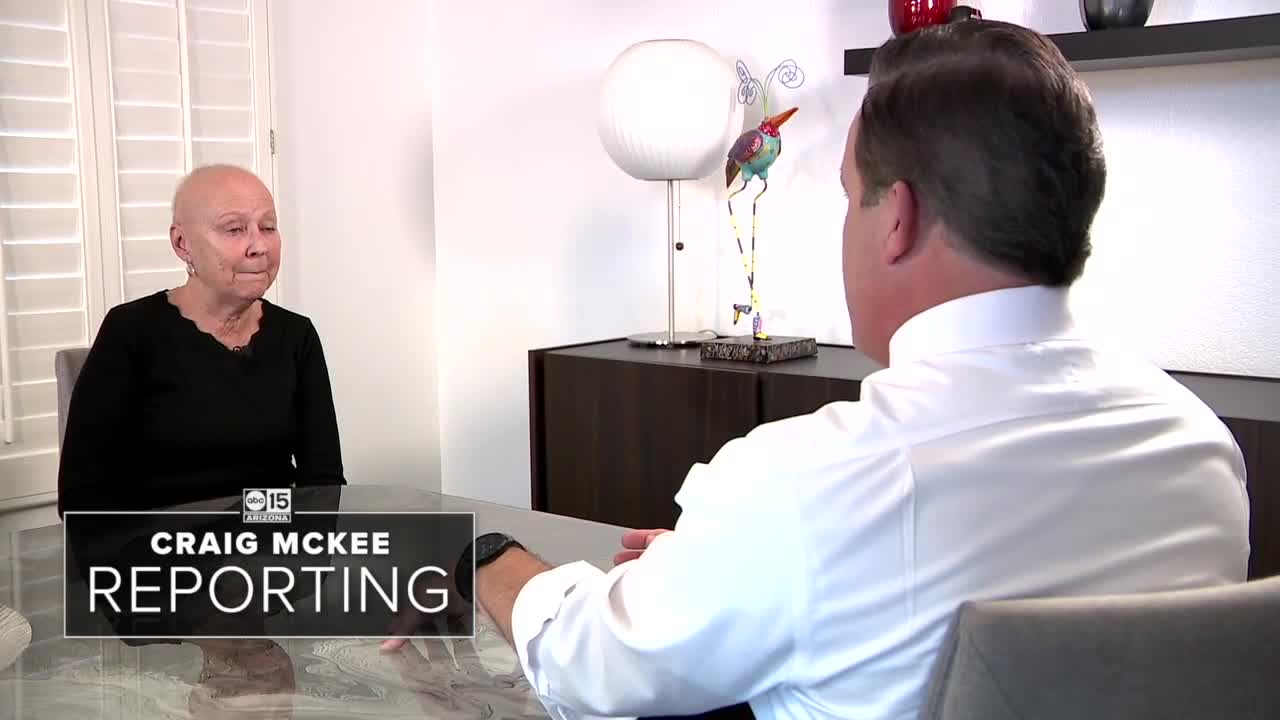


PHOENIX — As renewed U.S. interest in Greenland raises diplomatic tensions with Denmark, a Danish-American woman with deep family ties to the Arctic island is urging restraint and respect, while a Danish researcher says Washington already has broad authority to expand its military footprint there under an existing agreement.
Colette Pedersen, a dual U.S.-Danish citizen living in Arizona, said the rhetoric surrounding Greenland — particularly past suggestions that the United States could purchase the territory — has been troubling both personally and politically.
“You can’t just say you want to buy a country,” Pedersen said in a recent interview. “It’s not going to happen without affecting people. My family lives there. This is real life for us.”
Greenland, the world’s largest island, is an autonomous territory within the Kingdom of Denmark, with its own government and growing control over domestic affairs. Denmark continues to provide financial support while gradually transferring authority to Greenland’s government.
“Denmark has spent decades working toward Greenland governing itself,” Pedersen said. “It’s a slow, deliberate process.”
The issue has resurfaced amid broader discussions of Arctic security, climate change and global competition. Greenland’s strategic location makes it increasingly important for missile defense and Arctic surveillance.
Under a 1951 defense agreement between the United States and Denmark — amended in 2004 to formally include Greenland’s authorities — the U.S. already has significant latitude to expand its military presence, according to Mikkel Runge Olesen, a senior researcher at the Danish Institute for International Studies.
“The U.S. only has one base in Greenland right now, but according to the defense agreement, they can contact Denmark and request to open other bases,” Olesen said. “Such requests would, in all likelihood, be met with a positive reply.”
Olesen said Denmark and Greenland have long been receptive to U.S. security needs, noting that the agreement allows expansion if justified by national security concerns.
“That understanding has been in place for decades,” he said.
Pedersen echoed that point, saying U.S. military access has never been the issue.
“America already has pretty much carte blanche to operate there,” she said. “It’s just a matter of negotiation.”
What has unsettled many Danes, Olesen said, is the suggestion that the U.S. might sidestep diplomatic norms or the alliance altogether.
“There was disbelief,” he said. “Denmark has been extremely open-handed with letting the U.S. take care of security interests in Greenland.”
Denmark is among Washington’s closest allies and has supported U.S.-led military operations in Afghanistan and Iraq. Olesen said the renewed debate has left some Danes feeling “disappointed” and even “betrayed.”
Pedersen was more blunt in her assessment of the tone.
“I think America, our president, is acting like a bully,” she said. “This is a NATO ally. My son is an officer in the Danish army. He has fought shoulder to shoulder with U.S. troops.”
She also pointed to historical context, noting that while Denmark sold the U.S. Virgin Islands to the United States in 1917, Greenland’s status is fundamentally different.
“Greenland has been part of our kingdom for over 600 years,” she said. “You don’t just sell a place with that kind of history.”
The debate is not abstract for Pedersen. Her godson and his family are moving to Greenland this year, and much of her extended family still lives in Denmark.
“It’s front and center for me,” she said. “I’m ashamed of how this is being handled.”
Pedersen warned that escalating tensions between allies could have far-reaching consequences, particularly at a time of global instability.
“If military force enters the picture,” she said, “the world is not going to be the same.”
Despite the friction, both Pedersen and Olesen emphasized that diplomatic mechanisms already exist to address U.S. security interests without undermining alliances.
“Essentially, the U.S. already has a green light,” Olesen said. “All it has to do is ask.”
Pedersen said she remains deeply loyal to both countries she calls home.
“I love America. I love Denmark,” she said. “I would hate to be forced to choose — but this is one situation I absolutely do not agree with.”

