

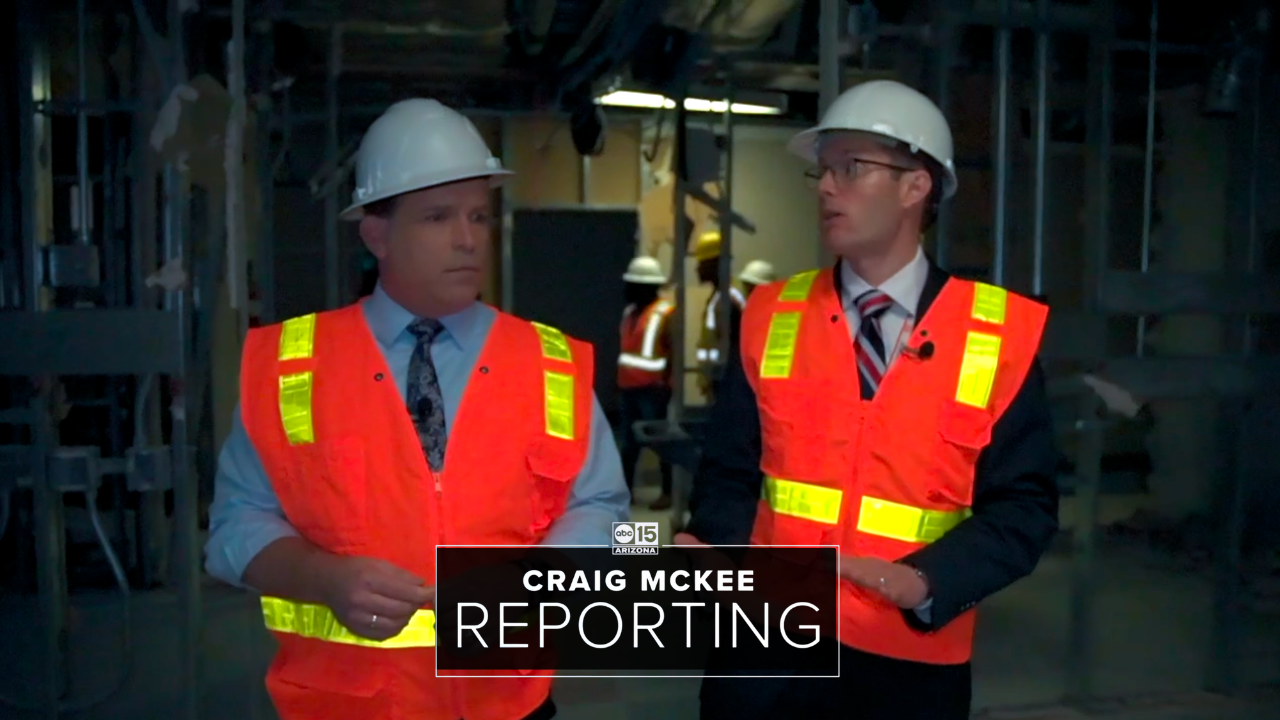


PHOENIX — The Phoenix VA Health Care System (PVAHCS) is in the midst of a major construction project that will more than triple its infusion center space, expanding capacity from nine to 22 treatment chairs as part of a broader, multibillion-dollar nationwide investment in veterans’ care.
PVAHCS Executive Director Elijah Ditter said the new infusion center, now under construction inside the decades‑old main hospital tower, will grow from about 6,000 square feet to 20,000 square feet and is expected to be completed next year.
“The project you’re in here is our new infusion center,” Ditter said during a walkthrough of the construction site.
“Chemotherapy is the biggest one, but there’s a lot of other options, such as arthritis, a lot of gastrointestinal for say, Crohn’s disease and infusions prior to surgery. And we’re expanding this space from nine chairs to 22 chairs.”
The work is part of roughly $4.8 billion in funding the Department of Veterans Affairs has allocated for maintenance, modernization and renovations across its facilities nationwide. Ditter called it a “historic amount of funding” that is helping the Phoenix VA keep pace with surging demand.
The medical center’s main tower opened in 1951 and was designed to serve about 30,000 unique veterans, Ditter said. Last year, Phoenix VA served a record 125,000 unique veterans — more than four times the original design.
“So, there’s a lot of opportunity, as veterans continue to choose Phoenix, to expand options and expand care,” Ditter said.
Ditter said the expanded space is designed not only to accommodate more patients at once, but also to improve comfort and privacy during what can be hours‑long treatments.
“Not only do you get more space for your chair and your entertainment, but your family members,” Ditter said, noting some chemotherapy infusions can last up to eight hours. “So, you’re going to be here for a while.”
The new center will include guest Wi‑Fi, entertainment options and areas where family members can sit with patients, talk or watch movies on tablets or other devices. At the same time, designers are trying to balance privacy with patient safety.
Large portions of the existing southern-facing walls will be “blown out” to open the area and bring in natural light, along with several private rooms and additional nursing stations.
The new footprint will also co-locate the oncology clinic with the infusion center, bringing cancer physicians and nurses into the same space where veterans receive care.
“VA does care coordination just unmatched to the community,” Ditter said.
“Not only are cancer patients or other patients getting infusions, but they’re likely getting other medical care. They have unique dietary needs. They have, oftentimes, social needs. They may have spiritual needs. And we’re able to have all this care coordination under one roof and one area all here, right in Phoenix.”
The infusion expansion is one of several construction and renovation efforts underway or planned at the Phoenix VA.
Ditter said inpatient wards are slated for modernization with the hospital aiming to award at least one inpatient ward renovation contract by the end of next year, with additional units to follow in a “domino” sequence over time.
“The inpatient wards, what we’re doing there is more modernization — being able to have larger rooms, more privacy, more space for your families,” he said. “So, when you’re done with inpatient, you also can get discharged to, say, our community living center, which we recently renovated, and also to our outpatient clinics, such as infusion, that can follow up on your inpatient care.”
The VA is also moving ahead with design work to renovate its operating rooms, Ditter said.
The Phoenix facility has just completed its 1,000th surgery using a Da Vinci robotic surgical system and is looking to acquire another robot as part of an expanded operating suite.
At the same time, the medical center plans to expand its pharmacy capacity and staffing to keep up with the growth in infusion therapies and other advanced medications.
“All those medications, all of those advancements with medications — we need a larger pharmacy,” Ditter said. “A lot of momentum in this last year. How do we meet that demand? That 5 billion is going to be a great start to get there.”
To staff the larger footprint, Ditter said the Phoenix VA is conducting “robust recruitment” for physicians, nurses and administrative staff across specialties, focusing on candidates who want to serve veterans as patient volumes grow.
Outside the infusion center, additional construction is visible around the aging campus. Ditter said some of that work is part of the current multibillion‑dollar investment, while other projects fall under separate contracts.
He acknowledged there have been ongoing discussions within the VA about whether Phoenix may eventually need a new facility, especially as infrastructure ages and the veteran population grows.
Those decisions, he said, will be made at higher levels of the VA and federal government, and could involve questions about available land or redeveloping the existing campus.
For now, Ditter said, the focus is on using the funding already in hand to modernize the current hospital and improve the experience for veterans and their families.
“Ultimately, we’re thankful for what we have. We’re going to renovate it, we’re going to use that 5 billion to the best of our ability to deliver that exceptional care here at Phoenix,” he said. “You have to take care of the veterans that are here — the 125,000 that are using the facility.”
Ditter said he hopes veterans will notice the changes and the reason behind it.
“I hope they see that we’re committed to maintaining the highest quality, modern safe spaces for all their clinical needs,” he said. “When you have a beautiful space like this, it has that glow to the entire facility … It creates an environment for them, their families, their caregivers, to walk in and feel welcome, not only from a clinical standpoint, but as a veteran.”

