


PHOENIX — Grooming is a dangerous first step in sex trafficking; it’s how a trafficker makes contact with a victim. Now Arizona advocates are rolling out new tools to help parents and kids understand the red flags.
Sheri Lopez says she was just 15 years-old when someone began grooming her.
“Just a shy kid, going into high school,” Lopez said. “I just happened to run into a boy in school. He became my boyfriend. At least I thought that's what he was. And I eventually was introduced to his father.”
Lopez says the grooming lasted three months, then led to sex trafficking through that family in Colorado.
“I'll tell you why I graduated high school: because my math teacher was my buyer,” Lopez said. “He gave me the passing grade to graduate high school.”
She says it all played out while she kept the secret from her own family.
“I had to keep that secret from them. There were threats against my family,” Lopez said. “When my parents' cars were egged, their tires were slashed, when somebody would climb over our six-foot fence and let my dog lose time and time and time again, those were messages to me to keep my mouth shut and do what was expected.”
As an adult, she says she was eventually passed to other traffickers and transported around the country.
“I was flown all over the United States. I flew on airplanes, private jets, very influential and wealthy people,” Lopez said. “But by that point, I was just a walking dead person.”
After seven years, Lopez escaped in Arizona, with the help of a woman she met in Glendale.
“There was an older woman and her name was Pearl, and she started talking to me, and she kept saying, ‘Honey, I know something's wrong. When you're ready to go, I'll take you,’” Lopez said. “I walked away with her. I didn’t know what was going to happen. I just, I didn't want to die.”
Today, she is turning her experience into prevention.
The Arizona Human Trafficking Survivor Coalition, where Lopez is President, has released a new online master class called Recognizing Grooming Before Exploitation.
“It's designed for teachers. It's designed for parents. It's designed for grandparents. It's designed for anybody that truly wants to understand how somebody can actually be groomed,” Lopez said.
The course teaches adults how groomers build trust, exploit emotional needs, isolate a child, and how to recognize changes in behavior.
“It's watching out, who has your child's emotions in their hands?” Lopez said.
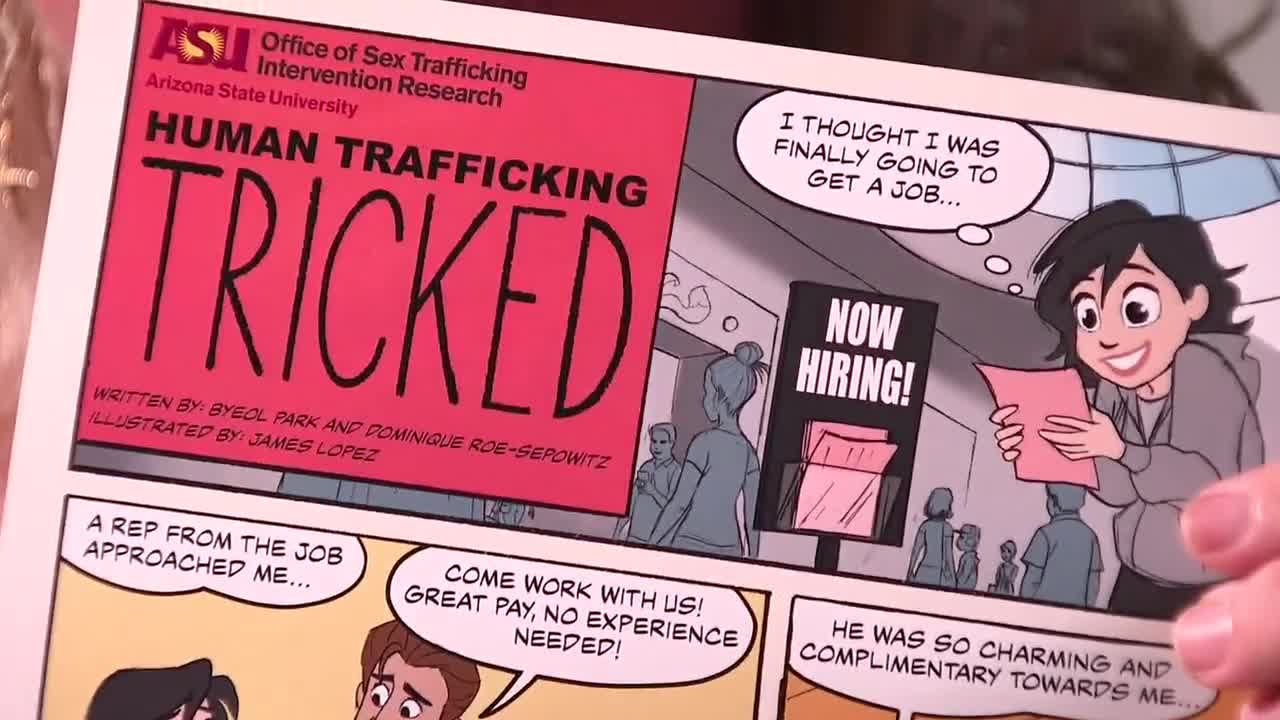
At ASU's Office of Sex Trafficking Intervention Research (STIR), researchers are putting some of the signs of danger directly into kids’ hands with a series of graphic shorts. Teaming up with illustrator James Lopez, all of the shorts are free and downloadable at sextraffickinghelp.com.
“We have nine different topics,” Dominique Roe-Sepowitz, ASU-STIR Director, said. “We have two versions: one is with cat characters, those are for seventh and eighth graders, and then the human versions are for ninth to twelfth graders. The purpose of these are not to scare kids. The purpose is to have a conversation."
The stories depict real cases from Arizona, including exploitation within a family, “sugar baby” offers, labor trafficking, and deceptive job offers.
Tens of thousands of copies will be distributed to schools, police, and social workers.
“The people who groom them aren't always scary looking,” Roe-Sepowitz said. “They might be a really good-looking person. They might offer them money. They might offer them compliments or things that make them feel good.”
The goal is to help a child recognize the approach before it goes further.
“We think that if kids read this, seventh through twelfth graders read this, maybe someone makes contact with them and they know to not follow up with that contact,” Roe-Sepowitz said.
Lopez agrees, prevention starts with an earnest conversation.
“We want parents to not be so afraid to have these conversations with their kids,” Lopez said. “We teach them fire drills. We teach them all kinds of different things in school. Why aren't we teaching them how to protect themselves from somebody who may be trying to prey on their body?”
If you or someone you know needs help, call the Arizona Human Trafficking Hotline at 877-429-8477.

Do you have a concern in your community or a news tip? We want to hear from you!
Connect with us: share@abc15.com
Want more news in your community? Add ABC15 as a preferred source on Google below: