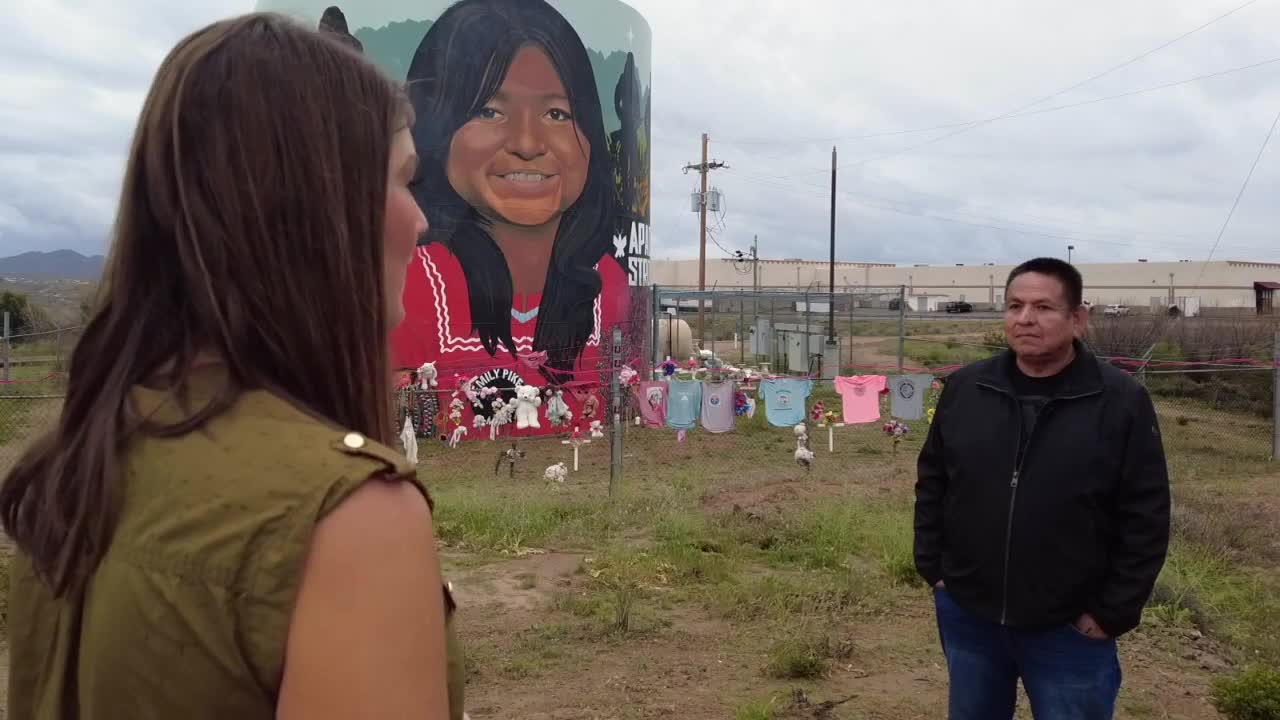



PERIDOT, AZ — It has been a year since Emily Pike was found dead in the shadow of the mountains surrounding Globe, on February 14, 2025. Her body was dismembered.
The 14-year-old from the San Carlos Apache Tribe has sparked statewide policy change and brought the Missing and Murdered Indigenous Peoples (MMIP) crisis to the forefront.
With the somber anniversary, Emily’s uncle, Allred Pike, spoke with ABC15, as the family still searches for answers.
“She was tossed to the side of the road. Like she was a piece of trash,” Pike said
He remembers getting the call from his sister.
“I had to pull over. I mean, I was in shock,” Pike said. “What happened to her, the way they found her, it's the worst thing to ever find out. And we just don't want anyone else to go through this."
One year later, there are still no arrests.
“That's what scares me. That this may become a cold case,” Pike said. “I don't want law enforcement to forget about my niece. We want to let them know that we are not going to stop talking until the killers are found.”
The Gila County Sheriff’s Office tells ABC15 the case is still an active investigation.
“The Gila County Sheriff’s Office, along with the assistance of other agencies are continuing to follow-up on leads and evidence,” Chief Deputy Jim Lahti said in a statement. “Unfortunately, due to the sensitive nature of the leads and evidence being worked at this time, no information can be released, as it could hamper the investigation.”
While the answers the family seeks aren’t within their grasp, what they do see is a movement.
Hundreds have rallied across the state throughout the past year, demanding “No More Stolen Sisters.”
“It’s sad. She’s like a year older than me,” Arianna Perez, Salt River Community, said at a rally at the State Capitol in March.
“She’s a baby. She had a long life to live,” Faith Ramon, Tohono Nation, said at the same rally.
Emily’s death has also raised questions about policies to protect teenagers. She had been living in a group home in Mesa before she disappeared.
“I always go back to the term ‘runaway. If they had classified her as ‘missing’ right from the beginning, maybe things would have been different,” Pike said. “From my point of view, the tribes, DCS, the state, they need to work a little bit more closer regarding teens.”

Since her death, the Department of Child Safety says they have removed outdated terms like “runaway” and “AWOL,” and strengthened communication with tribal and law enforcement partners.
In a statement, DCS says in part:
“As part of this work, DCS has drafted updated rules to clarify expectations for missing child reporting, including evaluating potential statutory and rule changes related to the timeframe in which group homes must notify DCS and law enforcement when a child leaves placement. The draft rules are complete and ready to begin the formal rulemaking process.”
“The updated rules provide a clear and consistent definition of missing. A child is considered missing when group home staff have made reasonable attempts to locate the child, including contacting the child’s school, friends, and other locations.”
In July, the state also adopted turquoise alerts to help find the disproportionate number of missing people from tribal communities. While an amber alert focuses on abducted kids, and silver alerts are for the elderly, a turquoise alert aims to broaden the scope that can warrant an emergency alert, particularly for indigenous individuals.
This came as a recommendation from a special task force studying the MMIP issue.
With the one-year-anniversary of Pike’s body being found, Liliana Soto with the Office of the Arizona Governor says the solemn milestone is a reminder of the urgent need for action.
“Emily’s memory continues to drive Governor Hobbs’ commitment to systemic change, justice, and healing for Indigenous communities across Arizona,” she said in a statement.
On the San Carlos reservation, tokens left by people who visit from around the country show the scope of Emily’s reach.
“I told her I love her, even though I don’t know her,” one 19-year-old, who visited the memorial from California with her family, told Allred Pike.
Hundreds of people have put handprints on the side Emily’s mural.
“You look at the handprints, those are handprints of people that came throughout the state, throughout the country. It means a lot,” Pike said.
Those red handprints, a symbol of the pain of the MMIP crisis.
“My niece just woke up a sleeping giant,” Pike said. “It's just not my niece. It’s everybody out there. Other tribal members who have lost loved ones, they also need people to look into their cases, to make sure that nobody falls through the cracks.”
Want more news in your community? Add ABC15 as a preferred source on Google below: