

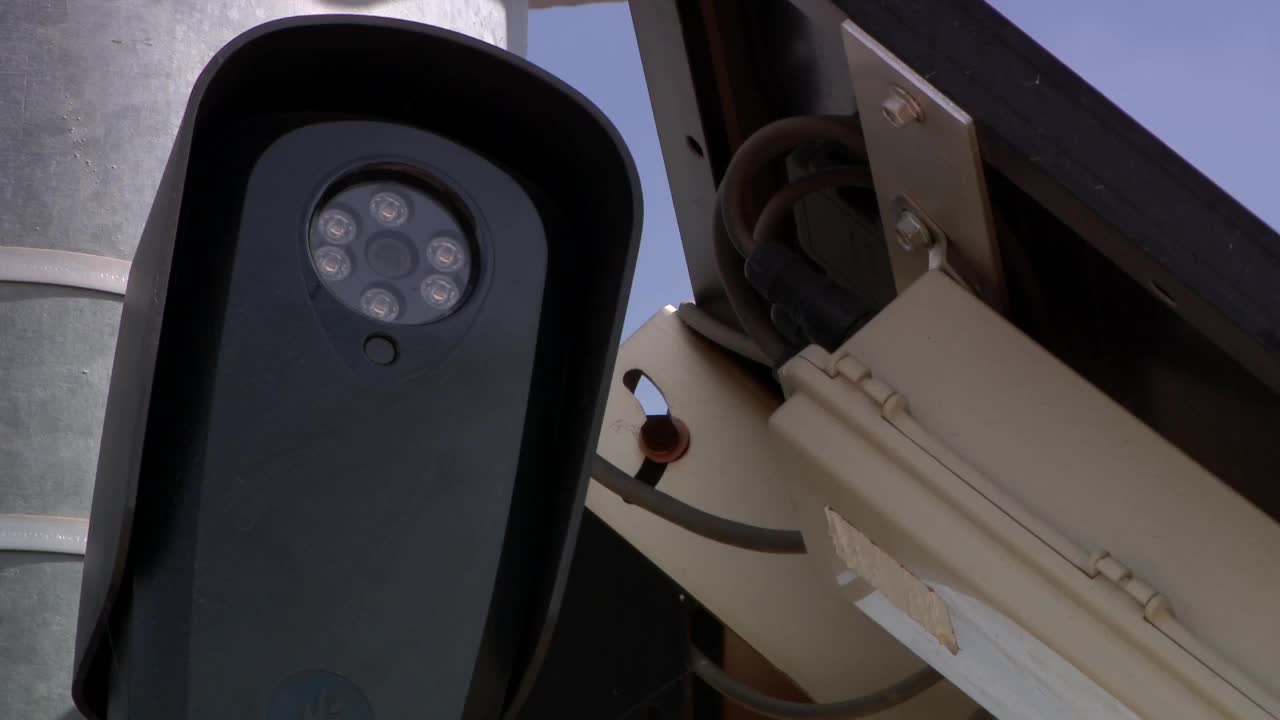



CHANDLER — You may have never noticed the cameras lining many Valley streets tracking every car that drives by.
Automated license plate readers, like those made by Flock Safety, capture images of vehicles and transmit them to computer servers. Using artificial intelligence, data is extracted, including license plate numbers, color, make, and model. Some cameras can even identify bumper stickers, dents, and other characteristics.
That data is saved to the cloud for police use.
Records obtained by ABC15 detail how the cameras are used and who has access to the tracking data — including a controversial federal law enforcement agency.
Chandler Debates Flock Contract
During a contentious Chandler City Council meeting last month, community members raised pointed questions about the city’s 40-camera system. Council members were preparing to vote on whether to extend their contract with ALPR provider Flock Safety.
"How many serious cases were actually solved because of this system?" Resident Andre Rubio asked.
"Where is this data stored for how long? And who has access to it?" said another resident.
"Why are we using taxpayer dollars to build massive databases on our movements and habits?" Resident Travis Gunville asked.
The Chandler City Council, which was considering a contract extension for the ALPS system, tabled the Flock Safety discussion until July.
Watch Your Chandler Reporter Molly Hudson's report on the discussion being tabled in the player below.
Earlier this year, the ABC15 Investigators asked several police agencies to provide internal and external audits that showed law enforcement queries of Flock Safety data for January 2026. Agencies can adjust settings in the Flock Safety interface to automatically allow data queries from no external departments, only specific departments, all departments in their state, or the entire Flock network nationwide.
RELATED: After residents voiced privacy concerns, three Arizona cities canceled Flock Safety contracts
Chandler Police was one of three agencies that provided the records.
A five-page internal audit log shows every time Chandler officers searched their own Flock data, and in most instances, a case number and a reason for the search were listed. It includes 454 searches related to about 70 investigations. The queries ranged from stolen cars to assaults.
Take a look at the 454 queries conducted by Chandler PD in the month of January below.
Chandler Police Chief Bryan Chapman said he is making sure his officers only use the system for legitimate law enforcement purposes.
"If there's a breach of that information, specifically, if people are utilizing this information for personal gain, or you're sharing it outside the norms of what is established protocol, the discipline process would commence immediately, and they would be terminated," Chapman said at a city council meeting in May.
An external audit log for the same one-month period in January 2026 shows every time outside police agencies searched Chandler's Flock data through automatic data sharing. That log included nearly 40,000 entries and was more than 500 pages long.

ABC15 is committed to finding the answers you need and holding those accountable.
Submit your news tip to Investigators@abc15.com
Community members across the political spectrum are asking how oversight can be provided and abuse prevented within such a massive sharing system.
"This is a lot of collaboration. And when we see that, we have to call into question who we're collaborating with, why, and, you know, what result are we getting from that?" said Rohith Chandrashekhar, a LUCHA member. LUCHA, which stands for Living United for Change in Arizona, is a grassroots organization that advocates for social, racial, and economic justice.
Eric Fowler, chairman of the Maricopa County Libertarian Party, said he sees no easy solution.
"I don't see a great way of corralling that use without extremes, amounts of guardrails and warrants," Fowler said.
Who Can Search Flock Data?
Paris Lewbel, a Flock Safety spokesperson, emphasized that customers can choose which agencies can automatically see their ALPR data. He added that the data system includes built-in accountability measures.
"Every search within the Flock system requires a reason from a dropdown menu," Lewbel said.
Flock Safety also created an audit assistance tool to assist customers with oversight.
"The new tool uses some of our machine learning technology to determine if maybe there's a number of plates that are being searched repetitively over time that aren't potentially connected to an investigation, or if a timeframe of the searches is outside the normal ways that an officer may search for something within the system," Lewbel said.
After community pushback last year, Flock made other changes, allowing users to choose to block outside agency searches if the reason listed is "reproductive care" or "immigration."
Flock Safety also limits federal law enforcement access to the system.
"We do not have any contracts with ICE or any sub-agency of the Department of Homeland Security," Lewbel said.
ABC15's Melissa Blasius spoke one-on-one with Paris Lewbel, a Flock Safety spokesperson. Watch the extended interview in the video player below.
But according to the Electronic Frontier Foundation, a nonprofit organization defending digital privacy, free speech, and innovation, ICE can use a side door to access the data.
"They don't need a direct contract with Flock in order to get this data if local law enforcement agencies are just searching and providing that to them." said EFF attorney Lisa Femia. “And we've seen that all over the country."
Lewbel responded to that concern by saying customers own their data and can choose how to use it in compliance with local law.
“In states where cooperation is legal, customers and their local values determine how they choose to use the technology,” Lewbel said.
Chandler's Chief Chapman was firm about his department's federal sharing practices.
"We don't have sharing agreements with any federal entity; it is only through state and local people in the state of Arizona," Chapman said.
Records obtained by ABC15 show Chandler does share data with Mesa, which does have a police policy on cooperation with ICE and other immigration agencies.
A Mesa Police Department spokesperson confirmed one of their officers, assigned to the East Valley Fusion Center, did search Flock data in response to requests from the Department of Homeland Security for information regarding suspects who were at the center of criminal investigations. Those searches, from 2025, were marked as "immigration violations" in a Flock audit report viewed by ABC15.
Mesa police would not say how often these searches happen. However, a police spokesperson told ABC15 that these searches need a supervisor's approval and requests lacking a criminal nexus would be denied.
When asked about whether searches requested by ICE would be labeled “immigration” in the search reason, Mesa’s spokesperson responded, “Mesa PD will select the applicable criminal predicate from Flock’s drop-down menu.”
Chandrashekhar said the situation raises concerns about access and transparency.
"I'm not accusing Chandler of those backdoor searches, but you have to understand that we live in a time right now where everyone is afraid, and when you actively obscure what you're searching, you'll never gain community trust," Chandrashekhar said.
ABC15 asked the City of Chandler whether Mesa police searches could give ICE access to Chandler license plate data. A city spokesperson replied that Chandler does not share with ICE and that Chandler police block Flock searches that list "immigration" in the reason column.
But other agencies are responsible for complying with their own laws, policies, and terms, according to Chandler’s spokesperson.
The City of Chandler also provided ABC15 with this statement:
Chandler Police recognize the public’s interest in how automated license plate reader technology is used, which is why we provided ABC15 with Flock search data for the month of January 2026. Those logs show searches in the system, so we can verify that searches by Chandler Police are tied to legitimate investigations and consistent with department policy.
Flock license plate reader cameras are one of several tools Chandler Police use to help solve crimes and keep our community safe. It has supported the recovery of stolen vehicles and arrests of suspects tied to burglary, robbery, aggravated assault, fatal hit-and-run crashes and other serious offenses. The system also has helped locate missing and endangered people, including elderly drivers, endangered children and out‑of‑state missing persons who were safely recovered in Chandler.
We use this technology in a focused, accountable way that protects victims, locates those who are in danger, and holds offenders accountable while respecting the rights of Chandler residents. We understand public concerns about privacy and data use. Every search by trained Chandler Police personnel is automatically logged, which gives us a clear way to review our use of the system. License plate data is retained for 30 days under our agreement and is automatically deleted unless it is needed for an ongoing criminal investigation.
You can reach ABC15 Senior Investigator Melissa Blasius by email at melissa.blasius@abc15.com or call 602-803-2506. Follow her on Instagram, X @MelissaBlasius, or Facebook.
