


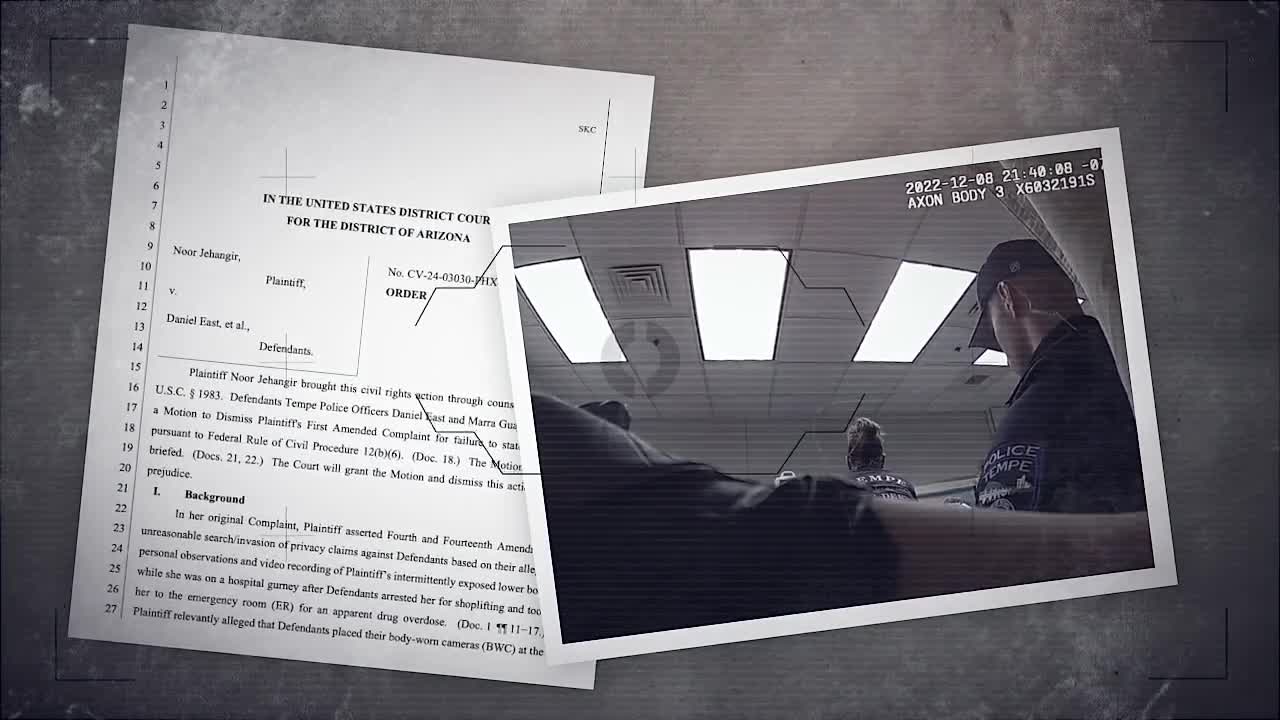


TEMPE, AZ — A pair of Tempe police officers removed their body-worn cameras and used them as makeshift surveillance devices inside an emergency room to record a mostly naked woman handcuffed to a hospital bed during a medical episode.
The woman, Noor Jehangir, is currently suing the city, and the case is being appealed, court records show.
This is a two-part investigation and you can watch both parts in the player above.
"I don't think anything I did justifies the way Tempe PD treated me," Jehangir said.
City officials, who declined multiple interview requests, cleared the two officers without conducting interviews and determined their actions did not violate any policies.
However, after ABC15 raised questions about the case, a Tempe Police Department spokesperson sent a statement saying the city is now reviewing its policies to make sure they “align with best practices and community expectations.”
Read Tempe’s full statements at the bottom of this report
Jehangir’s attorney, Robert Campos, blasted the department’s internal investigation.
"I cannot fathom a reason for them to take their body camera and graphically record for hours. I mean, we're talking hours at the hospital of them shooting a pornographic film," Campos said.
The incident happened in December 2022 inside the Tempe St. Luke's Emergency Room.
Jehangir, who had been arrested on suspicion of shoplifting, was handcuffed to a hospital bed, going through a drug-related medical episode. Tempe had Officers Marra Guajardo and Daniel East keeping her in custody. (Jehangir’s attorney said store surveillance video would later prove she was innocent and all charges were dropped.)
During the episode, Jehangir began to squirm and roll around, pulling off the hospital gown covering her naked body. At first, Guajardo and East tried to cover her with a sheet.
But they gave up trying and then removed their body cameras, setting the devices in the corner of the room facing her feet forward, recording her clearly exposed body for the next three hours.
"I don't want this to get lost. Noor was not guilty of shoplift. Let's not forget about that. She was arrested, handcuffed, and taken to the hospital and exposed," Campos said.
More than three years later, she still struggles to talk about it.
"It's been really hard. Oh my gosh, sorry. I can't describe it. I've never been through anything like this before. It's, it's still shocking," Jehangir said.
Officers Didn't Know Department Policies
Before the charges against Jehangir were dropped, Campos conducted defense interviews with the officers involved.
ABC15 obtained full recordings of the interviews, which show East and Guajardo did not know key portions of their department’s policies, especially a section about recording exposed areas of the body.
Tempe’s policy at the time stated, “When possible, officers should avoid recording exposed areas of the body that could cause embarrassment or humiliation, such as exposed breast, groin, etc.”
When asked if they knew of any policies, both officers did not.
East responded, "As far as I am concerned, I don't, I don't know."
Guajardo said: "I do not know."
Their cameras, set side-by-side, recorded Jehangir's exposed buttocks and groin for hours.
Guajardo admitted in her defense interview that she had other options.
"Could I have moved the camera? Sure. I could have put the camera in a thousand different angles within that room," Guajardo said. "You agree you could have placed the camera at an angle where it did not show her genitalia?" Campos asked.
"I could have, yes," Guajardo said.
In a statement, a Tempe spokesperson wrote that removing the body camera and placing them in the corner of a hospital room is “not a tactic or practice that is taught as a part of department training.”
But Guajardo, a field training officer who was overseeing East, described removing her body camera at hospitals as routine.
"That's a standard practice of mine at the hospital - to set the body camera. That way the body camera doesn't have to be looking at, say, anything investigative for other cases that I'm working at, maybe in front of me on my laptop," Guajardo said.
Despite Tempe finding that the officers didn’t violate any policies, Campos told ABC15 that he believes they violated a half dozen of them.
Under questioning from Campos, East said the privacy implications of recording Jehangir's exposed body never crossed his mind.
"At any point did you consider that you might be violating Noor's privacy by recording her when she's thrashing around and she's exposing her vagina?" Campos asked.
"Um, it didn't occur to me," East said.
When asked whether there was any investigative reason to record Jehangir naked below the waist, East said: "I mean, I guess, no."
Tempe’s body-worn camera policy also states that officers “shall wear (them) on duty… and shall wear them above their torso.” The policy does not state any reason or circumstance when an officer is allowed to remove their body camera.
"(Removing their cameras) seemed very normal for them, they were so casual about it that I'm concerned that this is a practice that they've been doing, and that Noor is not the only victim," Campos said.
The Lawsuit
Jehangir filed a federal lawsuit in 2024.
In response to a motion to dismiss filed by the city, a judge found Jehangir "plausibly alleges that having her body observed and recorded in this way caused her humiliation, embarrassment, indignation, and mental and emotional distress" and that the conduct "was not reasonably justified.”
But despite the finding, the lawsuit was dismissed based on qualified immunity.
The judge ruled the officers' conduct was not "egregious enough" for a reasonable officer to know they shouldn't do it and there wasn’t clear case law from a similar incident.
Campos, who did not file the initial lawsuit but is handling the appeal, pushed back on that reasoning.
"I think they're just some things that are just so common sense, so obvious, that you don't need another case to tell you don't graphically record a female's genitalia," Campos said.

ABC15 is committed to finding the answers you need and holding those accountable.
Submit your news tip to Investigators@abc15.com
Campos also asked for an investigation from the Arizona Attorney General’s Office, which declined to look further into the matter.
“I believe it's also in violation of Arizona's law against recording somebody without their consent and recording something that people have a reasonable expectation of privacy," Campos said.
As the appeal continues, Jehangir said she’s trying to rebuild her life.
She recently graduated from an EMT program and says she just passed her national test. Jehangir also hopes her case will prevent it from happening to others.
"I feel like they need to take accountability,” she said.
"There's nothing that I did that justifies the way they violated my privacy… I shouldn't have been exposed to the cameras like that," Jehangir said.
Tempe Police Department Statements
ABC15 first reached out to Tempe police for an interview in late March.
Officials declined several interview requests and instead sent a pair of statements in response to questions.
When asked why Tempe Chief Kenneth McCoy or another police officer wouldn’t sit for an interview regarding the issues in Jehangir’s case, a spokesperson wrote, “We believe the two statements we have already provided thoroughly address the concerns and issues you raised and accurately reflect the department's position on this matter.”
Those two statements are below.
Statement sent April 2, 2026:
"We understand that this situation may raise questions, and we take those concerns seriously. After reviewing the incident, we found no violations of department policy.
The officers’ actions in this case reflect an effort to balance two important responsibilities: protecting the suspect’s dignity while also maintaining accountability and transparency. The suspect was experiencing a medical emergency and was in a vulnerable state. Officers made repeated efforts to preserve her privacy by covering her and moving their body-worn cameras farther away to reduce close proximity and limit direct exposure, minimizing any potential embarrassment.
At the same time, body-worn cameras serve an essential role in documenting police interactions. These recordings are in place to protect all parties involved, making sure there is an accurate record of events and helping to prevent or address any concerns about officer conduct after the fact.
Situations like this are complex and often require officers to make real-time decisions in sensitive and rapidly evolving circumstances. While our review found the officers acted within policy and with the intent to respect the suspect’s privacy, we are taking this opportunity to review our practices to make sure they remain aligned with best practices and community expectations.
We remain committed to professionalism, accountability, and treating every person with dignity and respect."
Statement sent May 20, 2026:
"The Tempe Police Department takes questions about policy, training, and community expectations seriously, and we understand the importance of maintaining public trust and accountability.
Regarding the question of whether officers violated policy, the incident occurred in 2022 and was reviewed based on the policies that were in effect at that time. There was no policy language in place that specifically addressed the removal of body-worn cameras.
The department recognizes why members of the public may question whether leaving a body-worn camera recording inside a medical setting was appropriate, particularly in circumstances involving medical treatment and patient privacy. The officers involved were attempting to balance privacy concerns and custodial responsibilities during a sensitive situation.
Additionally, the department's body-worn camera policy speaks to where the camera should be positioned when it is being worn, requiring placement above the midline of the torso. The language establishes proper placement while the device is on an officer, rather than addressing every circumstance involving the handling or temporary placement of a camera. Based on the policies in effect at the time of the incident, the department determined the officers' actions did not constitute a policy violation.
The use of body-worn cameras in the manner described is not a tactic or practice taught as part of department training.
An internal review into this matter was opened in February 2026. While the involved officers were not re-interviewed as part of that review, investigators considered their detailed statements that had already been provided during previous interviews and were available as part of the review process.
Separately, the department is conducting a broader review of our policies to ensure they align with best practices and community expectations. That work is currently underway and is expected to be completed by the end of July. As part of that process, we are evaluating procedures and considering whether additional guidance or clarification may be appropriate regarding body-worn camera use in medical and privacy-sensitive settings, including expectations related to officers removing cameras from their mounted position.
We recognize that body-worn cameras play an important role in transparency and public confidence, and we remain committed to continually evaluating our policies and practices to make sure they meet operational needs while also reflecting community expectations."
This digital article was produced with the assistance of AI and converted to this platform based on the broadcast story written and reported by ABC15 Chief Investigator Dave Biscobing (Dave@abc15.com). Our editorial team verifies all reporting on all platforms for fairness and accuracy.