

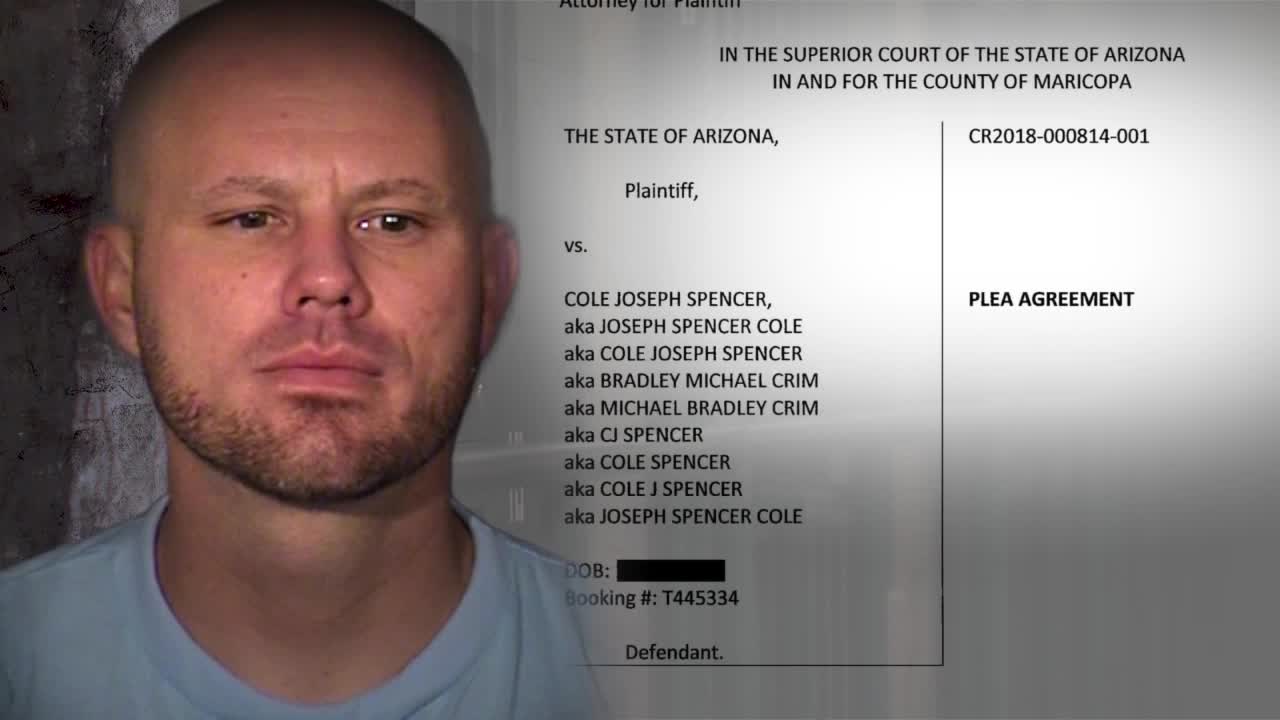


MESA, AZ — EDITOR'S NOTE: The video in the player above contains graphic content. Viewer discretion is advised.
Nearly eight years after a Mesa man was involved in a violent confrontation with police, his civil rights lawsuit against the officers has resulted in a financial settlement, and his precedent-setting case is changing some police training programs.
Cole Spencer was released from prison on December 12 after serving most of his nine-year sentence for burglaries and aggravated assault on an officer.
At a party inside his mom's east Mesa apartment, Spencer said he was “definitely overstimulated, but it's all setting in now.”
Spencer first reached out to ABC15 in 2020 after seeing the station’s coverage of the controversial police beanbag shooting of another man. ABC15 reported Mesa SWAT Officer Aaron Pew had pulled the trigger in that case.

Spencer told us he also accused Officer Pew of excessive force from his own 2018 arrest, and Spencer, acting as his own attorney, said he had already filed a lawsuit.
Using his own self-taught legal knowledge and free assistance from law students, Spencer was able to prevail at a federal appeals court on a key police use-of-force issue.
“I'm actually kind of glad that I did get arrested,” Spencer told us this month.
Now 40, Spencer said his experience suing the officers gave him “a blueprint” on how to respond when “faced with something tough in life.”
Spencer’s 2018 arrest
In the 2018 case, Spencer had been a passenger in a car that two Mesa SWAT officers stopped for a minor traffic violation. According to the police report, Spencer was asked for his name, but he gave a fake one.
When one officer tried to handcuff and arrest him, Spencer admitted he “shoved” one officer while attempting to get away.
There’s no video of that interaction. However, two Maricopa County Sheriff deputies, who responded to help with the arrest, did have body-worn cameras that captured Spencer’s beating, Tasering, and choking.

"You got some pepper spray?" one officer asked. "Put it right in his face."
Officer Pew wrapped his hands around Spencer's neck from the back, and he squeezed, "hoping Cole would go unconscious so we could control him," according to the police report.
At one point, the driver of the car is heard yelling at his friend, "They are going to kill you. Stop."
After handcuffing, officers continued to use force.
I can't breathe," Spencer said. One officer responded that Spencer could breathe, and Pew repositioned his knee on what appears to be Spencer's neck area.
Pew went on to say, "What part of ‘shut up’ don't you understand?"
According to the Mesa police report, Spencer displayed superhuman strength during a struggle with officers. The officers and their attorneys claimed this justified the increasing force during the three-minute arrest.
Spencer spent three days in the hospital, and he was later taken to jail. He was nearly unrecognizable in his mugshot.
“His face was just all scabs,” Spencer’s mom, Terry Miller, said. “I didn't look at it for a very long time.”
Months later, prosecutors offered Spencer a plea deal to get a lighter sentence on some burglary cases if he also pleaded guilty to assaulting one of the officers from his arrest. He agreed and went to prison.
Serving as his own lawyer
Spencer believed the officers’ force was excessive and unconstitutional, but civil rights attorneys refused to represent him. After all, he was a prison inmate with prior felonies who had pleaded guilty to assaulting an officer.
“I’m not the type to give up,” Spencer recently told ABC15.
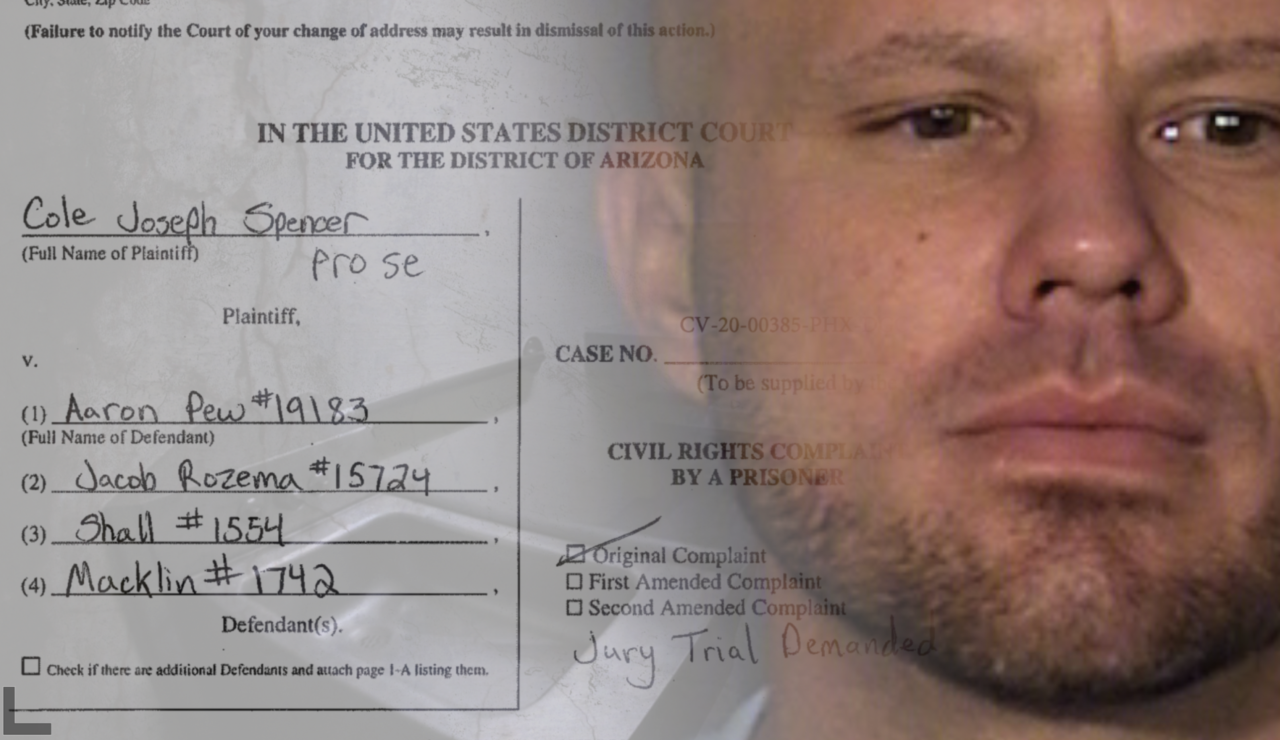
Despite never graduating from high school, Spencer decided he would have to serve as his own lawyer. He started to study case law.
“I've never really read anything or came across anything I couldn't understand at least a little bit,” he said.
From his cell, Spencer handwrote his lawsuit alleging Fourth Amendment violations by Pew and three other officers. However, a federal district court judge ruled that the officers were protected by what's known as qualified immunity and tossed the case.
Qualified immunity is a legal shield protecting government officials from being sued for violating someone's rights, unless their actions violate a "clearly established" law or right. Generally, there must be a similar court case beforehand showing that exact behavior was illegal.
Spencer disagreed with the qualified immunity ruling, and he penned a notice of appeal to the 9th Circuit Court of Appeals.
He said he worked “obsessively” on his case. “Pacing back and forth in my cell for a few years, reading and writing every day.”
Then, he finally got a break from the federal court system.
“They read my brief and nominated my case for the pro bono program,” Spencer said.
Two law students from the University of Washington and Washington State University were appointed to represent Spencer in his 2023 appeal hearing. From prison, Spencer watched a live feed of the proceedings, but he was not allowed to attend.
“Once Spencer was handcuffed and laying prone on the ground, Pew still drove his knee into his back for over a minute,” Hannah Garland, Spencer's student lawyer, told the three-judge panel in 2023.
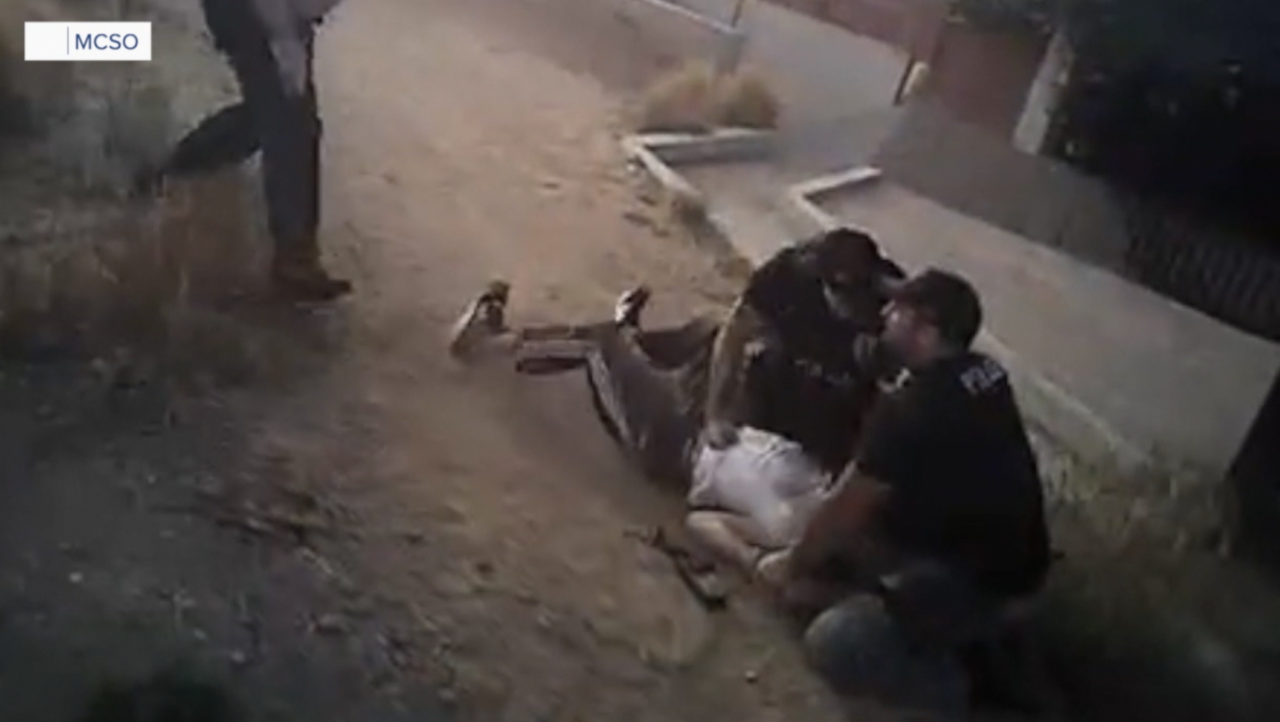
However, an attorney for the City of Mesa and their officers defended the heightened use of force, calling the situation “chaotic,” “very stressful” and a “rapidly evolving situation.”
The appeal judges took nearly a year to issue their decision. While they mostly agreed with the lower court and the officer’s lawyers, the judges refused to give immunity to Officer Pew.
This is an excerpt from the court’s written opinion:
"Every reasonable officer would recognize that full-body-weight compression of a then largely compliant, prone, and handcuffed individual, despite his pleas for air, involve[d] a degree of force that is greater than reasonable."
Spencer was in prison in Tucson when he heard the decision.
“I started crying,” Spencer said.

ABC15 is committed to finding the answers you need and holding those accountable.
Submit your news tip to Investigators@abc15.com
The new ruling did not impact Spencer’s prison sentence, but it did let Spencer’s lawsuit go forward.
In Summer 2025, just weeks before the scheduled trial start date, the City of Mesa, without admitting fault, offered Spencer a $150,000 settlement.
He accepted.
“I paid some property taxes. I'm going to fix my house up so my son has a house to live in,” Spencer said.
Spencer said the money will help restart his life.
Police training precedent
Spencer v. Pew’s appeals court ruling set a legal precedent about the amount of force officers can use on a handcuffed individual, especially when the person is facedown on the ground.
Some police trainers are even using Spencer’s arrest as an example of what officers should not do.
“That's amazing,” Spencer said. “That's a good feeling.”
In 2024, the Mesa Police Department told ABC15 that they've updated their training to focus on jiu-jitsu techniques where officers put weight on someone's hips, and away from the neck and spine.
A City of Mesa spokeswoman declined to comment specifically about the Spencer v. Pew settlement.
Spencer’s excessive force complaint was never sustained by the Mesa Police Department's internal investigation. Neither was the excessive force complaint stemming from the 2020 beanbag shooting of Lorenzo Jones. However, the city also paid a financial settlement to Jones.
Mesa police have acknowledged that Pew was accused of excessive force several other times in his career. Internal investigators sustained a 2022 complaint, and Pew was disciplined, according to a department spokesperson.
Pew is no longer on the SWAT team, but he was promoted. He currently works in Mesa as a police sergeant on the bike squad, according to an MPD spokesperson.
ABC15 reached out to Pew and his attorney for comment, but did not receive a response.
You can reach Melissa by email at melissa.blasius@abc15.com or call 602-803-2506. Follow her on X @MelissaBlasius , Facebook, or Instagram.
