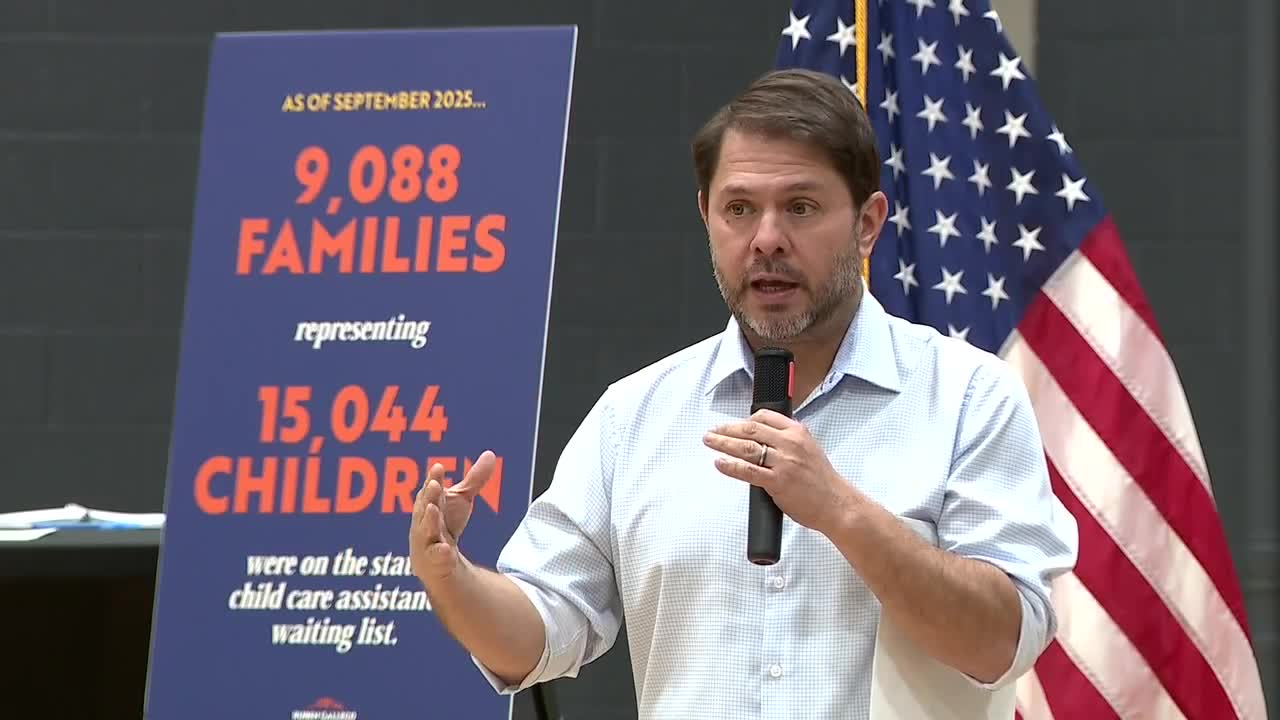


PHOENIX (KNXV) — Several mothers told U.S. Sen. Ruben Gallego at a town hall Monday in Phoenix that childcare is out of reach for even many two-income Arizona families.
Gretchen Lopez, the mother of two young girls, said she struggled to afford childcare for her 20-year-son when she was a single mom and is surprised to find it’s still a fight today.
“And never would I have ever thought that this many years later, now with a husband, two income-family, that we would still be struggling with childcare,” she told Gallego.
Lopez and her husband make too much to qualify for Head Start, a free federal early-childhood education program.
“Childcare costs almost more than our rent a month, and we are a two-income family,” she told reporters after the town hall.
Lopez’s youngest daughter has a scholarship for half the cost of her preschool, but the family still strains to cover the other half.
“The cost of childcare on top of the cost of everything else right now, really is almost impossible,” she said.

Do you have a concern in your community or a news tip? We want to hear from you!
Connect with us: share@abc15.com
The ‘missing middle’ families
Lopez says preschool is critical. She and her husband pulled their older daughter from preschool because they couldn’t afford it.
“When she started kindergarten, she wasn't ready,” she said. “She hadn't, you know, had time in the classroom learning from other people and to have that foundation.”
It's a move they don’t want to repeat for their youngest, so she and her husband are prioritizing preschool, even considering second jobs or delivering for Door Dash to pay for it.
“Being in that that middle ground, where you don't qualify for things like Head Start, really kind of makes it hard because we've worked hard to get to this level that we're at to provide for our family but yet, it's, like, not enough,” she said.
Gallego said the federal and state government need to do more to help families like the Lopezes. He’s calling for lawmakers to rethink how families should be classified based on income and do more to subsidize programs to help middle-class families.
"Those people that are making enough not to be poor, but they're not making enough to actually be comfortable, right?” he said. “That missing middle.”
'A real challenge’ for single parents
Melisha Alhambra, a single mother of four, told Gallego she can’t afford to work and pay for childcare when her kids are out of school.
“It’s been a real challenge,” she said. “Just even going those few months without consistent income has greatly affected our family.”
Alhambra, who adopted her four children five years ago, is starting an in-home childcare business.
“I just haven't worked, and so have to use savings, credit cards, all of those things, to try to keep my family afloat,” she told reporters after the town hall.
Alhambra has relied on food banks to keep her kids fed when they’re out of school.
“It's undignifying, you know what I mean?” she said. “You feel like you've lost a little bit of self-dignity every time you have to ask for that type of help.”
A long waiting list
Alhambra is on the waiting list for Child Care Assistance – along with thousands of other Arizona families.
As of Friday, 9,193 families and 15,200 children are on the Child Care Assistance waiting list, according to the Arizona Department of Economic Security, which administers the program.
According to the state agency’s latest numbers, 12,677 families and 22,332 children used the program as of August.
Much of the money for Arizona’s Child Care Assistance comes from federal funding to help low-income working parents. The Trump administration is working on a proposal to allow married couples to use the money to pay a parent to stay at home with their children, the New York Times reported last month.
Gallego said he supports expanding childcare assistance to include stay-at-home-parents — but not at the expense of working parents.
“I don't think it's fair to just somehow value one type of childcare or the other because not everything fits for everybody,” he told ABC15. “There's some families that do need someone to go to work. There's some families that want someone to stay home, and I don't think we should particularly try to push one way or the other that.”
Gallego said the nation needs universal childcare.
“We have to figure out how to actually fund it, because it is very expensive,” he said.
But the investment would be worth it, he says.
“People being able to go to work, make more money, will end up paying itself in the long run,” he said.
In a statement to ABC15, DES said its budget request for the next fiscal year calls for $44.7 million to shorten the wait list and maintain a robust network of childcare providers.
“We look forward to continuing conversations with the Governor’s Office and the Arizona Legislature on child care funding,” DES wrote.
Want more news in your community? Add ABC15 as a preferred source on Google below: