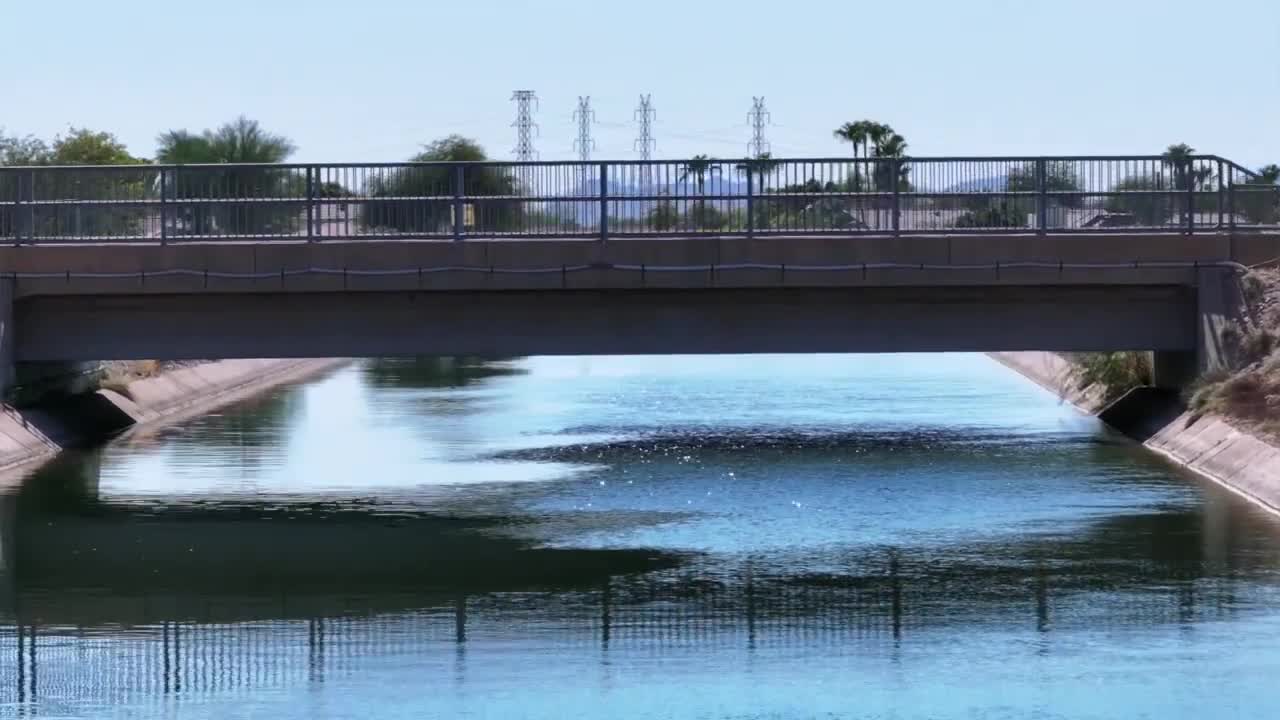


Arizona, California and Nevada would take less water from the Colorado River under a proposal announced Friday by the federal government to stave off crisis in the beleaguered waterway.
The proposed cuts in the Lower Basin states of California, Arizona and Nevada would be the biggest to date and could have huge impacts across cities and farms — higher water prices, increased groundwater reliance, more agriculture out of production and conservation mandates in places where none have existed before.
SCOTTSDALE IMPACT
Scottsdale gets about 70 percent of its water supply from the Colorado.
City officials say they are evaluating the proposed cuts and won’t know the impact until their technical review is finished.
They say they’ve been preparing for changing river conditions for years. The city is bringing new wells online and lining up alternative water sources.
“Because of this decision, no, we will not have any mandatory conservation measures coming as a result of today's decision,” said Bryan Bouchard, spokesman for Scottsdale Water.
However, he said once the federal government publishes the operating guidelines, "we will know better how all of this is going to impact Scottsdale residents and its customers.”
Scottsdale says it always encourages customers to conserve water where they can, especially outdoors.
IMPACT ON GILBERT FARMERS
Fourth-generation farmer Wyatt Freeman, who farms in Gilbert and across the Valley, says uncertainty surrounding the Colorado River could have a direct impact on how much land his family can keep in production.
Freeman, who was cutting alfalfa at one of his family’s fields in Florence Friday, said less available water could force farmers to leave more acres unused. “The less acres you can farm, the less of a living you can make,” Freeman said.
The concern comes as the federal government released its Final Environmental Impact Statement for post-2026 Colorado River operations.
Gilbert officials say the document does not specify operating plans for the next two years, meaning the town is still waiting to fully understand the local impact. Colorado River water currently provides about 40% of Gilbert’s water, according to the town, which says it has been preparing for future uncertainty by diversifying its water supply and storing water underground for future use.
Leaders and community members are reacting to the proposal and its potential impacts on Arizona:
Arizona Governor Katie Hobbs:
“Today, the federal government released a broad range of alternatives for how the Colorado River will be managed over the next ten years. Within that range is the opportunity for the federal government to adopt the commonsense, compromise proposal put forward by Lower Basin States for 2027 and 2028. Our proposal is one of the largest conservation programs in Colorado River history and builds on Arizona’s decades-long commitment to responsible water stewardship. While this FEIS still contains unacceptable options that include the federal government forcing Arizona to take the majority of draconian water cutbacks, implementing the Lower Basin agreement would protect Arizona from massive water cuts, distribute reductions more fairly across the Lower Basin States, and provide stability and protection to the water supply that our communities rely upon.
“As the federal government finalizes their operating plans for 2027 and 2028, my administration will be working around the clock advocating for an approach that protects the stability of the system, distributes water reductions equitably, and ensures water security for all Colorado River water users. I remain steadfast in my commitment to a long-term Colorado River solution that ensures every state in the system shares in its conservation.
“Arizona provides the agricultural produce, critical minerals, weapons defense systems and cutting-edge semiconductors that feed America, protect America and fuel America’s high-tech economy. No other state in the Colorado River basin can say the same. We developed the Lower Basin Proposal to increase water resiliency for the region and ensure that no single state was bearing the burden alone. Inequitable, federally imposed cuts to our Colorado River water allocation will be unacceptable to Arizonans, and will put every American at risk. Previous federal proposals to slash Arizona’s Colorado River water would be devastating for our nation as we work to compete with China in the AI race, onshore critical supply chains, feed the country, and rebuild our depleted missile stockpile. I will continue making that case to the federal government and fighting relentlessly to protect Arizona’s fair share of the Colorado River so our families can feel confident we will have the water we need to turn on the taps, nourish our crops, and grow our economy well into the future.”
Senators Mark Kelly & Ruben Gallego:
“The framework outlined in the Department of Interior's Final Environmental Impact Statement could place an unfair burden on Arizona, including the possibility of reducing the Lower Basin’s Colorado River allocation by as much as 40 percent, without requiring comparable commitments from the Upper Basin. Arizona, California, and Nevada have already put forward a fair, practical proposal to stabilize Lake Mead and Lake Powell through shared conservation, and that proposal should serve as the foundation for the Colorado River operating guidelines in 2027 and 2028.
“We remain committed to working with all seven Basin states, Tribal nations, water users, and the federal government to reach a durable agreement that protects Arizona's water future, strengthens the Colorado River system, and ensures every Basin partner does its part.”
State Representative Teresa Martinez, Chairman of the House Rural Economic Development Committee:
“Pinal County farmers already lost their Colorado River water. That happened years ago. They took the hit without a bailout, without fanfare, and without much sympathy from anybody.
“So when Washington tells Arizona to cut more, I want straight answers. Who is being asked to cut? Who is being protected? And is rural Arizona once again expected to absorb the pain while others get credit for talking about conservation?
“My district has already paid a heavy price. I will be talking to cities, farmers, growers, and water leaders across Legislative District 16 to find out exactly what this decision means for them. Then I will have more to say.
“What I will not do is support a system where some keep holding onto water while Pinal County farmers are forced to bail out others who are only now feeling the pain. Rural Arizona cannot keep being treated like the first place to cut and the last place anyone thinks about.”
Arizona Department of Water Resources:
"For many months it has been clear that the direction of Colorado River negotiations has been an exercise in lowering expectations, particularly for a long -term, seven -state agreement on operating this vital river system. It was that increasingly bleak scenario that prompted the three Lower Basin states of Arizona, California and Nevada to step forward with our proposal to help stabilize Lake Powell and Lake Mead with more than three million acre -feet of water savings over a two -year period.
"While the FEIS just released by the Department of the Interior does nothing to elevate expectations around a coherent seven -state plan for shared sacrifice, it includes an analysis that allows the adoption of many of the core elements of the Lower Basin proposal. We will continue to work with the federal government, as well as with our tribal, agricultural and municipal partners in Arizona, and the other Colorado River Basin states, to make river operations work for the betterment of all.
"The FEIS contains a framework that includes sideboards that are unacceptable for the state of Arizona including reductions in the Lower Basin of up to 3 million acre-feet per year, in priority. Such reductions would devastate Arizona’s water users and its economy. The FEIS framework also fails to include any Upper Basin reductions or sufficient use of water stored in the Upper Initial Units (reservoirs above Lake Powell).
"A forthcoming Record of Decision and operating guidelines will provide the details for operations through 2028 and a framework for an additional eight years of operations. We hope to see those documents provide for operations in 2027 and 2028 consistent with the May 1 Lower Basin Proposal, including sharing reductions among the three Lower Basin states (Arizona, California, and Nevada) of 1.25 million acre -feet in each year, as well as an additional commitment of 700,000 acre -feet of system conservation water. ADWR will continue to work to complete the agreements necessary to implement the Lower Basin Proposal while preserving Arizona’s legal rights.
"We will provide additional statements and opportunities for interviews when Interior releases the Record of Decision and the operating guidelines.
Central Arizona Project:
"We believe the FEIS contains several fundamental legal flaws, fails to encourage consensus among the seven Basin states and inaccurately portrays Arizona’s rights to Colorado River water."
Arizona House Speaker Steve Montenegro:
“Arizona must be clear-eyed, united, and firm in defense of our water future. The Colorado River is vital to our state, and Arizona has spent decades preparing for drought, conserving water, storing water underground, and building a stronger water system. Our job now is to stay prepared, continue protecting Arizona’s rights, and defend our economy while making sure decisions in Washington recognize the contributions our state makes to national security and the economy.”
U.S. Representative Greg Stanton:
“Solving the Colorado River crisis for the long term demands a fair, workable, basin-wide solution where every state has skin in the game. What we got today is the opposite. Again and again, the federal government refuses to force the Upper Basin to put cuts on the table and entertains scenarios that would devastate Arizona. It is a total failure of leadership.
"Making Arizona shoulder the burden of a shrinking Colorado River ignores our decades of leadership in water conservation, and it ignores our economic and national security importance. Arizona is now America's semiconductor capital. Hundreds of chipmakers and suppliers operate in the Phoenix metro area, building the cutting-edge chips required for everything from consumer electronics to the defense systems flown from our military bases.
"As Mayor and now in Congress, I have worked to prepare Arizona to use less Colorado River water through strong investments in conservation and water recycling in urban and rural areas alike. My top priority is to keep the pain of these cuts as minimal as possible for Arizona families and businesses. I will work with state and federal negotiators to see the Lower Basin Proposal realized and restore some certainty before current guidelines expire. Arizona won’t compromise its legal rights to water without all seven states fairly sacrificing to ensure the future of the Colorado River.”
Phoenix Mayor Kate Gallego:
"Solving the Colorado River crisis demands a fair, basin-wide solution in which every stakeholder is asked to sacrifice. Instead, the federal government takes aim at Arizona and Lower Basin states even though we continue to do our part and conservation is a core part of our water culture. Phoenix is prepared to use less Colorado River water, but it is wrong to lay a disproportionate share of the burden on Arizona."
Arizona Senate President Warren Petersen and President Pro Tempore T.J. Shope:
"Arizona recognizes the serious condition of the Colorado River, and we are prepared to be part of a responsible solution. What we will not accept is a federal plan that protects some states while placing a devastating and disproportionate burden on Arizona," said President Petersen. "Our state has already conserved enormous amounts of water and made difficult sacrifices to protect this river. The final decision must respect the Law of the River, recognize Arizona's contributions, and protect the water our families, farmers, tribes, and businesses depend on. We appreciate the Trump Administration's willingness to continue working with us toward a fair agreement, but the Senate stands ready to use every legal and legislative tool available if Arizona is forced to carry this burden alone."
"I've seen firsthand what draconian water cuts do to communities like mine in Pinal County, and these decisions have very real consequences," said President Pro Tempore Shope, Chairman of the Senate Committee on Natural Resources, Energy & Water. "Farmers in my district lost their Colorado River water years ago, forcing them to fallow fields, rely more heavily on groundwater, and absorb tremendous financial losses. Arizona has already made difficult sacrifices while other states continue to avoid binding reductions. The final operating guidelines must protect our communities, credit Arizona for the water we have already conserved, and ensure our state is not required to sacrifice more than its fair share."
Congressman Biggs:
“While I am grateful for the cooperation of California and Nevada and the federal government's willingness to listen to the concerns of the Lower Basin States, I am extremely disappointed that the Upper Basin States have continuously refused to come to the table to help bring relief to the entire basin. Over many previous years, Arizona has drastically cut its water usage to prove its responsible partnership with both the Upper and Lower Basin States. We cannot afford to take on more cuts, yet here we are with another framework that puts Arizona last.
“Over the past two years, I worked with the federal government on a solution that could be less harmful to Arizona than the options presented by the Upper Basin States. I understood, however, that Arizona could not rely solely on this new framework for its water future security, so I have worked in Congress on other solutions to help our state enhance existing infrastructure and bring relief to stakeholders most affected by existing drought conditions and ongoing cuts. I will continue to take action to bring relief to our state and ensure that we can protect our citizens, agriculture industries, and everyone else relying on this life-giving resource.”
Want more news in your community? Add ABC15 as a preferred source on Google below: