



For days after he woke up in a hospital, Jake Pratt was unaware of the military helicopter crash that killed three people and robbed him of his ability to walk.
Doctors had heavily medicated the former National Guard soldier because of the massive trauma to his body, so his ability to comprehend what happened in the accident was limited.
“I thought I was in a car accident,” he told Scripps News in his first national TV network interview. “I think it took a while... to retain information and understand the magnitude of what actually went down.”
The crash
In March 2024, Pratt was part of a four-person crew aboard a UH-72A Lakota helicopter, monitoring a river border crossing near La Grulla, Texas.
“We’re the eyes and ears for everything in the sky. We’re able to see a lot more than they can see on the ground, so we were on our way out there to assist the ground agents,” he said.
Pratt was the crew chief that day, sitting behind the pilot, as the chopper hovered low and slow near the Rio Grande.
The rest of the team included two soldiers, Casey Frankoski and John Grassia, as well as a Border Patrol agent, Christopher Luna.
The mission was routine until the helicopter started spinning out of control.
“I remember the feeling of inertia – of being thrown to the side, essentially – and that must have been the first spin – the beginning of our spin,” he said. “After that, (I remember) absolutely nothing.”

The aftermath
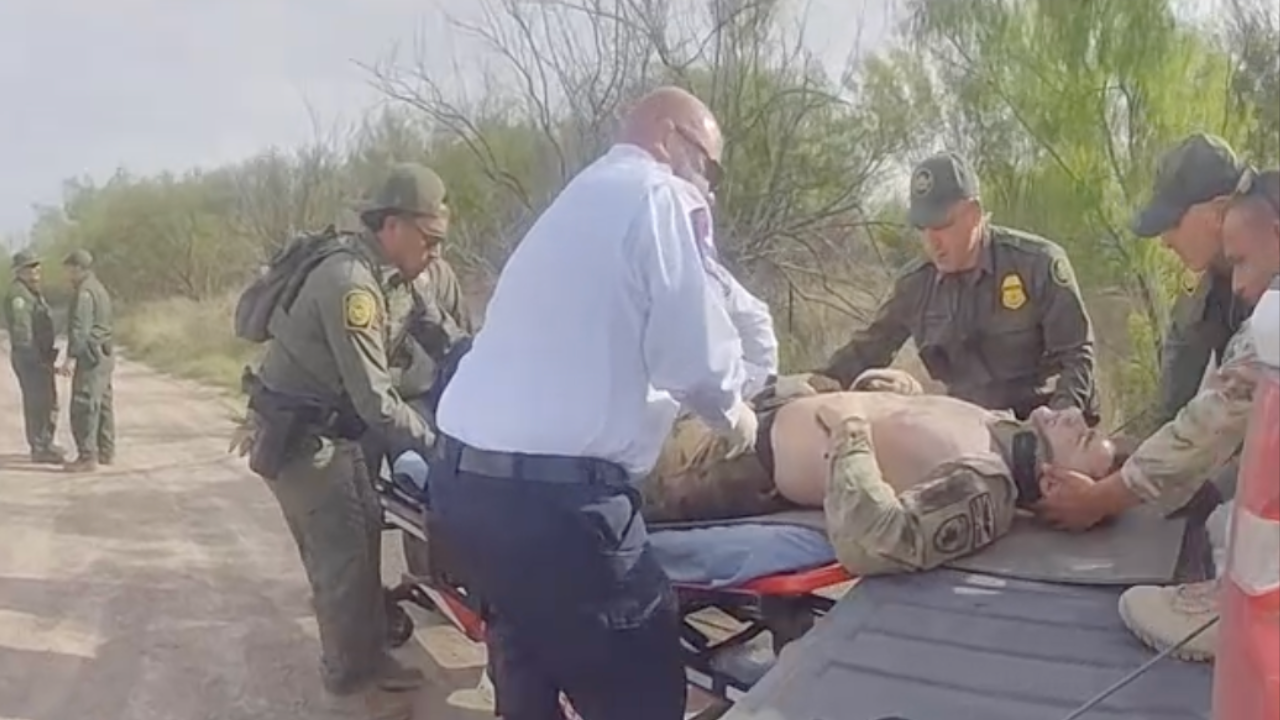
First responder body camera footage obtained by Scripps News shows emergency crews rushing to the scene.
Pratt, the only survivor, was conscious after the crash, but he does not remember the aftermath.
“Apparently, I was awake and alert the whole time. That’s what everybody told me,” Pratt said. “They took me out of the aircraft and put me on a backboard and everything, and they all said, ‘You were awake. You were speaking to us. You were good.’ I had some trouble breathing because I had a lot of internal damage, especially to my lungs, but yeah, I was awake and talking. I just don’t know what I was saying.”

Although there was no digital recorder (or black box) aboard the aircraft to track flight data, Army safety investigators determined the crew experienced a phenomenon called “loss of tail rotor effectiveness.”
“It just seemed like there was a wind change after we had done so many of these patterns,” said Pratt. “You get, I believe, less than two seconds per the book to react to this, and if you don’t do it exactly perfectly or on time, it’s non-recoverable. There’s really nothing you can do. So, unfortunately, all these things had to line up in order for this to happen, and they did."

Pratt said the military training that would teach someone how to react to the specific circumstances his crew endured was inadequate at the time.
“At that time of the crash, I don’t think they were doing enough to train our people how to react to that situation,” he said.
It’s possible that even with more focused training, the crash might have still occurred, Pratt said. “I am upset that at some point (the training) slipped through the cracks.”
Following multiple incidents involving loss of tail rotor effectiveness, the Army worked to close the related “training gap.”
After a spike in the most severe Army aviation accidents in 2024, military data show the numbers significantly decreased the following year.
FY 2026 totals surpassed last year for major aviation accidents in most branches
In fiscal year 2026, however, a Scripps News review of major military accidents — or Class A aviation “mishaps” — found the current combined number of mishaps across the Army, Navy, Marines and Air Force has surpassed the number for 2025.
A Class A mishap, as the military calls it, is one that involves a fatality or permanent disability or damage to equipment totaling at least $2.5 million.
For example, in June, eight people were killed when an Air Force B-52 Stratofortress crashed at Edwards Air Force Base in California, shortly after takeoff. The military confirmed the aircraft was worth more than $84 million.
A U.S. Marine Corps fighter jet also slammed into a Washington mountainside that month. The pilot ejected and landed safely, but the cost of the jet was close to $66.5 million, according to Connie Briggs, a public affairs officer.

In May, two aircraft collided at a Navy Air show. Four crew members ejected and survived, but the two jets were a total loss. According to military data provided to Scripps News, the aircraft cost close to $192 million.
Aviation mishaps can also involve unmanned aircraft as well as incidents in which the aircraft was not in flight.
The total combined number of Class A aviation accidents involving both manned and unmanned aircraft in the Army, Navy, Marines, and Air Force as of July 2026 was 50 compared to 45 last year.
Here are the numbers for each branch as of July 29, 2026:
Army aviation Class A mishaps
- 2025: 9
- 2026: 8
- 2025: 5
- 2026: 4
- 2025: 19
- 2026: 25
- 2025: 12
- 2026: 13
“While we analyze each year’s data for emerging trends, mishaps vary from year to year, and we have found looking at data over several years gives us a more accurate picture of mishap trends,” said Keith Wright, chief of public affairs for the Air Force Safety Center.
The Navy and Marines typically report their mishap numbers weekly, and on Tuesday their report removed one incident that had previously been classified as a Class A aviation mishap.
“It’s common for the data to change as mishaps are downgraded or upgraded over time as an investigation continues and determines the true cost associated with the mishap,” said Sarah Langdon, a deputy public affairs officer for the Naval Safety Command.
“For Army aviation...the gold standard is one mishap for every 100,000 hours flown. We fly between 700,000 and 800,000 hours annually now, and that has evolved over time,” said Eric Schwegler, the director of operations for the Army Combat Readiness Center. “It’s really not about the mishap or even the aggregate of mishaps; it’s the ability to see where your trends are at and those are based upon the number of flying hours, (and) the types of missions that you’re flying.”
Past numbers show nearly 200 deaths since 2020
A Scripps News review of military data dating back to 2020 shows there have been more than 300 Class A accidents and more than $8 billion in losses involving manned and unmanned aircraft from the Army, Navy, Marines and Air Force combined through July 22, 2026.
Some of the data Scripps News reviewed includes records provided by the military to Sen. Elizabeth Warren’s office.
A Scripps News analysis found at least 180 deaths linked to these crashes, including the 67 people who perished in January 2025 when a commercial plane and a military helicopter collided in Washington, DC.
“It’s absolutely tragic,” said Schwegler. “Our obligation (is) to ensure that our soldiers are well-led and well-equipped and are doing their missions as safely as possible.
Schwegler’s team makes recommendations for improvements in the Army.
“Our first obligation when we find out why something happened is to make sure that the rest of the Army is not at risk,” he said. “When we’re talking about aviation mishaps, is there something systemically wrong with our training or our materials or our helicopters or our training and doctrine? If there’s something wrong that needs to be addressed immediately, that’s our focus,” he said.
How the Department of Defense is handling mishaps
Earlier this year, the Department of Defense created an Aviation Mishap Task Force, according to a spokesperson.
The task force will “ensure that the department’s aviation enterprise remains safe, ready, and lethal,” a Pentagon press officer wrote in an email. “The AMTF is currently conducting a comprehensive study to further identify the underlying causes of aviation mishaps. The findings of this study will inform a prioritized Aviation Safety Plan of Action to target improvement areas; such as materiel solutions, training adjustments, and cultural transformation, and guide future safety policy and resource decisions.”
Pratt said he also has ideas for safety improvement, and it starts with giving power to service members who are working at the ground level.
“The decisions are made way up ... in Washington, and we have no say over it ... They need to listen to the people who are actually doing that job,” Pratt said.
Looking forward
Pratt, now out of the military, is looking forward to co-hosting a regular podcast he’s producing with his sister.
The two will talk about accessibility issues on the show, Squeaky Wheels Podcast. The title is a play on the wheels that Pratt now uses to get around.
“Every single day is a challenge,” said Pratt. “Literally every single day I have to figure something out. I have to learn how to do something new, and It's a lot.”
Pratt also helps other service members who have been impacted by physical restrictions.
“I have always been like a teacher. I was a leader in the Army for a very long time. I love that role. I love helping other people. So, now, they use me,” he said. “So, whenever they have a younger person who’s clearly struggling immensely with their new life, I’ll come in and I just sit there and talk with them and be like, ‘Look, I’m not going to lie to you. This is going to be an uphill battle for a really long time, but you’re not the only one. And you have people out there that you can lean on and rely on,’ which is really nice.”
He says he thinks often of his fellow soldiers and the border patrol agent who lost their lives in the crash.
“They gave everything,” he said. “They were doing it for their country. They did it for the Army. They did it for their families.”
