

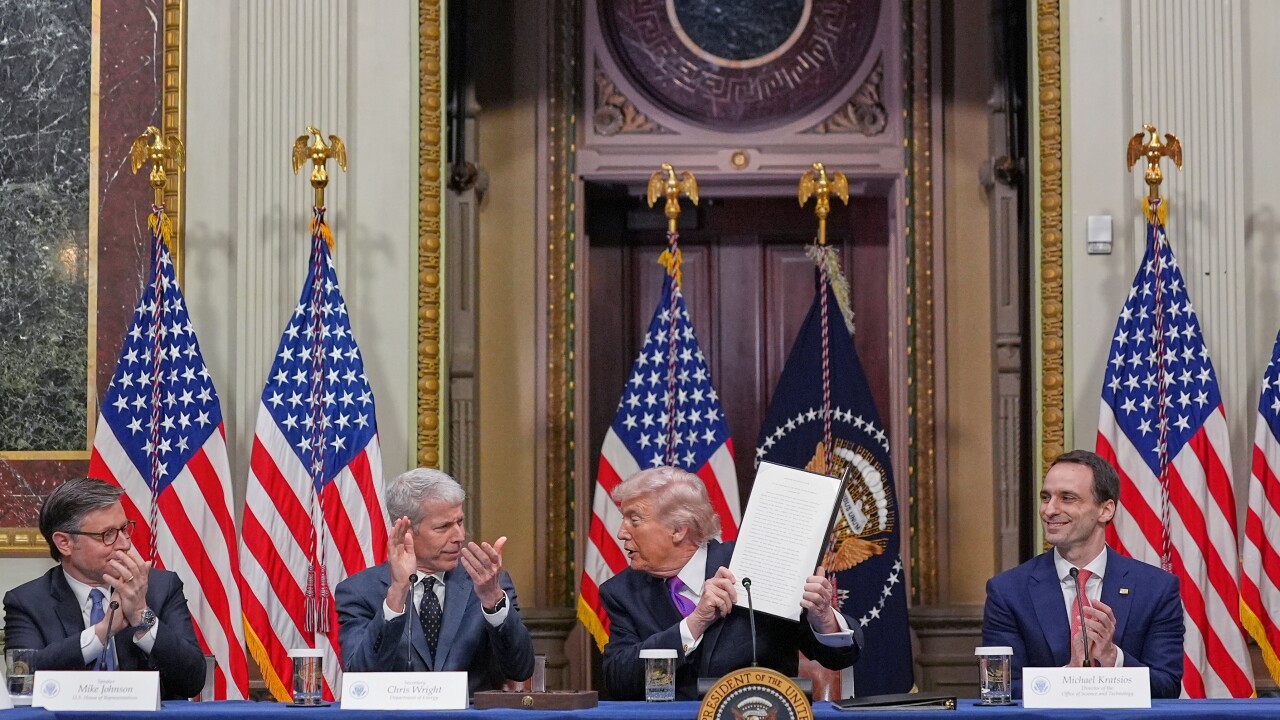

This week the Trump administration held a roundtable discussion focused on touting more than 200 additional signatories to the President's Ratepayer Protection Pledge, an effort aimed at lowering higher utility costs Americans may face during data center building and development.
"The American innovators and consumers strive to win together because we're insisting that AI data centers and big tech companies pay their own way" President Trump said during the roundtable.
"They're going to have a lot of electricity left over, and they'll put that into the grid, so actually end up with more electricity. The rates are going to go down."
The pledge — which does not have the force of law — encourages hyperscalers and AI companies to build or bring new power supply, pay for any upgrades to power grids, invest in local workforces, and pay for their own water and electricity. It also encourages officials in charge of providing power to states to keep rates low.
The President first introduced the Ratepayer Protection Pledge during his State of the Union in February, saying tech companies have an obligation to provide for their own power needs.
Major data center builders and AI developers like Google, Amazon, Meta and xAI signed on to the pledge in March.
RELATED STORY | New York puts yearlong moratorium on new data centers, citing energy and climate risks
Now the White house says at least 23 Governors, and dozens of representatives from Big Tech and utility providers have also signed on. Some of those signees were present for the roundtable.
Louisiana Governor Jeff Landry highlighted part of the reason he signed on to the pledge, saying, "America once led the space race, we now face a new race. This one, though, is going to be defined by technology and artificial intelligence. And who wins, who wins will absolutely control the levers of global power. But just as the space demanded courage and vision, so does this one. But winning, as the president said, cannot come at the cost of American families."
Chris Womack, the CEO of the Southern Company, the second largest utility company in the country, also provided insight on why his company signed on to the pledge.
"The Ratepayer Protection Pledge aligns with how we view, how we work with data centers, how we work with hyperscaler to make sure that we're reinvesting in the grid at the same time, providing rates stability for the families and the businesses and the communities that we are privileged to serve."
MORE AI NEWS | An OpenAI test model escaped and broke into a real company’s servers
The debate over data centers has exploded in recent years as demand for artificial intelligence and cryptocurrency has surged. The issue is forcing dozens of communities across the country to deal with higher energy costs. Supporters of more data centers say they bring jobs, wealth and other benefits to communities that need them. According to Pew Research approximately 42% of Americans either live within 5 miles of an existing or planned data center, meaning the issue could take more of a center stage in the coming months.
The U.S. is currently one of the top builders of data centers in the world. According to Market Intelligence firm Cleanview, as of July 2026, there are 1,214 operating data centers in the U.S. with a combined power requirement of as much as 55,509 MW, and 1,719 planned projects that would add up to 370,455 MW of additional requirements.
