

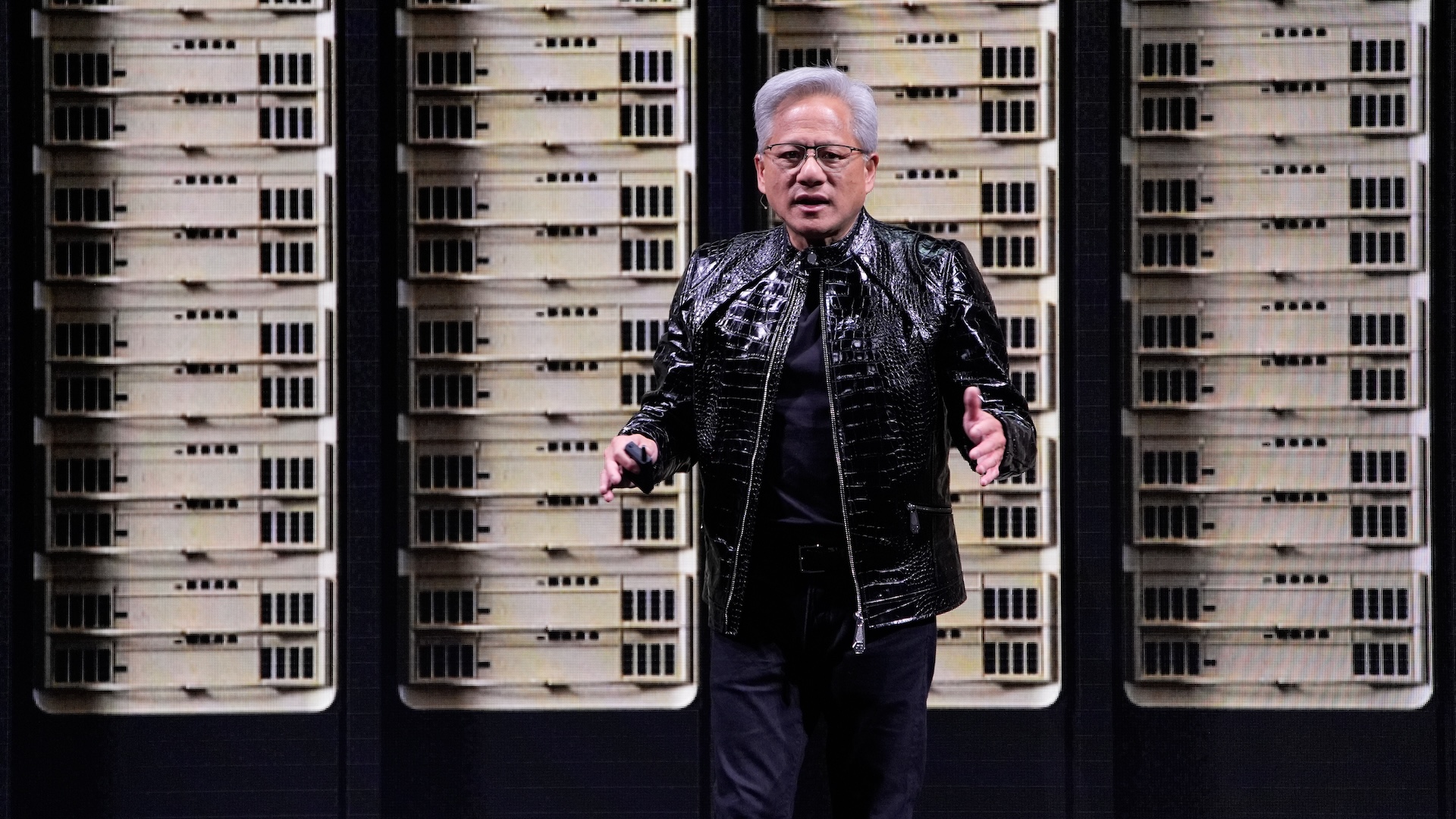


Jensen Huang, the co-founder who built Nvidia into the engine of the artificial intelligence boom, resigned as CEO on Thursday, effective immediately.
Nvidia's board announced that Huang is also stepping down as president and leaving the board, ending a 33-year run as the only CEO the company has ever had. The move followed New York Times reports of two affairs, including one with a woman U.S. intelligence reportedly identified as a Chinese asset.
The New York Times reported that U.S. intelligence agencies determined Huang had developed a close relationship with Alice Huang and that she was feeding information to Beijing. The two are not related. Alice Huang was a top executive at Megaspeed, a Singapore-based data center company that bought advanced Nvidia chips. Megaspeed has faced claims it illegally shipped those chips into China, which it denies. On Thursday, the company said it would cooperate fully with any relevant U.S. government authority.
Huang acknowledged the affair in a memo to employees. "I was unfaithful to my wife," he wrote. "My actions hurt her and our children. There is no excuse for what I did. I am deeply sorry." China has called the spying allegations unsubstantiated.
Then on Wednesday, The New York Times, citing five people who worked at the company, reported that Huang also had a relationship with a married executive who reports to him. That appears to violate Nvidia's code of conduct. Nvidia has not commented on that report.
Chief Financial Officer Colette Kress will serve as interim CEO while keeping her finance role until a permanent successor is named. Kress joined Nvidia as CFO in 2013 after nearly 25 years in finance roles at Cisco and Microsoft, and she is a familiar face to Wall Street from years of earnings calls.
The board also named its first-ever chair, Harvey Jones, a former CEO and executive chairman of chipmaker Synopsys. The board says it will consider internal and external candidates for the permanent CEO role.
"The Board has full confidence in Colette and the leadership team, and we expect the company's operations, customer commitments and product roadmap to continue without interruption," Jones said in a statement.
MORE ON THE STORY | Nvidia CEO Jensen Huang resigns amid affair, national security concerns
Nvidia shares fell more than 14% at Thursday's open to an intraday low of $148.80, then recovered to trade down about 4.6% at $165.75 in the afternoon. NBC News reports the week's slide has erased about $830 billion in value and pushed Nvidia's market value below $4 trillion for the first time since 2025.
That matters well beyond people who own Nvidia stock directly. Nvidia makes up about 7% of the S&P 500, according to Motley Fool data, so anyone with an S&P 500 index fund or a typical 401(k) has a stake in it.
Some investors aren't waiting to see what comes next. Dan Ye, CEO of Brooklyn Tech, who also teaches investing in the age of AI at Johns Hopkins University, sold his entire Nvidia stake on Thursday.
"I've had Nvidia stock for a long time, and it really pains me to sell it," Ye said. He added, "I just don't see anyone replacing Jensen Huang right now."
He, and others, saw opportunity elsewhere. Shares of rivals AMD and Broadcom each jumped about 6%, making them the S&P 500's best performers Thursday.
Nvidia's chips power nearly every major AI company, which puts the company at the center of America's competition with China. Ye said chips are currently the AI industry's biggest bottleneck, and he argued the damage from losing Huang won't show up right away.
"You're probably not going to see any immediate results," Ye said. "Nvidia's revenue is not going to change, their net income is not going to change, but the pain will start to show up in a few years when Nvidia fails to innovate accordingly."
Not everyone sees it that way. Many analysts said the board had little choice, and Nvidia has said it has "no reason to believe" national security or company secrets were compromised.
Washington is still asking questions. President Donald Trump said Sunday that the FBI is investigating, and the Republican leaders of three House committees have asked Huang for a closed-door briefing on his interactions with Alice Huang. House Speaker Mike Johnson (R-La.) called the resignation "a big and shocking development," noting Nvidia's importance "not only in the US economy but for national security purposes."
On Thursday, Trump floated former Apple CEO Tim Cook, now Apple's executive chairman, as Huang's replacement in a Truth Social post. Nvidia's board, not the White House, chooses its CEO.
RELATED STORY | Advocacy groups sue AI giants to freeze models, warning of 'catastrophic' risks
For years, Huang ran Nvidia with an unusually flat structure, reportedly with dozens of direct reports and no publicly known succession plan. Until Thursday, the company had never had a separate board chair.
Lindsey Stewart, director of institutional investor content at Morningstar, said those questions went largely unasked during Nvidia's meteoric rise.
"The sudden departure of one of the world's most influential CEOs illustrates just how quickly an unconventional governance structure can become a source of risk, and often real losses, for investors," Stewart said. "While Nvidia's share price rocketed over the last few years, very few people were asking deep questions about CEO succession planning, board composition and challenge, or oversight of geopolitically sensitive aspects of company strategy. Now, all those issues will be front and centre, perhaps not just for Nvidia, but also for other founder-led companies like Anthropic, Meta Platforms and SpaceX."
