



As the white Jeep SUV pulled into Richmond Ave., a quiet street on the northeast end of town, our target soon became clear: there, behind the well-manicured grass yard, sat a small, shingled house, each window filled edge-to-edge with union signage: “This Union Home Supports Rob Sand” and “Steelworkers for Turek,” among them.
Waiting for us out front was Wilson, a member of the United Steelworkers Local 310, soon to be greeted by Josh Turek, a state senator vying for the U.S. Senate.
A former paralympian who, born with spina bifida, uses a wheelchair, Turek quickly made his way over to chat.
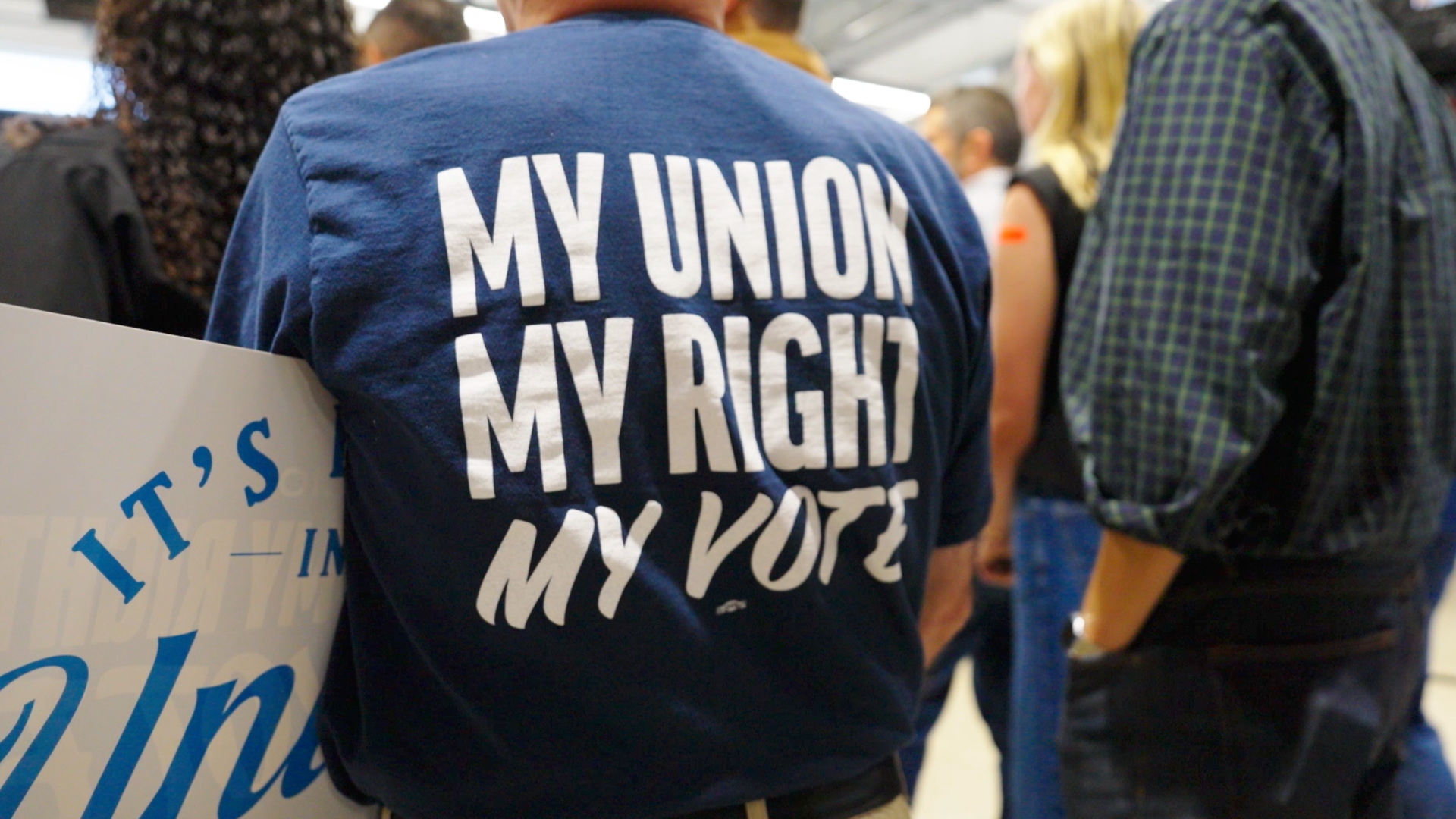
It was the kind of choreographed encounter the Turek campaign was expecting; Scripps News on Saturday was granted “exclusive access” to trail Turek and AFL-CIO President Liz Shuler as they knocked on voters’ doors, following the launch of a union get-out-the-vote effort earlier that morning.
But as Wilson shared with Turek his efforts to gin up support for Democrats up and down the ballot, the two flanked by several campaign staff and videographers hoping to catch a viral moment, my eyes soon turned to the house immediately west of Wilson’s.
Its yard was in considerably worse condition, the front porch littered with old toys and empty energy drink bottles. Standing out front were two women and a young baby, watching the events next door with both curiosity and distance.
IN CASE YOU MISSED IT | Trump reverses course, will hold rallies in Kansas and Iowa after all
One woman, the elder of the two, introduced herself as Traci Cone. She worked at a nearby medical device manufacturer and was struggling to make ends meet, she said.
“If you have rent and a car payment plus all your other bills, $14 an hour ain't even close to what you need to pay all that,” Cone told Scripps News.
“After you pay all your other bills so that you have a roof over your head, you don't have a lot left for groceries. And when you go to the store and spend 50 bucks and come out with two bags, that's not enough,” Cone continued. Her eyes began to fill with tears, her voice choking up: “Yeah, it's a struggle”
Economic troubles present political opportunities
Cone is not alone in her struggle.
Inflation in the midwest region, which includes Iowa, has climbed higher than almost anywhere else in the country since the Iran war began, according to the Bureau of Labor Statistics. Iowans’ wages, meanwhile, have not kept pace, lagging especially in Polk County, which includes Des Moines.
Those realities present an opportunity for Democrats in Iowa — a state that has seen a steady rightward shift over the past decade and that Trump handily carried in the past three presidential elections.
“The economic issues that Trump was talking about last time around really did appeal to working people because they were struggling with the same things we're struggling with today,” Shuler told Scripps News from the car between pre-selected door-knocking sites. “This time, it's completely different, because the issues, the kitchen table bread and butter issues that people are struggling with, are the campaign.”
The Democratic candidates running for office seem to agree: Turek, gubernatorial nominee Rob Sand, Congressional candidates Sarah Trone Garriott, Lindsay James and Christina Bohannan all have made prices and affordability the centerpiece of their campaigns.
RELATED STORY | Democrats tout momentum as early voting rises ahead of midterms
“Everywhere I'm going, I'm hearing the same things: this state is uniquely hurting,” Turek said at the union worker rally. “The very first thing: let's end this war in Iran. Two, let's repeal these tariffs that are decimating rural communities. Three: let's get a livable wage.”
For an audience of workers at the International Brotherhood of Electrical Workers (IBEW) Local 347 Union Hall, it was a message worth celebrating.
“I drive a diesel truck. $6 a gallon for gas is ridiculous. The minimum wage is beyond failed. Working people need more than what they're getting right now,” said Todd Copley, president of AFSCME Council 61. “This is labor at its finest. That's why we're here.”
GOP leans into culture
Four hours later and 60 miles southeast, GOP gubernatorial hopeful Zach Lahn walked into Olive Branch, a local Mediterranean restaurant, to greet a somewhat smaller audience consisting of a considerably older crowd.
There were the sorts of Iowa voters I’d grown accustomed to meeting on the presidential campaign trail in recent cycles: overwhelmingly white, soft-spoken and deeply conservative.
In a tight, 25-minute stump speech, Lahn laid out his case as to why he should be Iowa’s next governor. “We need to protect and defend the culture of the state that we love,” he said. “What's happening on the left right now across the country is you have very radically liberal people who are running in conservative states and pretending as if they're moderates when they are not whatsoever.”
He rattled off a list of Democratic boogeymen: Texas Democratic Senate nominee James Talarico, New Jersey Governor Mikie Sherrill, rioters and fraudsters in Minneapolis.
If elected, Lahn said, he’d “protect the lives of the unborn,” “prosecute illegal immigration” and “keep men out of women’s bathrooms.”
Unmentioned in his speech: the words “Iran” or “tariffs.”
“We all want prices to come down, we want more affordability, we want gas prices to come down, we want the wars to end. I want that too,” Lahn said towards the end of his remarks.
“But we have to remember, we're here for something much deeper than that… if we don't fight properly to preserve what we love here, we're going to have way bigger problems on our hands than affordability,” he added. “My promise is that every decision I make will be looked at through a lens of ‘will this promote and protect the culture of the state that we live.’”
After he wrapped his speech, I asked Lahn how he balanced Iowans’ economic concerns with their cultural ones, and how he wanted voters to think about that question too.
“We all want to see prices come down, no doubt about it,” he reiterated. “But also, we're not just fighting that battle; we're also fighting a battle, as we can see across the country, where there is a lot of turmoil that's coming up in some of these places that don't prioritize having good, safe communities.”
“The cultural message matters deeply,” Lahn concluded.
GOP voters in attendance seemed to buy into that framing. Yes, they were struggling with higher prices and yes, they wanted the Iran war to end. But those were small prices to pay to preserve their cultural preferences.
“Being on social security and stuff, it's been tough,” said Vicki Brown, a retiree. “But I think it was a necessary war, and so I'm just riding it out.”
“I'd rather pay a little extra for fuel than have the ground burn, having them have nuclear weapons,” echoed farmer Doug Findley. “In farming, there's a lotta times you look and it probably doesn't look like things’re very good or won't work [out], but it will.”
A chance for bipartisanship; a wish for independence
If there’s an upside for Iowans torn between voting based on economic concerns and cultural ones, it’s that there some issues that candidates on all sides agree need to be addressed.
Sand, Turek, Lahn and GOP Senate nominee Rep. Ashley Hinson have each made addressing agricultural runoff, and Iowans’ health outcomes more broadly, a feature of their campaigns — as the state suffers with one of the highest cancer incidence rates in the country.
I was also struck by some of Lahn’s comments supporting increased antitrust enforcement and anti-corruption measures, policies that, at least in recent memory, have typically been more welcome in left-leaning spaces.
“We have not been enforcing antitrust laws,” Lahn told me. “People told me, ‘don't talk about this in the Republican primary, don't go after these big agricultural conglomerates that are extorting our farmers and prices.’ I said, ‘tough, I'm going to do it anyways because it's actually the real issue.’”
MORE MIDTERM NEWS | Trump makes last-minute push to keep Texas in Republican hands with third trip
Back in Des Moines, as I wrapped my conversation with Traci Cone, Turek came over and introduced himself.
“I'm seeing too many people that are hurt and struggling,” he told the women. “I want to go up to D.C. to be able to fight for these people.”
Cone looked on intently; her friend glared. “We hear that, but it still ends up being for the people that already have money,” Cone noted.
The two spoke a bit longer about her health struggles, problems receiving insurance coverage and desire to raise the minimum wage when the other woman — who declined to share her name — chimed in.
“Healthcare and wages aside, where do you stand on abortion and transgender and co-ed in bathrooms and elementaries?” she asked.
“I have been quite outspoken,” Turek responded, noting he supports women’s right to “access reproductive freedom” but stressing his belief that “biological males should not compete against females in sports” — a position that’s cost him support among some Democratic officials in the state.
After three more minutes of smalltalk, the conversation drew to a close.
Cone, who said she’d never before voted in an election, said she was unlikely to this time either, adding that she wished an independent candidate, unaffiliated with either party, would run.
To me, the exchange illustrated both the opportunities Iowa Democrats here — and their limitations.
“Happy Halloween,” Cone said.
Turek turned back towards his car. A few moments later, he was off to the next door to knock.
