

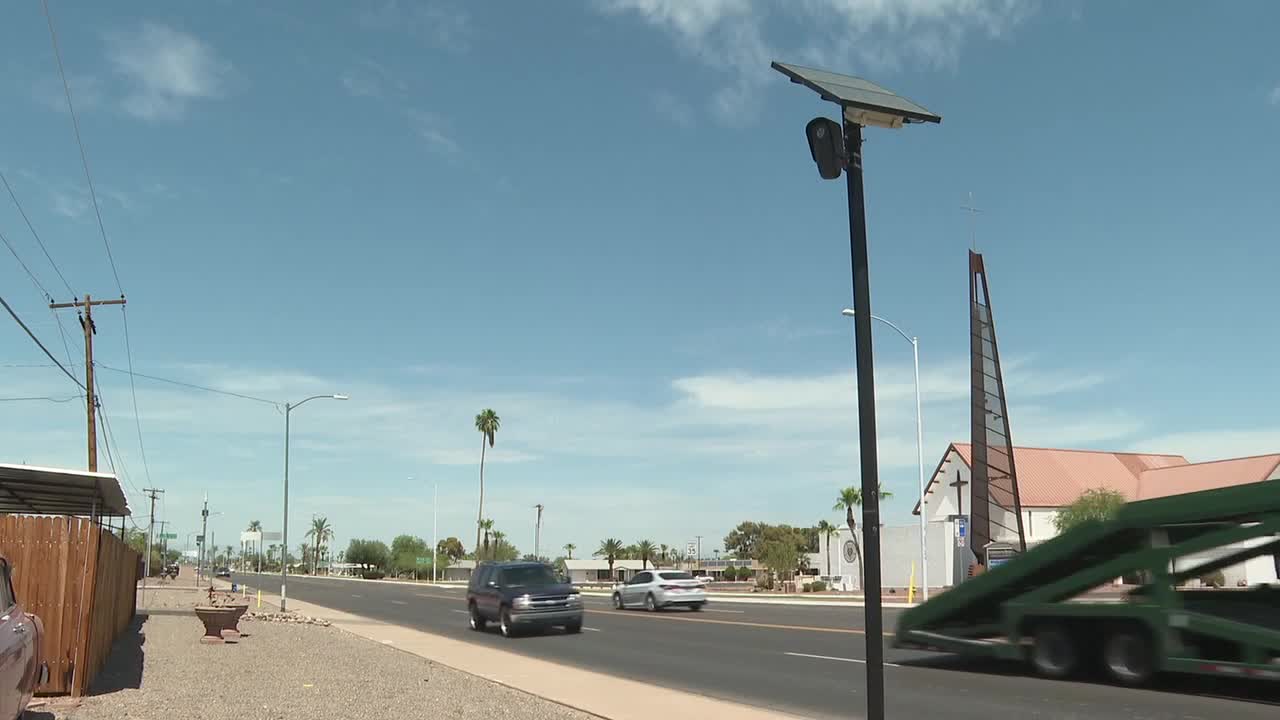



YOUNGTOWN, Ariz. — A growing number of Youngtown residents are questioning the town's extensive use of automated license plate reader cameras, arguing the technology has gone too far and raises concerns about privacy.
Drive through parts of Youngtown, particularly along 111th Avenue, and the cameras are difficult to miss.
Mounted throughout the community, the devices are part of the Flock Safety camera system used by law enforcement agencies across the country to identify vehicles connected to crimes, stolen cars and other investigations.
For some residents, however, the cameras feel excessive.
“If somebody cut that thing down, it wouldn't bother me a bit,” said Youngtown resident Richard Kline.
Residents along 111th Avenue say they're recorded every time they leave and return to their neighborhoods. Some have begun organizing opposition to the system and discussing efforts to remove the cameras.
This stretch of Youngtown along 111th Avenue contains one of the highest concentrations of Flock cameras in the Valley, with roughly 40 cameras located throughout the area.
“I've talked to a couple neighbors actually to start a petition to get them removed,” said resident Mark Brown. “If you look right across the street to Sun City, they have none.”
Youngtown Mayor Michael Levault defended the program, saying the town's camera network has proven its value during the six years it has been in operation.
According to Levault, the cameras have helped Maricopa County Sheriff's deputies recover dozens of stolen vehicles passing through the community.
“None of them stolen in Youngtown, but as they rolled through Youngtown, we were able to pick them up and recover the cars,” Levault said.
Supporters of automated license plate readers argue the systems provide a valuable investigative tool for law enforcement, helping track stolen vehicles, locate suspects and identify cars connected to criminal activity.
Levault acknowledged concerns about misuse but said isolated incidents should not outweigh the broader public safety benefits.
“If you find there is a little abuse in the system, you don't throw the whole system out,” Levault said. “You figure out how to minimize and segregate the abuse, but you keep the system and you move on.”
Some residents worry the technology represents an invasion of privacy and creates a detailed record of people's movements that could be abused.
“It's a total invasion of privacy,” Kline said. “They don't need to know who's coming and going to my house.”
Brown cited reports from around the country in which license plate reader data was allegedly accessed for personal reasons rather than legitimate law enforcement purposes.
“It's been abused by people looking to see what their exes are doing or their spouses are doing,” Brown said.
This story was reported on-air by a journalist and has been converted to this platform with the assistance of AI. Our editorial team verifies all reporting on all platforms for fairness and accuracy.
