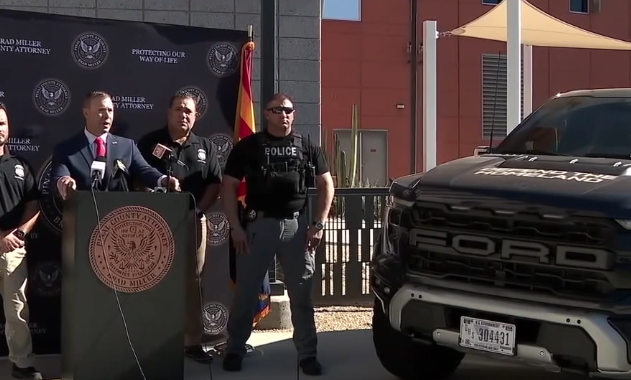


PINAL COUNTY, AZ — A fight is unfolding in Pinal County over whether county investigators have the authority to enforce federal immigration law under an agreement with the Department of Homeland Security.
The Pinal County Attorney says the deal is already in effect, while the Board of Supervisors, citing an outside legal opinion, says it is void.
This began when the Pinal County Attorney’s Office announced it had entered into a 287(g) agreement with DHS, a federal program that trains and authorizes local law enforcement officers to carry out certain immigration enforcement duties while performing their regular jobs.
But the Pinal County Board of Supervisors says the agreement is invalid because the county attorney does not have the authority to enter into it without the board’s approval.
The County Attorney’s Office maintains that it has had that authority since December. The Board of Supervisors says otherwise.
At Wednesday’s Board of Supervisors meeting, members put out a legal opinion from outside counsel at Snell & Wilmer, which stated the 287(g) task force model agreement is invalid because it was never approved by the board, as required by state and federal law.
In addition, the decision states that the 287(g) agreement creates a conflict because it makes the County Attorney the enforcer of the law and the prosecutor of cases.
The opinion states this violates the traditional separation between law enforcement and prosecution.
- Under Arizona law, only the Sheriff has authority to preserve the peace and make arrests, meaning the agreement improperly assigns the sheriff’s powers to the County Attorney’s Office.
- The Board alone controls county spending, and the agreement requires the use of county funds without board authorization, violating the board’s fiscal oversight role.
The board is asking the county attorney to stop acting under the agreement and outline steps to terminate it by January 28, 2026.
Public comment at Wednesday's meeting reflected strong and divided opinions.
"Yes, I want those people deported. That's the law. Do you want these people roaming around committing horrible crimes against Americans? That's insane," one resident said in support of the County Attorney. "Our police need to protect ICE. It is not ICE’s job to be the police. Police need to be police,”
Another speaker addressed fear among his loved ones, saying, “I live in fear, not because of my legal status, but because of my skin color and because of the languages I speak with my friends and family. I fear my sisters and their young family. I fear for my grandparents, who have been permanent residents of this country since the 80s. They have begun to carry their documents with them, even just to go get groceries, out of fear.
Despite the board’s position, County Attorney Brad Miller is not backing down.
He has challenged the board to prove the agreement is invalid and has called on supervisors to put the issue on a future agenda if they truly support ICE and federal immigration enforcement.
For now, the board wants the agreement shut down by January 28 — setting up a standoff over who ultimately has the authority to decide.
In a statement, Miller said, “The Board of Supervisors says our 287(g) agreement is ‘void.’ Prove it. Since December, we have repeatedly asked the Board for the legal authority supporting that claim, and they have provided none to our office. A claim without communication does not justify pulling our ICE partners off the street and weakening public safety. If the Board truly stands with our ICE partners, it should place this issue on the agenda for the next Board meeting and ratify the agreement. We stand with President Trump and our federal law enforcement partners.”
Want more news in your community? Add ABC15 as a preferred source on Google below: